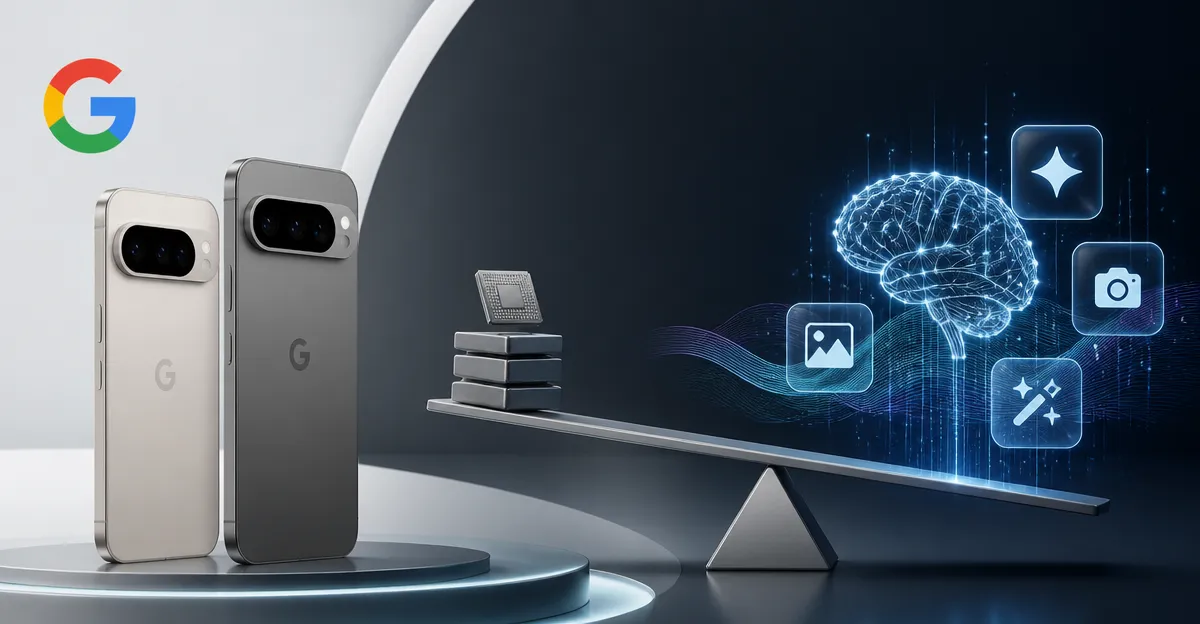
August 30, 2026, (Inside AI) — Google’s Pixel 11 and Pixel 11 Pro XL arrive with a clear message: the hardware race is over, and the software race has just begun. The new phones, priced at Rs 89,999 and Rs 1,34,999 respectively for base models, lean heavily on AI features to justify their existence. But a closer look reveals a familiar design, a controversial RAM downgrade, and a feature set that feels more scattered than cohesive.
The core question is not whether the Pixel 11 series is a good phone. It is whether Google’s software-first approach can overcome a hardware plateau that has gripped the entire smartphone industry. Early signs suggest a mixed answer.
The most visible hardware addition is HiLight, an LED notification light on the back of the Pixel 11 Pro XL. It replaces last year’s temperature sensor and works only with Gemini activations and calls from favorite contacts. It does not light up for texts or app notifications. Customization is absent for now, leaving the feature feeling like a half-finished experiment rather than a reason to buy.
The base Pixel 11 skips HiLight entirely. Both phones share the same Tensor G6 processor, but the Pro XL’s base model ships with 12GB of RAM, down from 16GB on last year’s Pixel 10 Pro XL. Google argues the reduction does not matter because of silicon and software improvements, but the timing is awkward. The phone is more expensive, and mobile gamers may notice the difference in demanding titles.
Storage gets a welcome bump. Both models now start at 256GB, matching moves by Apple and Samsung. The displays remain excellent. The Pixel 11’s 6.3-inch Actua OLED panel is bright and smooth, while the Pro XL’s 6.8-inch screen peaks at 3,600 nits, making outdoor readability effortless even under direct sunlight.
AI Features That Actually Help, and Some That Don’t
The standout software addition is Rambler, an AI-powered dictation tool built into Gboard. It removes filler words and formats speech in real time. During testing, it handled English, Hinglish, and Punjabi with surprising accuracy, even converting spoken Punjabi into English text. That level of multilingual support is rare and genuinely useful.
Pixel Recorder remains a quiet powerhouse. It transcribes interviews and briefings on-device, with no subscription required. Call Screen continues to filter spam and robocalls effectively. These are features that solve real problems without demanding constant attention.
Gemini’s new Proactive Suggestions aim to take actions on your behalf, but the feature is currently limited to the US. In India, a test of scheduling a store visit worked as promised, triggering a reminder at exactly 5:30 pm. That is promising, but the broader vision of a touchless phone still feels distant.
The camera system is where hardware and software align best. The Pixel 11 Pro XL gets a 50-megapixel main sensor, a 48-megapixel telephoto with 30 per cent more light intake, and a 48-megapixel ultrawide with autofocus. Instant Night Sight speeds up low-light capture by up to 4.5x. Portrait mode shows clear improvement over previous generations.
New camera features include Looks, which alter the computational photography pipeline rather than simply applying filters. Magic Capture pulls stills from video automatically, but results are inconsistent in chaotic scenes. Creator Suite adds a teleprompter and audio visualizer for video creators, tools that will likely see heavy use at product launches.
The Plateau Is Real, but Google’s Bet Is Clear
Battery life is strong across both models, easily lasting a full day. Charging speeds remain unchanged, with the Pro XL capped at 45W wired. The Pixel 11 can hit 55 per cent in 30 minutes with a 30W PPS charger.
The design language is nearly identical to last year’s models. The camera bar is now fully covered in glass and offers double the scratch resistance, but the overall silhouette is unchanged. Google appears committed to a three-year design cycle, a strategy shared by most major brands.
The Pixel 11 series does not reinvent the smartphone. It refines it. The AI features are uneven, the hardware is iterative, and the price has gone up. But the foundation is there: a phone that could eventually become a touchless, Gemini-driven device. Whether that future is desirable remains an open question. For now, the Pixel 11 and 11 Pro XL are solid phones that ask users to pay a premium for software promises that have not fully arrived.