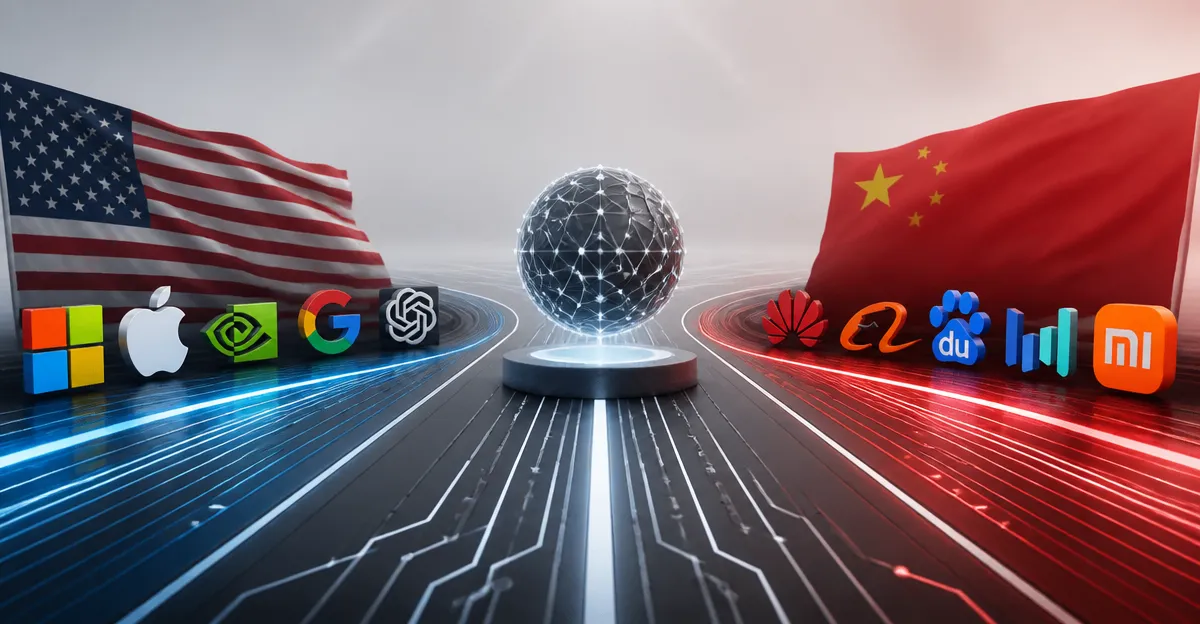
September 25, 2026, (Inside AI) — The global artificial intelligence landscape is often framed as a two-horse race between the United States and China, with hundreds of billions of dollars pouring into research and development. But according to Harvard economist Jason Furman, the metaphor of a race with a finish line is fundamentally flawed. In a conversation with the Harvard Gazette, Furman argued that the competition is more of a perpetual marathon, and the idea of a single winner is a dangerous oversimplification.
Furman, the Aetna Professor of the Practice of Economic Policy at Harvard Kennedy School and the Department of Economics, shared his insights as the world's two largest economies continue to escalate their AI investments. His perspective challenges the prevailing narrative that dominates political and corporate discourse, suggesting that the race may not have a definitive end, and the real challenges will be shared by all nations.
The Illusion of a Finish Line
Furman contends that the AI race is not a sprint but a continuous process. He compared frontier AI models to high-performance cars, where the difference between a 100-mile-per-hour vehicle and a 500-mile-per-hour vehicle is irrelevant for most drivers. Only a small segment of users, such as cybersecurity experts and cutting-edge researchers, will need the absolute fastest model. For everyone else, a less advanced but still capable system will suffice.
This dynamic undermines the "winner-take-most" logic that defined the internet era, where network effects created powerful monopolies like Google in search and Meta in social networking. Furman pointed out that switching between AI models like ChatGPT and Claude is relatively easy, and users are not locked into a single ecosystem. This suggests that the economic premise of a single dominant player may not hold for AI.
"Today, if you're on ChatGPT, I can still be on Claude, and that works just fine," Furman said. "Moreover, it's so far relatively easy to switch from Claude to ChatGPT. So, some of the economic 'winner-take-most' premise that we're so used to in the technology space -- I think it is an open question and far from certain that it will apply to these companies."
This observation has profound implications for investors and policymakers who are betting on a concentrated market. The valuations and capital expenditures of AI companies resemble those of firms attempting to dominate an entire sector, but the actual market dynamics may be more fragmented.
National Security and Economic Realities
While the economic benefits of AI may be diffuse, Furman acknowledged that national security concerns are a different matter. For cybersecurity and military espionage, having the very best AI is crucial, and the second-best may not be sufficient. This is where the U.S.-China competition is most intense, and where the argument for maintaining a technological edge holds weight.
However, Furman cautioned that this argument is sometimes used as a convenient rationalization by companies and policymakers who oppose regulation. "I think there's one part sincerity in that argument and one part convenient rationalization," he said. He also noted that China shares many of the same concerns about AI safety and job displacement, suggesting that dialogue and cooperation are possible even amid rivalry.
"I was in China in May talking to a lot of people, and there's a lot of sincere concern about AI safety," Furman said. "There's a lot of worry about job displacement. If you talk to professors at Chinese universities, they're worried about how it impacts teaching on their campuses."
This shared ground could serve as a foundation for international collaboration on AI safety, even as the two nations compete on other fronts. Furman emphasized that knowledge in AI is difficult to contain, and both countries will inevitably learn from each other. "It's foolish to think you can completely contain this," he said. "Maybe you can protect a small edge. But ultimately, I think trying to work together while not being naive about what that work consists of is the best path forward."
The economic stakes are enormous. The AI build-out has generated significant demand, but the promised productivity gains have yet to materialize. If they do not, Furman warned of financial repercussions. "If we don't see the productivity, then we're going to see a lot of financial problems because much of the financing of the system was built on the premise that number one, we're going to get the productivity, and number two, that companies will be able to profit from the productivity," he said. He added that while a crisis akin to the 2008 global financial meltdown is unlikely, the fallout could still be severe.
As the U.S. and China continue their AI investments, Furman's analysis suggests that the race is not about crossing a finish line first, but about navigating a complex, ongoing competition with shared risks. The true winners may be those who can adapt and collaborate, rather than those who simply sprint ahead.