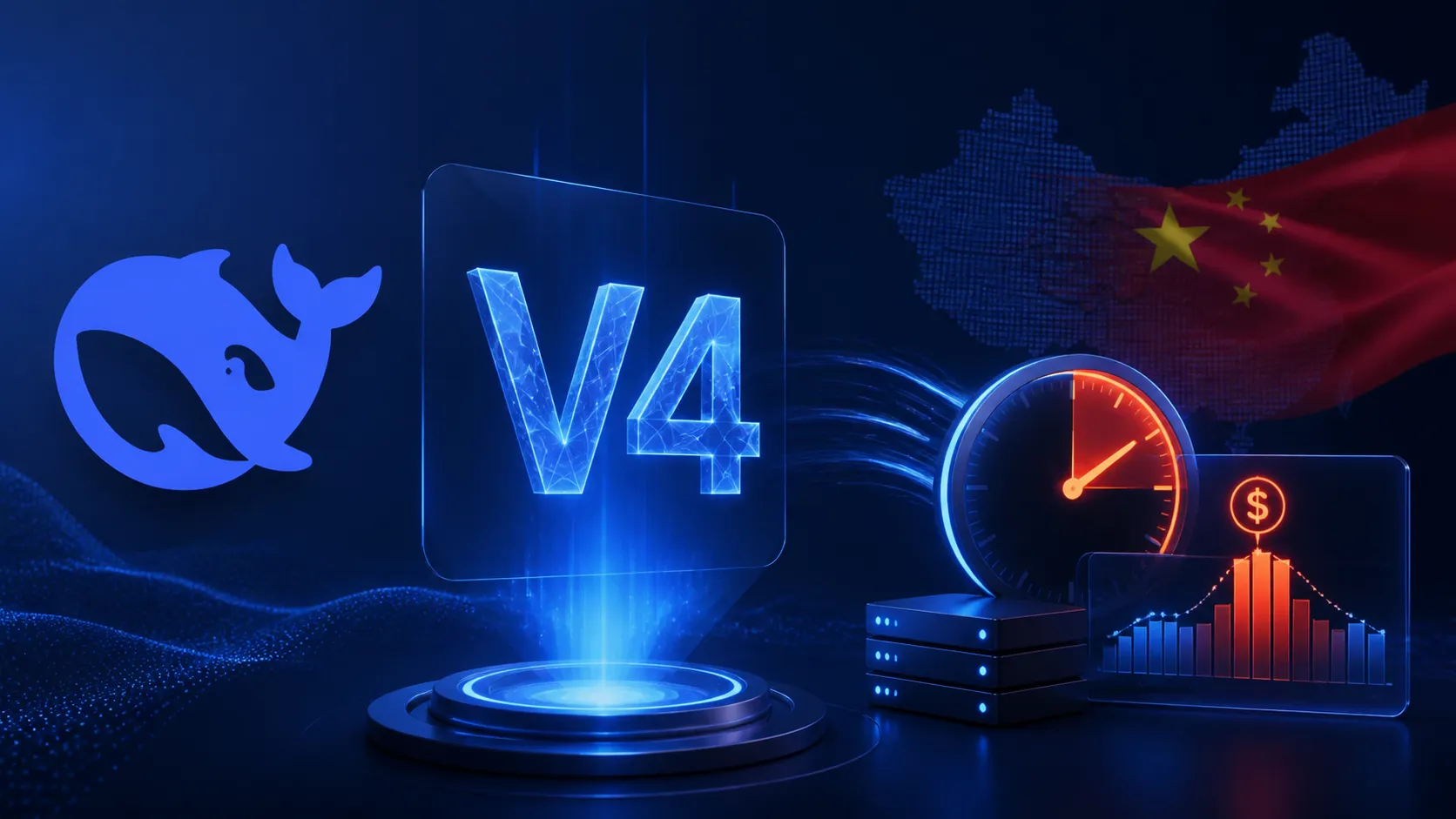
June 30, 2026, (Inside AI) — DeepSeek plans to release its V4 model in mid-July, equipping the entire lineup with a 1-million-token context window and stronger performance in agentic tasks, math, and code. The launch will also debut a first-of-its-kind peak and off-peak API pricing scheme.
The company disclosed the timing and features on Monday. DeepSeek V4 builds on an existing preview version, adding unspecified feature enhancements and performance upgrades. The standard context window of 1 million tokens applies across all model variants, a move that resets expectations for long-context processing in commercial LLMs.
DeepSeek’s new pricing will charge double the off-peak rate during two daily peak windows: 9:00 a.m. to 12:00 p.m. and 2:00 p.m. to 6:00 p.m. This marks the first time a major AI provider has tied API costs to time-of-day demand, a practice common in energy and telecom but untested in cloud AI services.
The company did not disclose absolute price levels, leaving developers to guess at the cost impact. Peak pricing could steer non-urgent workloads to off-peak hours, but it may also penalize real-time applications that can’t shift schedules. No other large model provider has adopted such a model, making DeepSeek an outlier.
DeepSeek’s V4 preview already showed competitive results in reasoning benchmarks. The new version explicitly targets agent-based task execution, a domain where models must plan, use tools, and iterate over long horizons. A 1-million-token window enables processing of entire codebases or book-length documents in one pass, but it also raises questions about latency and cost at scale.
Industry observers note that token-based pricing with peak multipliers could complicate budgeting for startups and enterprises. While off-peak discounts might attract cost-sensitive users, the lack of transparency on base rates leaves the total cost of ownership unclear. DeepSeek has not said whether fine-tuning or batch processing will receive separate pricing.
The mid-July launch puts DeepSeek in direct competition with upcoming releases from OpenAI and Anthropic, both rumored to expand context windows this summer. DeepSeek’s aggressive pricing innovation may pressure rivals to rethink their own models, but it also risks fragmenting developer expectations around API cost predictability.
DeepSeek has not confirmed whether the V4 model weights will be open-sourced, a practice it has followed for some previous versions. The company’s research arm has published technical reports on mixture-of-experts architectures, but details on V4’s parameter count and training data remain undisclosed.
The announcement comes as global AI regulation debates intensify. Time-based pricing could draw scrutiny if it disproportionately affects users in certain time zones or creates barriers for smaller developers. DeepSeek has not addressed these concerns yet.
For now, developers await the mid-July release to test the real-world performance of V4’s long-context reasoning and agentic capabilities. The dual pricing tiers will be an immediate stress test for market acceptance of demand-based AI API costs.