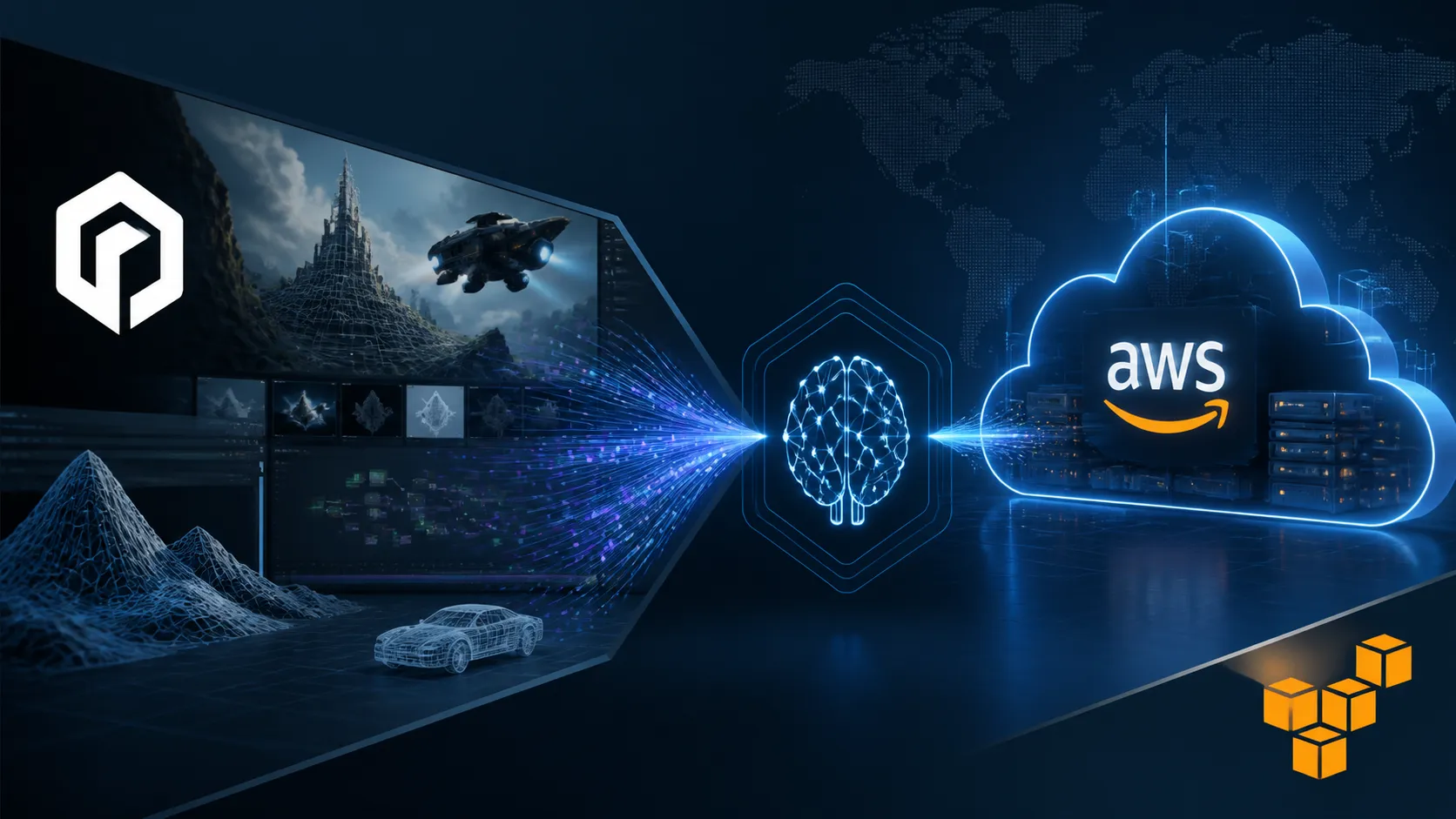
July 1, 2026, (Inside AI) — Outpost VFX has cut AI model training time for face replacement from up to 2 weeks to just 2 days by moving to AWS multi-GPU infrastructure. The visual effects studio, with operations in the UK, Canada, and India, achieved an 8x speedup using Amazon EC2 P5 instances equipped with NVIDIA H100 GPUs.
The performance leap came from parallelizing training across multiple GPUs, a shift from the single-GPU workstations that previously bottlenecked production. For high-end film and episodic projects, the delay meant 5 days or more just to create initial face replacement versions for director approval.
The bottleneck wasn’t just hardware. Outpost’s existing AI face swap tool could only use one GPU at a time, capping video memory and processing capacity. That forced artists into manual compositing or specialist beauty work, slowing the iterative approval cycle that is most critical to production timelines.
Outpost VFX had already built an AI model that could train on on-set footage to accelerate face replacement. But single-GPU training meant each fine-tune took 1–2 weeks. Scaling up with cloud workstations added management overhead without solving the core parallelism problem.
Read: Carry on Jatta 4 Uses AI to Recreate Late Actor Jaswinder Bhalla in a First for Indian Cinema
The studio turned to the AWS Generative AI Innovation Center, a team of strategists, data scientists, and engineers that builds bespoke generative AI solutions. Over a 6-week advisory period, AWS scientists helped convert the face swap model code to use PyTorch Distributed Data Parallel (DDP).
DDP copies model weights to each GPU, allowing the system to process more images per training batch. This directly accelerates training by increasing batch size. The implementation ran on P5 instances, which use NVLink interconnects for high-bandwidth gradient synchronization—a critical factor in multi-GPU training.
Compared to G5 instances that rely on PCIe communication, P5’s NVIDIA H100 GPUs offer 14,592 CUDA cores and 80GB of HBM3 memory. That represents a substantial upgrade from the local RTX 3090 GPUs Outpost previously used.
To measure the improvement, Outpost fixed model hyperparameters and trained on a fixed image dataset until reaching a specific loss threshold. The baseline was one GPU on a G5 instance. The result: an 8x improvement in training speed.
“We are now able to iterate much faster thanks to our parallelized workflow and the ability to harness multiple top-end GPUs at once,” said Tim Chauncey, CTO of Outpost VFX.
“Speed of iteration is critical to VFX work, and this architecture provides more robust and scalable capabilities for future development.”
Read: Amazon SageMaker AI Cuts Generative AI Scaling Time by Half with Container Caching
The security architecture was also critical. Outpost has been an AWS customer since 2022 with a fully virtualized stack, and the new setup had to meet exacting requirements for sensitive production data. The P5 instances run in a segregated, secure cloud environment aligned with existing infrastructure.
The impact is already visible in delivery timelines. Initial versions for client review now take 2 days, down from 1–2 weeks. The team can also train on higher-resolution images and larger datasets, improving output quality.
“What excites me most is that these models are no longer research experiments; they are becoming an integral part of the modern VFX pipeline,” said Dheeraj Bhadani, Lead Software Architect at Outpost VFX.
“Multi-GPU acceleration is the foundation on which next-generation creative tools will be built.”
Future improvements could include using newer P5 instances with more VRAM to process even larger images and datasets. Outpost is also evaluating Amazon SageMaker AI for managed training, model versioning, and hosted inference across its global studios.
The collaboration highlights a broader shift in VFX: AI-assisted tools are moving from experimental to essential. For studios under pressure to deliver high-end content on tight schedules, cloud-based multi-GPU training offers a path to both speed and quality.