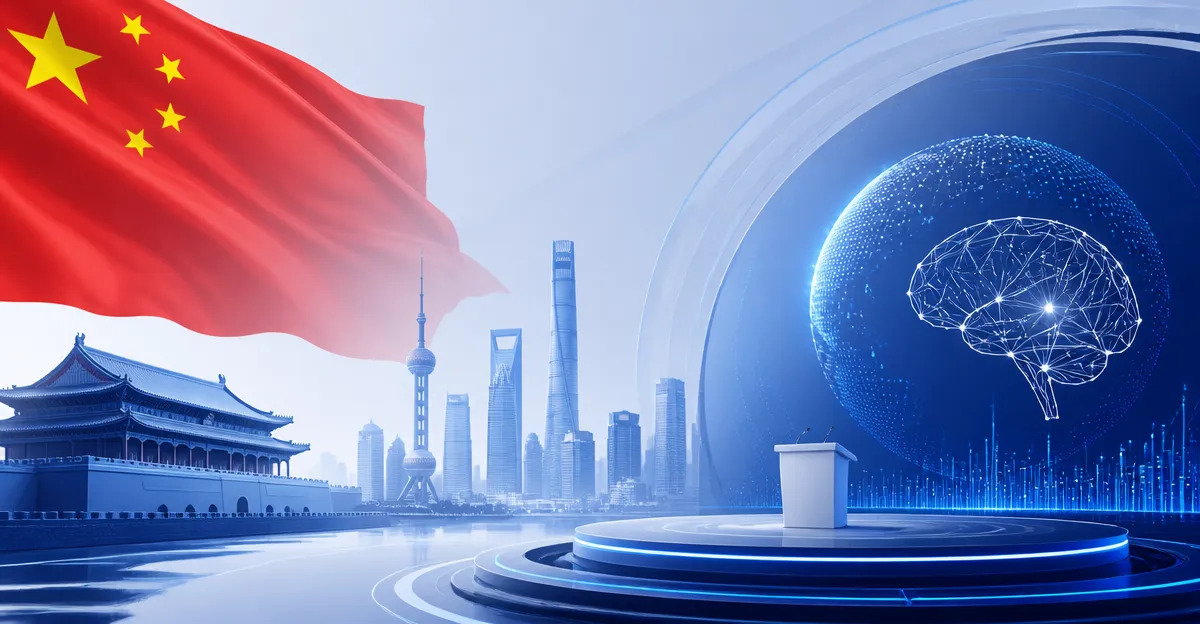
July 13, 2026, (Inside AI) — Chinese President Xi Jinping will attend the opening ceremony of the 2026 World Artificial Intelligence Conference (WAIC) in Shanghai and deliver a keynote address, the Ministry of Foreign Affairs announced on Monday. This marks his first in-person appearance at the annual event since its launch in 2018.
The four-day conference, co-located with a high-level meeting on global AI governance, starts on Friday. Organizers say it will feature over 140 forums, 1,400 guests, and 1,100 exhibitors, with more than 300 products making their global debut.
Xi’s attendance signals the elevated priority Beijing places on AI as an engine for economic growth, technological competitiveness, and global rule-setting. During a 2025 visit to a Shanghai start-up incubator, Xi said AI was entering a period of “explosive development” and urged the city to lead in both its development and governance.
From Policy Signals to Concrete Action
The WAIC has grown from a niche tech gathering into a platform where China projects its AI ambitions. Xi’s presence transforms the event into a stage for high-level policy signaling. It follows a series of moves by Beijing to shape international AI norms, including the Global AI Governance Initiative launched in 2023.
Read: 29 Countries Sign Agreement in Beijing to Form Global AI Cooperation Body
“President Xi’s attendance underscores that AI is now a top-tier national priority, not just an industrial one,” said Ding Jie, a technology policy researcher at the China Institutes of Contemporary International Relations. “It’s about demonstrating China’s readiness to lead in both innovation and regulation.”
This year’s conference emphasizes practical applications. Over 300 global debuts suggest a shift from conceptual demos to market-ready products. Sectors like autonomous driving, smart manufacturing, and AI healthcare are expected to dominate the exhibition floor.
Shanghai itself has been positioned as an AI hub. The city hosts a national AI pilot zone and has attracted major labs from firms like SenseTime and Alibaba. Municipal policies offer subsidies and testing sandboxes, aiming to integrate AI into urban management and finance.
Competing Visions in a Fractured Tech Landscape
Xi’s keynote comes as global AI governance fractures along geopolitical lines. The U.S. has tightened export controls on advanced chips, while the EU pushes its AI Act as a regulatory template. China’s alternative framework emphasizes state-led development with “socialist values.”
“The conference is a counter-narrative to Western-led governance models,” said Sarah Zheng, an independent AI analyst based in Beijing. “China wants to show it can foster innovation while managing risks, especially to developing nations seeking a third way.”
Yet challenges persist. Chinese AI firms face chip shortages due to sanctions, spurring a domestic semiconductor push. Meanwhile, talent retention remains a concern, with top researchers often lured abroad. Xi’s speech may address these bottlenecks through new funding or policy pledges.
Read: China Urged to Avoid ‘Us or Them’ Split with US Over AI Governance
Past WAIC keynotes by officials like Vice Premier Liu He have unveiled national AI strategies. This year, attendees expect concrete measures on data governance, computing infrastructure, and ethical guidelines. A possible announcement on a national AI training data platform has been rumored in industry circles.
The high-level governance meeting running parallel to WAIC will involve officials from over 30 countries, according to organizers. It aims to build consensus on issues like military AI use and cross-border data flows, areas where China has previously clashed with Western nations.
For Shanghai, the event cements its role as a tech showcase. The city has invested heavily in AI, with a goal to scale the industry to 500 billion yuan ($69 billion) by 2025. Xi’s visit validates those efforts and may attract more foreign partnerships, despite ongoing decoupling pressures.
As the conference unfolds, all eyes will be on Xi’s speech for clues on how China plans to navigate an AI future defined by both rivalry and interdependence.