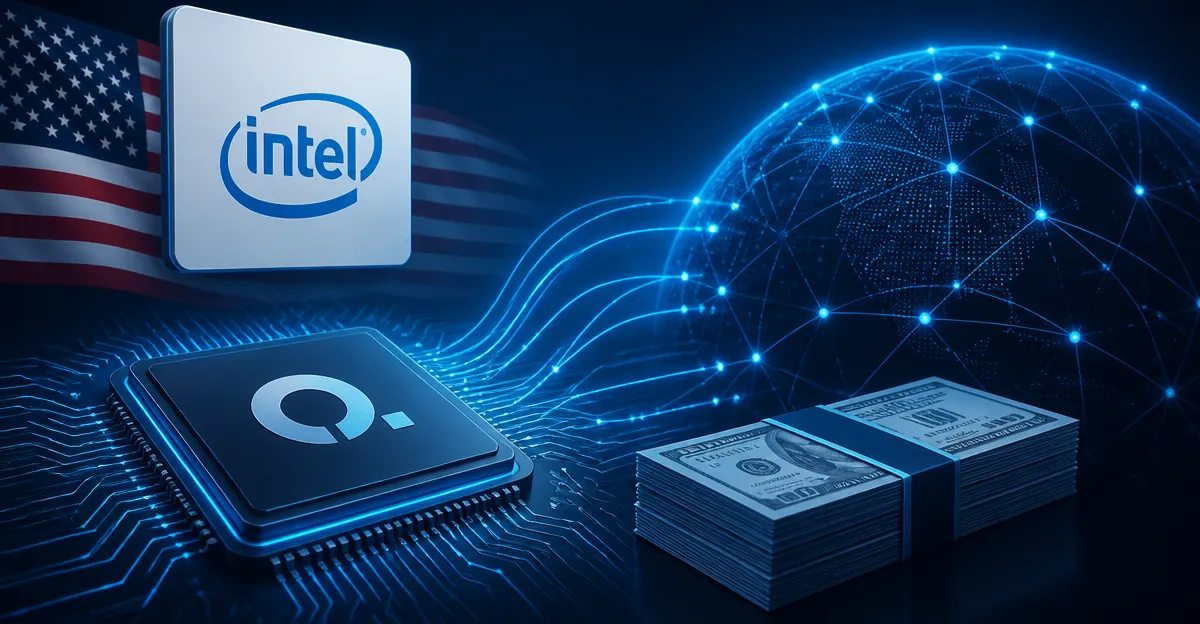
September 15, 2026, (Inside AI) — Delos Data, a chip startup founded by former Intel engineers, announced on Tuesday that it has raised $100 million to build networking silicon and software designed to speed up data movement inside AI data centers. The funding round was led by Matrix Partners and Playground, with participation from Socratic Partners, Capricorn, Matter Venture Partners, IAG, and DYNAMIQ.
The company is targeting a pain point that has grown more acute as AI data centers shift from training large models to running inference for autonomous agents. In the early days of the AI boom, these facilities were largely homogeneous, built around Nvidia GPUs connected by Nvidia's proprietary networking. But the rise of agentic AI has pushed data center operators to mix chips from AMD, Cerebras Systems, and even multiple Nvidia architectures. That heterogeneity creates a networking nightmare.
Delos Data's answer is a set of network chips and software that promise to move data as fast as possible regardless of which compute silicon sits at either end. The company says its technology is designed to be flexible enough to adapt to whatever mix of processors a data center owner chooses, now or in the future.
"We don't know what the next infrastructure architecture is going to be for agentic (AI)," Delos Data Chief Technology Officer and Co-Founder Dan Daly said in an interview. "But we do know that we can provide the quickest, fastest way to move that data around."
Read: Positron AI Hits $5 Billion Valuation After $875 Million Round
The startup's pitch has attracted high-profile backing. Pat Gelsinger, the former CEO of Intel who is now a partner at Playground, joined the round and framed the problem in stark economic terms.
"I can have all the computers in the world, and if I can't get these devices communicating effectively with one another, I've got lots of hot hardware, burning watts and sitting here twiddling their thumbs," Gelsinger said.
Gelsinger's involvement is notable. During his tenure at Intel, he pushed an ambitious strategy to challenge Nvidia in AI chips, only to be ousted in late 2024. His move to venture capital and his investment in a networking startup suggest he sees the interconnect layer, not just the compute layer, as a critical battleground.
Delos Data is not alone in this space. Broadcom, Marvell, and Cisco have long sold networking gear for data centers. Nvidia itself offers InfiniBand and Spectrum-X Ethernet for AI workloads. But Delos Data argues that existing solutions are either too proprietary or not optimized for the emerging mix-and-match world of agentic AI.
The timing of the raise is significant. AI data center capex is projected to exceed $250 billion in 2026, according to industry analysts. Yet a growing share of that spending is going toward inference and agentic workloads, which have different networking requirements than training. Training tends to be predictable and batch-oriented, while agentic inference involves many small, bursty requests that must be routed quickly and reliably.
Delos Data's software layer may be its key differentiator. The company says its stack can abstract away the underlying hardware, allowing data center operators to swap in new chips without rewriting their networking logic. That could appeal to hyperscalers like Amazon Web Services, Microsoft Azure, and Google Cloud, all of which are designing custom silicon and want to avoid vendor lock-in.
Still, the startup faces steep competition. Nvidia's networking business generated over $13 billion in revenue last fiscal year, and the company has deep relationships with data center builders. Broadcom's Tomahawk and Jericho series dominate Ethernet switching for AI. Delos Data will need to prove its chips can deliver measurable latency and throughput gains in real-world deployments.
The company has not disclosed when its products will be available or which customers it is working with. A spokesperson said more details would be shared in the coming months.
For now, the $100 million round gives Delos Data runway to hire engineers and tape out its first chips. The involvement of Gelsinger and the backing of top-tier venture firms signal that investors believe the networking layer is ripe for disruption. As AI data centers grow more complex, the ability to move data efficiently may become just as important as the chips that process it.