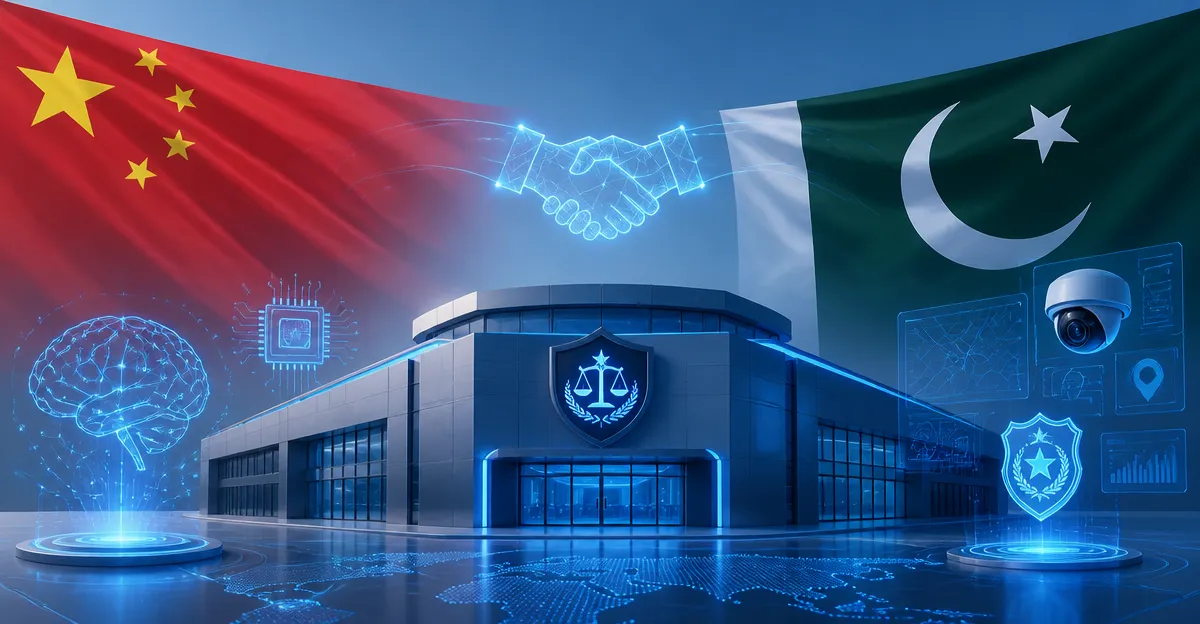
September 16, 2026, (Inside AI) — China will help Pakistan build a law enforcement center equipped with artificial intelligence technology, according to an official statement issued on Wednesday. The agreement emerged from a meeting in Islamabad between Pakistan's Interior Minister Mohsin Naqvi and visiting Chinese Vice Minister for Public Security Gao Qi.
The two sides discussed expanding cooperation against terrorism and drug trafficking. They also agreed to strengthen an existing police training exchange program and to cooperate on advanced law enforcement technologies and equipment. China will support Pakistan in developing AI-based law enforcement capabilities.
The announcement matters because it extends a security partnership that has run for years into a new domain. AI surveillance and analytics are becoming central to how states police borders, cities, and communications. When one country supplies another with that technology, it shapes both domestic security and regional power dynamics.
Gao praised Pakistan's sacrifices in the fight against terrorism and reaffirmed the importance of continued security cooperation. Naqvi said the proposed AI-powered center would represent another symbol of the longstanding friendship between the two countries. He added that Chinese AI technology and modern law enforcement equipment could help Pakistan address emerging security challenges and strengthen its capabilities.
Read: AI Too Big to Slow as US and China Accelerate Geopolitical Race
Pakistan has faced a sharp rise in militant attacks in recent years, particularly in Khyber Pakhtunkhwa and Balochistan. Its security forces have long relied on Chinese equipment, from surveillance systems to drones. The new center would deepen that reliance and move it toward algorithmic tools such as facial recognition, predictive policing, and automated threat detection.
China has built similar systems at home and exported them to multiple countries. Its public security vendors have supplied AI surveillance platforms across Asia, Africa, and Latin America. The pattern is consistent: hardware, software, and training bundled together, often financed through Chinese loans or grants.
For Pakistan, the appeal is practical. Human intelligence and conventional policing have struggled against insurgent networks that operate across rugged terrain and porous borders. AI tools can process large volumes of data from cameras, phones, and sensors faster than manual analysis. They can flag patterns that might otherwise go unnoticed.
But the same tools raise questions. Facial recognition systems have higher error rates for darker skin tones and in low-light conditions, according to multiple independent studies. Predictive policing algorithms can reinforce existing biases if trained on skewed arrest data. Civil liberties groups have warned that such systems often lack transparency and oversight.
Pakistan does not have a comprehensive data protection law. Its draft Personal Data Protection Bill has been pending for years. Without clear rules on data collection, retention, and redress, AI-powered policing could operate with limited accountability. Inside AI could not independently verify what safeguards, if any, the two governments discussed.
Read: China Readies Humanoid Robots for Combat, Military Records Show
The timing is notable. China has been expanding its security footprint in South Asia and beyond, often through bilateral agreements that combine economic and defense elements. The China-Pakistan Economic Corridor already includes major infrastructure investments. Adding an AI law enforcement center fits a broader strategy of deepening institutional ties.
For Pakistan, the center could also serve as a training hub for officers from other countries. That would give Islamabad a role in shaping regional security practices. It would also give Chinese vendors a showcase for their technology.
Neither side released details on cost, timeline, or the specific AI systems involved. The statement did not name the location of the center or the agencies that would operate it. More talks are expected, and the police training exchange program will continue in parallel.
The announcement comes as Pakistan prepares for a period of political and economic uncertainty. Its government has been negotiating with the International Monetary Fund and managing strained relations with neighbors. Security cooperation with China offers a measure of stability, but it also ties Pakistan closer to a partner whose own human rights record faces international scrutiny.
How the center develops will depend on implementation. AI systems require reliable electricity, internet connectivity, and trained personnel. Pakistan has gaps in all three. Without sustained investment in maintenance and skills, even advanced equipment can sit idle.
The two countries have not said whether the center will be operational within a specific timeframe. They have not described how data will be shared or stored. They have not explained how citizens can challenge wrongful identifications or flag misuse.
Those omissions are common in security agreements. They are also the details that determine whether AI policing protects people or simply surveils them. The center will be watched closely by researchers, rights advocates, and rival governments alike.
For now, the agreement is a statement of intent. China will help Pakistan build the facility. Pakistan will use Chinese AI to fight terrorism and drug trafficking. The rest remains to be defined.