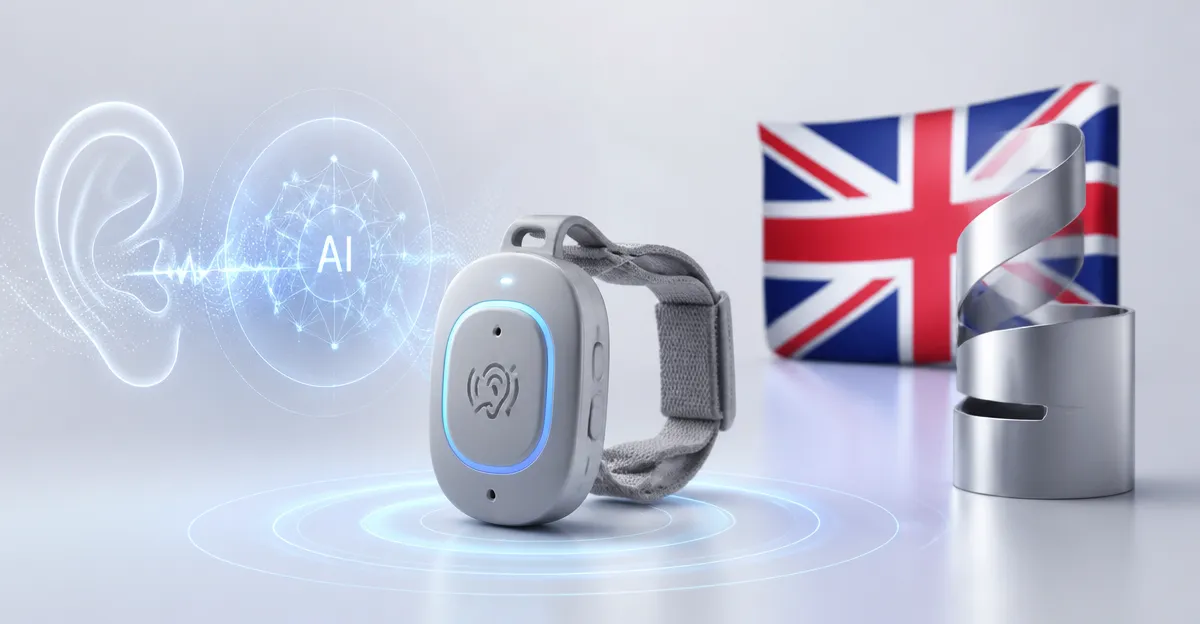
September 18, 2026, (Inside AI) — A wearable device that uses artificial intelligence to translate emergency sounds into vibrations and light for deaf and hard of hearing users has won the 2026 UK James Dyson Award. The system, developed by Gargi Agrawalla, a profoundly deaf graduate of Loughborough University, beat other UK entries to take the national prize. The win was announced on September 18, 2026.
The award, part of the global James Dyson Award run by the James Dyson Foundation, recognizes engineering and design students who solve real-world problems. Agrawalla’s device addresses a gap in safety tech for the deaf community: most alerting systems rely on sound or require visual attention to a phone screen. Her system detects critical noises like fire alarms, doorbells, and alarm clocks, then converts them into tactile and visual signals. The goal, she said, is to enable solo travel without fear.
Agrawalla’s win matters because it highlights how AI can be deployed for accessibility, not just automation. While much of the AI industry focuses on chatbots and image generators, this project shows a quieter but growing trend: using machine learning for assistive technology. The device reportedly runs on a low-power chip and uses a lightweight neural network to classify sounds in real time, distinguishing a smoke detector from a microwave beep. That kind of on-device processing avoids cloud latency and protects privacy, a key concern for always-on listening devices.
The James Dyson Award has a history of surfacing inventions that later reach the market. Past UK winners include a plastic recycling system and a low-cost prosthetic limb. Agrawalla’s project now advances to the international stage, where it will compete against national winners from over 30 countries. The global winner, to be announced later this year, receives £30,000 to further develop the invention. The UK prize itself comes with £5,000.
Read: US-based Pune engineer builds AI app for visually impaired readers
In a statement, Agrawalla explained her motivation: “I came up with the system as a way to realize my dream of being able to travel solo.” She added that existing alerting tools often fail in unfamiliar environments, leaving deaf travelers dependent on others. Her device aims to change that by providing immediate, localized feedback.
The technical details remain sparse, but the core idea is straightforward. A microphone array captures ambient sound. An AI model, trained on a dataset of emergency noises, flags relevant events. A microcontroller then triggers a vibration motor and an LED ring. The entire unit is designed to be worn on the wrist or clipped to clothing. Agrawalla told Inside AI that the next step is to refine the algorithm to reduce false positives, such as a phone ringtone that sounds similar to a fire alarm.
Accessibility advocates have welcomed the recognition. “AI has enormous potential to break down barriers for disabled people, but only if it is designed with us, not just for us,” said Dr. Sarah Osei, a researcher in assistive technology at University College London, who was not involved in the project. She noted that many AI safety devices for deaf users have struggled with accuracy in noisy settings. Agrawalla’s win, she said, could attract more investment to the field.
The timing is notable. As AI regulation debates intensify in the UK and EU, projects like this offer a counter-narrative: AI as a tool for inclusion. The UK’s AI Safety Institute has focused largely on existential risks, but grassroots innovations show the technology’s immediate social value. The James Dyson Award, founded in 2005, has awarded over £1 million to student inventors worldwide.
Read: Blind Egyptian Entrepreneur’s AI App Helps Sister ‘See’ the World
Agrawalla plans to use the prize money to build a working prototype and conduct user trials with deaf travelers. She is also exploring partnerships with hearing aid manufacturers. If successful, the device could reach the market within two years. For now, the award serves as validation that a personal frustration can become a public solution. As Agrawalla put it, the dream of solo travel should not be a luxury for the deaf community.