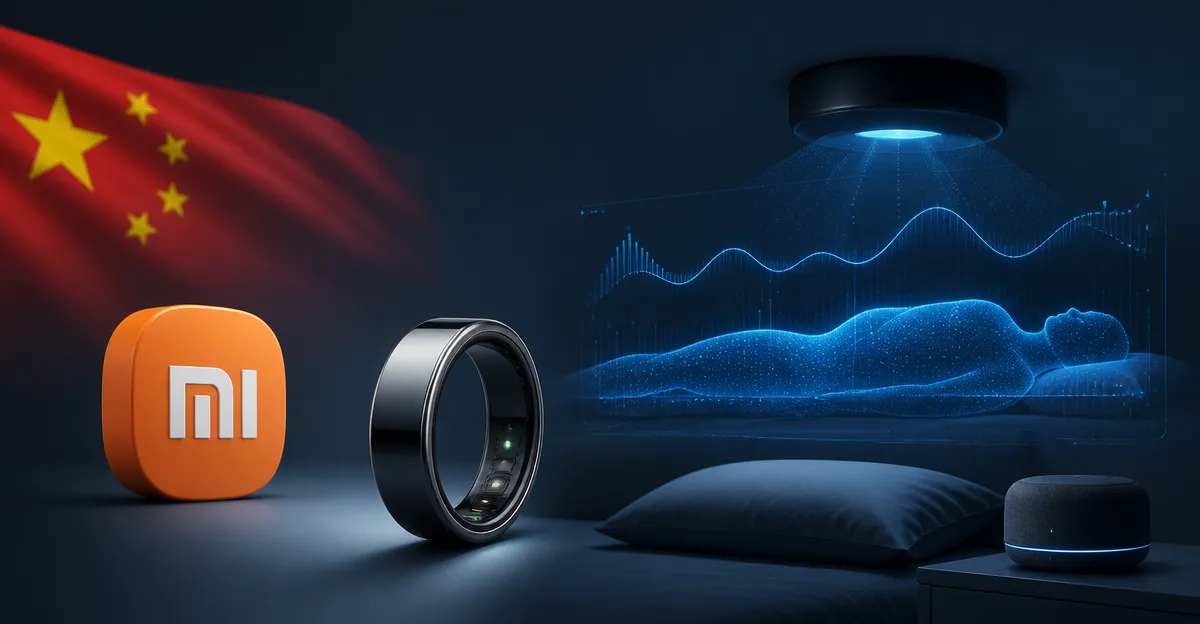
October 30, 2026, (Inside AI) — Wang Teng, the former Xiaomi executive who once led the company's Redmi brand, has launched a sleep technology startup called ISHO. On October 29, the company unveiled two products: the ISHO Ring, a smart ring priced from RMB 1,799, and the iFlow bed temperature-control system, starting at RMB 9,999. Both are now available for preorder in China. Ring deliveries begin November 11, with the standard iFlow system following in December.
The launch places ISHO in direct competition with established sleep-tracking hardware makers, but its pitch goes beyond simple monitoring. The ring tracks physiological signals to generate daily energy-management insights. ISHO claims a battery life of six to ten days and seven days of offline data storage. A RMB 2,199 Pro package adds an environmental sensing charging case. The iFlow system pairs overnight heart-rate and breathing monitoring with active temperature adjustment, including separate temperature zones for two people sharing a bed.
Can A Ring And A Smart Bed Redefine Sleep Tech?
Wang Teng's move from smartphone executive to sleep-tech founder reflects a broader shift in China's hardware industry. Former consumer electronics leaders are increasingly targeting health monitoring as a growth market. Xiaomi itself has invested heavily in wearables and smart home devices, and Wang's decision to leave suggests he sees an opening in dedicated sleep solutions rather than general-purpose gadgets.
The ISHO Ring's six-to-ten-day battery life stands out in a category where many competitors struggle to reach five days. The offline storage feature could appeal to users who prefer not to sync data constantly. The environmental sensing charging case is a less common addition. It suggests ISHO wants the ring to monitor surroundings, not just the body.
Read: Deaf Travelers AI Device
The iFlow system's dual-zone temperature control addresses a practical problem. Couples often prefer different sleeping temperatures. By combining heart-rate and breathing monitoring with active adjustment, ISHO positions iFlow as a responsive system rather than a simple mattress pad. The RMB 9,999 price places it in premium territory, well above basic heated mattress covers but below some high-end smart beds.
ISHO has not disclosed detailed technical specifications for its sensors or the algorithms behind its energy-management insights. The company also has not announced international availability. For now, the products are limited to the Chinese market, where smart sleep devices have gained traction among urban consumers willing to pay for health optimization.
The sleep technology sector has seen mixed results. Several smart ring makers have faced accuracy criticism, and bed temperature systems often struggle with reliability. ISHO's success will depend on whether its monitoring proves accurate and its temperature control works consistently. Wang Teng's experience at Xiaomi could help with supply chain management and brand building, but the sleep category demands clinical credibility that consumer electronics does not always require.
ISHO's launch also raises questions about data privacy. Sleep and heart-rate data are sensitive. The company has not detailed how it stores or shares user information. Chinese regulations on personal health data have tightened in recent years, and ISHO will need to comply with those rules while building user trust.
The preorder timeline gives ISHO a narrow window to generate momentum before rivals respond. Established players in smart rings and sleep systems are likely watching closely. Wang Teng's profile may attract early adopters, but long-term growth will depend on product performance and word-of-mouth reviews after the November and December deliveries.
Read: Apple AI Security Camera
ISHO has not revealed funding details or its total investment in research and development. The company's ability to scale production and support customers will be tested soon. For now, the launch marks a notable entry by a well-known industry figure into a challenging but growing market.