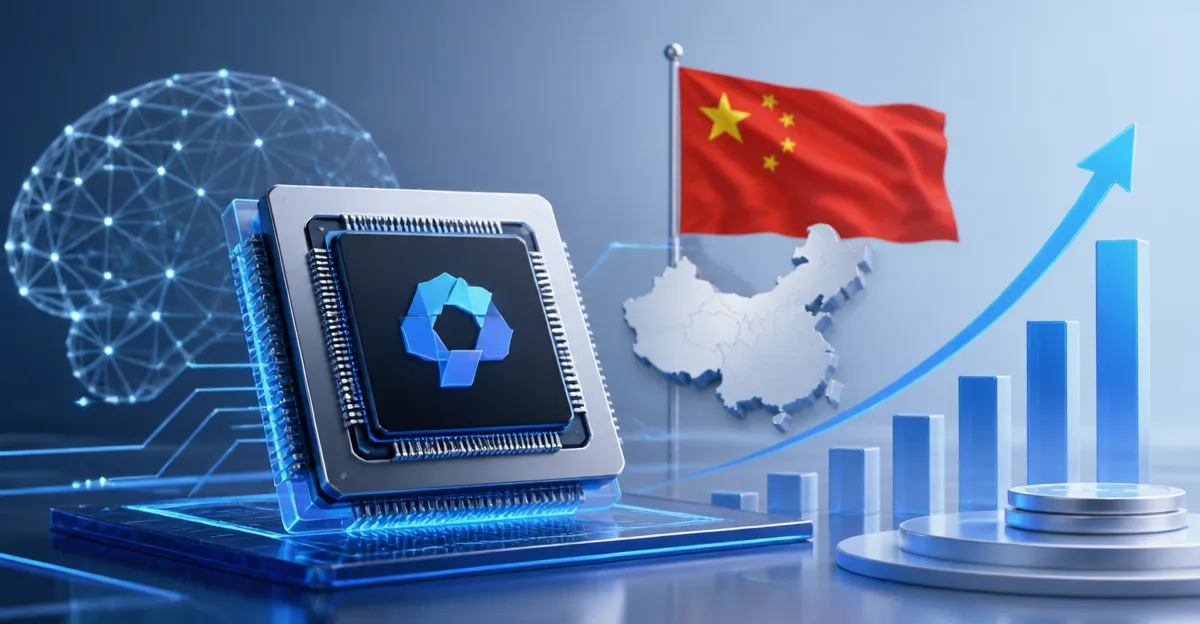
October 30, 2026, (Inside AI) — Chinese AI inference chip developer Nano-core Chip has secured more than RMB 1 billion in Series C2 funding, the Hangzhou-based company announced on October 28. The round was led by JianTou Investment, with participation from Hangzhou Capital, Kaitai Capital, and other unnamed investors.
The new capital will fund product development and preparation for volume production. Founded in 2021 and incubated at a Peking University research institute in Zhejiang, Nano-core Chip designs chips that combine three-dimensional near-memory computing, in-memory computing, and RISC-V processing. Its products target both edge devices and cloud infrastructure.
The company said its first three chips have completed tape-out, with customer sampling and initial volume shipments planned for early 2027. The Series C2 round follows a RMB 1 billion Series C1 round announced just one month earlier, in September. The back-to-back raises, totaling over RMB 2 billion within roughly two months, signal intense investor appetite for AI inference silicon in China.
The timing reflects a broader shift in the AI chip market. While much attention focuses on training chips, inference, the process of running trained models to answer queries, is where long-term commercial volume lies. As AI models proliferate and deployment scales, demand for efficient inference hardware is rising sharply. Nano-core's focus on near-memory and in-memory computing addresses the memory wall bottleneck, where data movement between processor and memory consumes most of the energy and time in AI workloads. By placing computation closer to data storage, the company aims to improve efficiency and reduce power consumption.
Read: H3C Shifts Focus to Token Efficiency at Apsara Conference 2026
Combining these techniques with the open-source RISC-V instruction set architecture adds another layer of differentiation. RISC-V allows for customizable, license-free processor designs, which can lower costs and increase flexibility compared to proprietary architectures. For Chinese chip startups, RISC-V also offers a path that is less exposed to export controls and licensing restrictions affecting some foreign IP.
JianTou Investment, the lead investor, is an arm of Beijing Infrastructure Investment Co., a state-owned entity. The participation of Hangzhou Capital, a local government-guided fund, and Kaitai Capital, a venture firm, underscores a mix of state and private backing. This aligns with China's broader push for semiconductor self-sufficiency, particularly in AI chips, as US export restrictions limit access to advanced Nvidia hardware.
Nano-core's planned timeline, with sampling and initial shipments in early 2027, places it in a competitive landscape. Domestic rivals include established players like Cambricon and Horizon Robotics, as well as other startups. The company's ability to deliver working silicon at scale will be a key test. Tape-out is a milestone, but volume production and customer adoption present significant engineering and commercial hurdles.
The rapid succession of funding rounds suggests investors are placing bets on inference silicon as the next battleground. As AI inference demand grows, driven by applications from chatbots to autonomous systems, the market for specialized inference chips is expected to expand. Nano-core's technology, if successful, could carve out a niche in both edge and cloud segments.
However, the company has not disclosed detailed performance benchmarks or customer names. It remains to be seen how its chips compare to offerings from Nvidia, AMD, and domestic competitors in terms of throughput, latency, and power efficiency. The proof will come with customer sampling next year.
Read: MIT Professor Uses AI to Curb Data Center Energy Use
For now, the funding provides runway to advance development and prepare for production. The involvement of government-linked funds indicates strong local support, which could help with manufacturing partnerships and market access. As China's AI chip ecosystem matures, Nano-core Chip's progress will be one to watch.