October 30, 2026, (Inside AI) — Alphabet's stock suffered its steepest one-day decline on record Thursday, falling more than 12% and wiping out roughly $500 billion in market value. The drop followed a quarterly earnings report that missed sales expectations and showed rising artificial intelligence spending alongside slowing growth in Google's core search advertising business.
The selloff was the second-largest single-day loss in market history, trailing only Nvidia's nearly $600 billion decline in early 2025. It exceeded any daily fall Alphabet experienced during the Covid-19 pandemic or the 2008 financial crisis.
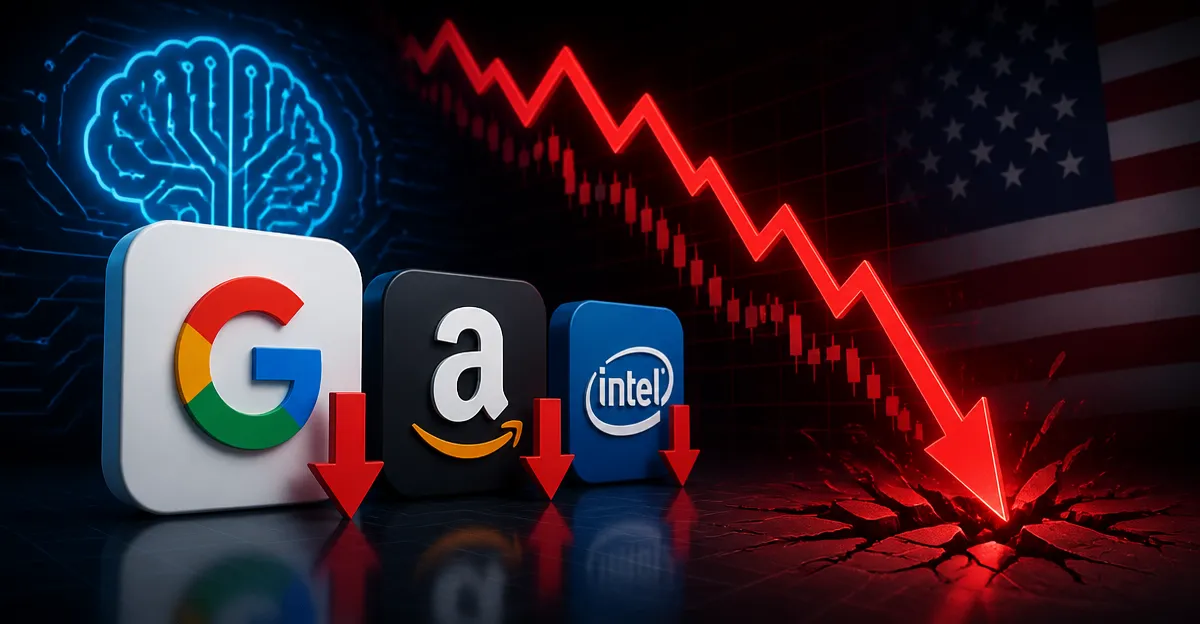
The broader tech sector absorbed collateral damage. Amazon shares fell more than 7%, while Intel tumbled 23% on Thursday amid a weakening personal computer market, manufacturing hurdles, and heavy spending on production expansion. Microsoft, by contrast, closed unchanged after reporting $18.6 billion in quarterly free cash flow despite its own multibillion-dollar AI investments.
The divergence underscores a new phase in the AI investment cycle. Investors are no longer rewarding spending pledges at face value. They are demanding evidence that capital outlays translate into cash returns without cannibalizing existing revenue streams.
Alphabet's third-quarter capital expenditure reached $51.4 billion, compared with $91.4 billion for all of 2025. More troubling to analysts, the company reported negative free cash flow for a second consecutive quarter. Before this year, Alphabet had never recorded a quarter of negative free cash flow since going public as Google in 2004. It adopted the Alphabet name in 2015.
Free cash flow funds dividends, share buybacks, and reinvestment. Its deterioration leaves less room for shareholder payouts while AI infrastructure costs, including data centers, continue to mount.
The core anxiety, however, centers on search. Google's advertising business grew more slowly than analysts expected. That weakness revived a question that has lingered since the arrival of ChatGPT: will AI chatbots, including Google's own, erode the traditional search query and the advertising model built upon it?
"Investors fear that the shift could happen more quickly than Google can adapt its business," said Jed Ellerbroek, a portfolio manager at Argent Capital Management.
That fear is not new, but the earnings report gave it fresh urgency. Google has integrated AI-generated answers into search results, a move that risks reducing the number of clickable ads users see. Rivals such as OpenAI and Perplexity continue to refine their own answer engines. The competitive pressure now arrives with a balance-sheet cost attached.
Read: Japan's Nikkei Slumps 3% as AI Profitability Fears Hit Tech Stocks
Alphabet is not alone in confronting this tension. Meta, Microsoft, and Amazon have all committed tens of billions of dollars to AI data centers and chips. But Microsoft's ability to post strong free cash flow while spending heavily suggests that execution, not spending itself, is the variable investors now track.
"The results were beginning to reveal differences in how rationally companies were investing in AI," said Richard Reyle, chief investment officer at Questar Capital Partners.
The market reaction also carries historical weight. Alphabet's previous worst days occurred during systemic crises. This decline is company-specific, tied to a strategic pivot that has not yet proven financially self-sustaining. That distinction matters for how the company communicates with shareholders in coming quarters.
Intel's 23% plunge offered a separate cautionary tale. The chipmaker faces a PC market downturn, manufacturing setbacks, and costly factory expansions. Its troubles are less about AI enthusiasm than about execution in a legacy business, but the timing reinforced the sector-wide mood.
Amazon's 7% decline reflected similar concerns about spending discipline, though the company has not reported negative free cash flow. Its AWS cloud unit remains a profit engine, but retail margins and AI infrastructure costs are drawing scrutiny.
For Alphabet, the path forward requires demonstrating that AI investments can coexist with search advertising growth. The company has not announced a change to its capital expenditure plans. Analysts will watch the next quarter for signs that free cash flow turns positive and that search revenue stabilizes.
If those signals fail to materialize, the pressure on management will intensify. The $500 billion loss is a market verdict, not a final one, but it sets a higher bar for every dollar Alphabet spends on AI from here.