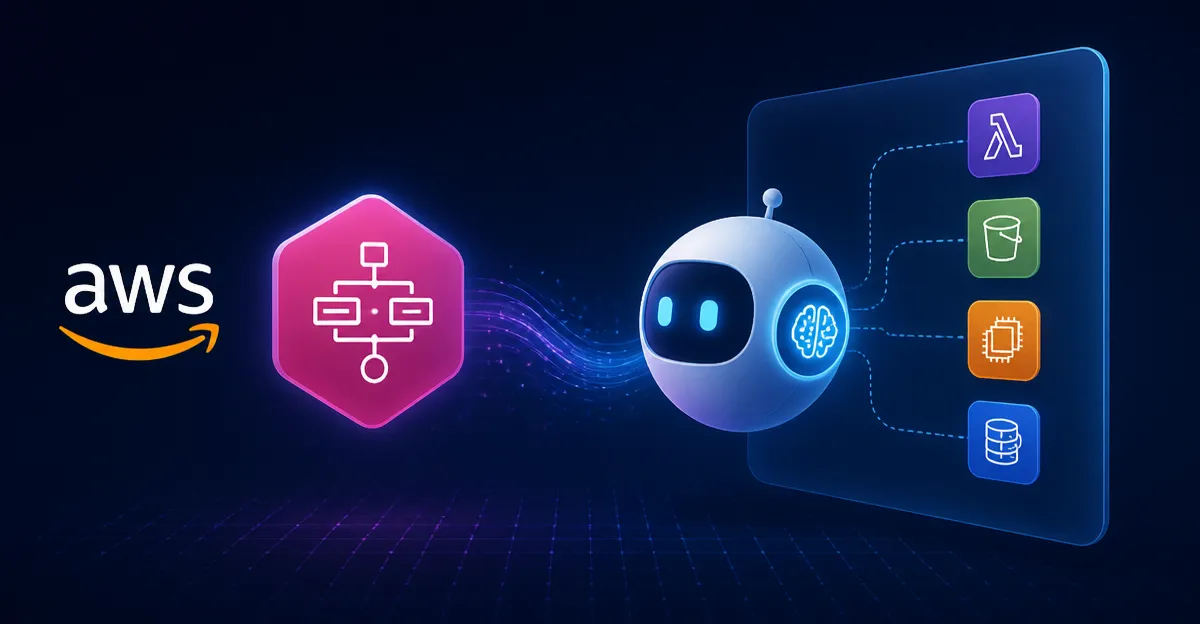
October 30, 2026, (Inside AI) — AWS has made its Step Functions workflows available as tools for AI agents through Amazon Bedrock AgentCore Gateway, the company announced. The integration lets agents trigger existing Standard and Express workflows, with Step Functions executing each step exactly as defined. This moves agentic AI from experimental pilots into production business processes, where determinism and auditability matter.
The significance goes beyond a feature update. Enterprises have spent years encoding business logic into Step Functions: refund approvals, order fulfillment, compliance checks. Until now, agents could not reliably invoke those workflows. AgentCore Gateway bridges that gap using the Model Context Protocol (MCP), an open standard for connecting AI models to external tools. The result is a hybrid model where the agent decides when to act, but the workflow enforces how.
Why Deterministic Execution Matters For Agents
Step Functions orchestrates over 220 AWS services and supports both Standard and Express workflows. Standard workflows suit long-running, auditable processes. Express workflows handle high-volume, short-duration tasks. By exposing both as agent tools, AWS lets teams reuse existing automation without rewriting logic in agent code.
Read: AWS Launches Bedrock Managed Agents Powered by OpenAI in Public Preview
The practical example AWS provides is a customer support agent that starts a refund workflow. Step Functions then runs the eligibility check, manager approval, and credit steps in sequence. Every refund follows policy, regardless of how the agent phrases its request. This addresses a core concern with agentic systems: large language models can hallucinate or skip steps. A workflow cannot.
Operations teams gain a second benefit. Agents can query workflow runs to diagnose failures. An operations agent can tell an on-call engineer which order runs failed overnight and where, allowing faster remediation. This turns the agent into a triage assistant rather than an autonomous actor.
The integration is available in all AWS Regions where AgentCore Gateway operates. Pricing follows standard rates for Step Functions and AgentCore Gateway, with no premium for the agent-tool capability.
Developers can start with a tutorial in the Step Functions Developer Guide. Full operation lists and setup options appear in the AgentCore Gateway documentation. AWS also points AI coding assistants like Kiro to the Agent Toolkit for AWS, which provides skills and guidance for building on the platform.
The move reflects a broader industry pattern: agent frameworks are converging on MCP as a common interface. By supporting MCP, AWS avoids locking agents into a proprietary tool format. That choice could accelerate adoption among enterprises already standardizing on MCP for internal tooling.
One open question is governance. When an agent triggers a workflow, who is accountable for the outcome? AWS places execution responsibility on the workflow definition, not the agent. That separation may satisfy compliance teams, but it also means agent errors in tool selection or input formatting can still cause failures. The workflow runs exactly as defined, even if the agent passes the wrong order ID.
Read: Governments Deploy Agentic AI for Public Services, Raising Accountability Questions
For now, the capability targets teams that already trust Step Functions for critical processes. It does not replace agent planning or reasoning. It gives agents a bounded, reliable action space. In a market crowded with autonomous agent promises, that restraint may be the feature enterprises need most.