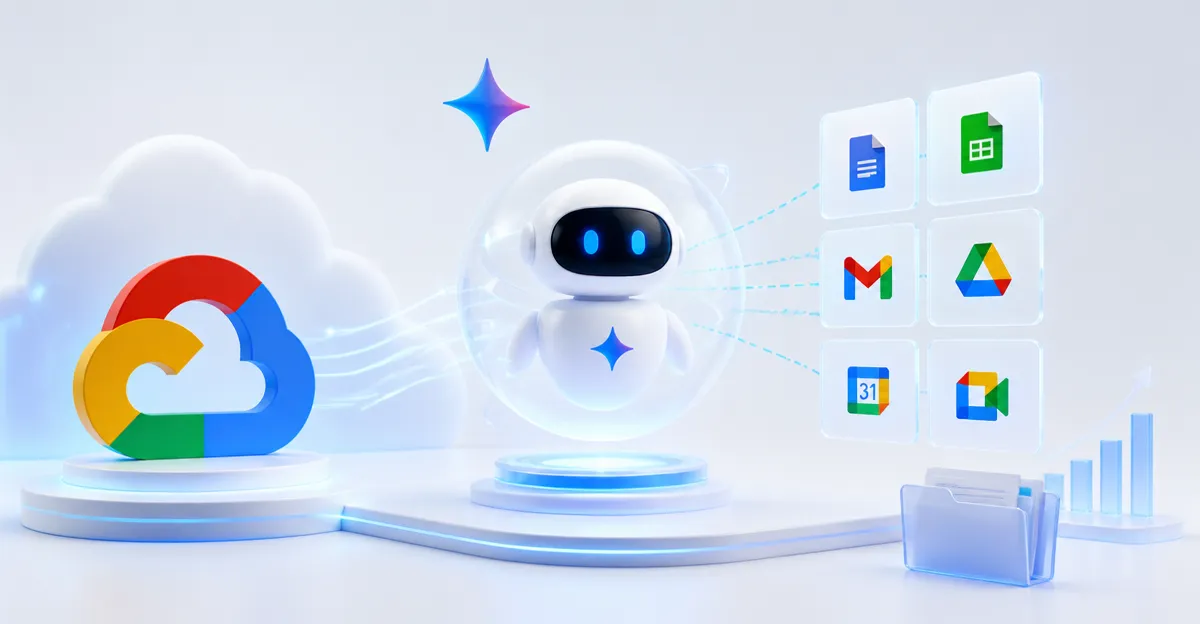
October 9, 2026, (Inside AI) — Google Cloud on Thursday unveiled the Gemini agent, a single AI assistant that can answer questions, handle tasks, create content, and write code for enterprise users. The launch places Google in direct competition with OpenAI and Meta in the rapidly growing market for autonomous workplace AI.
The Gemini agent plans work, uses tools, and connects directly to a company's business systems. It then returns finished work in documents, email, and developer environments. This differs from earlier AI assistants that required constant user prompts. The agent works inside Google Workspace apps like Gmail, Docs, Sheets, and Calendar. It also supports Microsoft 365 and Slack integration, allowing organizations with mixed productivity platforms to deploy it across workflows.
The announcement follows OpenAI's September launch of always-on "dots" agents, which chase user goals across multiple apps entirely on their own. Meta released Muse last month, a personal AI agent that can shop, book travel, send emails, and make payments. The enterprise AI agent market now features three major players competing for corporate customers.
Model-Agnostic Design Sets Gemini Apart
A key technical detail: the Gemini agent picks the best AI model for each specific task. It currently runs on Google's own Gemini models and Anthropic's Claude models. Google plans to add more models later. This multi-model approach contrasts with OpenAI and Meta, which primarily rely on their own models. By integrating Claude, Google acknowledges that no single model excels at everything.
Users can also create "coworker agents" that act as virtual team members. These specialized agents get their own email address and access only the information they receive from the company. Businesses can deploy focused AI workers alongside human staff without exposing sensitive data. This addresses a major enterprise concern: data leakage when AI systems have broad access.
Google announced industry-specific versions of the agent. Versions for financial services and legal work now sit in preview. Versions for government, healthcare, and retail will follow soon. These vertical solutions could accelerate adoption in regulated industries where generic AI tools struggle with compliance.
Alphabet shares rose marginally in early Thursday trading after the announcement. The muted market reaction suggests investors may be waiting to see real adoption metrics before pricing in significant revenue impact.
The launch reflects a broader shift in enterprise AI. Companies are moving from simple chatbots to autonomous agents that can execute multi-step tasks. Google's decision to support Microsoft 365 and Slack shows it prioritizes interoperability over locking customers into its own ecosystem. That strategy could appeal to large organizations that rarely use a single vendor.
However, challenges remain. Enterprises must trust AI agents with access to critical business systems. Security and reliability will determine whether these agents become mainstream. Google's "coworker agents" with limited data access represent one attempt to mitigate those risks. Whether it is enough to convince cautious IT departments remains an open question.
The race among Google, OpenAI, and Meta will likely intensify. Each company brings different strengths: Google's cloud infrastructure and workspace dominance, OpenAI's early lead in generative AI, and Meta's consumer reach. For now, Google Cloud has made its move. The next few quarters will reveal whether enterprises embrace the Gemini agent or wait for more mature offerings.