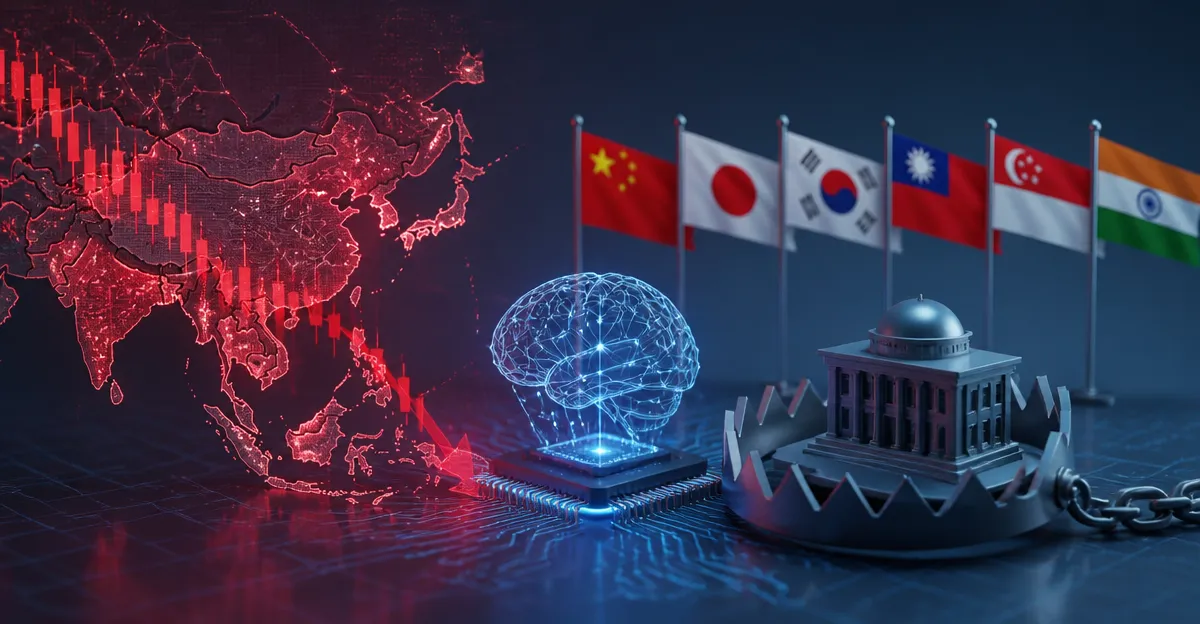
November 23, 2026, (Inside AI) — A sharp selloff in Asian technology stocks, led by steep declines in shares of Samsung Electronics and TSMC, has forced authorities in Seoul and Taipei into a defensive posture. Both governments are now weighing further market stabilization measures as they try to halt a slide that threatens the savings of millions of retail investors and the export-dependent growth models of their economies. The pressure is mounting on policymakers who have few tools left, and the precedent set by Beijing’s recent failed interventions suggests their efforts may yield little relief.
The rout, which accelerated in the past week, has wiped out billions in market value across the region’s semiconductor supply chain. Samsung and TSMC, the two largest contract chipmakers and key suppliers for AI accelerators, have seen their share prices fall sharply as global investors reassess the near-term profitability of artificial intelligence infrastructure. The selloff is not confined to chipmakers. It has spread to related equipment manufacturers and material suppliers across South Korea and Taiwan, threatening the broader tech ecosystem that underpins both economies.
At the heart of the problem is a structural dependence on AI-related exports. South Korea and Taiwan together account for a dominant share of global advanced chip production. Their economies rely on these exports for growth, and their stock markets are heavily weighted toward a handful of semiconductor giants. When AI sentiment turns, the fallout is immediate and severe. Both countries also have unusually high levels of retail participation in equity markets, meaning the pain is felt directly by ordinary households. Seoul and Taipei have responded with familiar tools: verbal support, potential buying programs, and hints of regulatory tweaks. But the fundamental driver of the selloff, a global repricing of AI stocks, lies beyond their control.
Why Beijing’s Playbook Offers No Comfort
The caution in Seoul and Taipei is informed by Beijing’s recent experience. Chinese authorities have repeatedly attempted to stabilize their own equity markets through state-backed buying and restrictive selling rules. Those measures have failed to reverse a prolonged decline in confidence. The lesson is clear: government intervention can slow a fall but cannot create demand where investors see risk. For South Korea and Taiwan, the challenge is compounded by their open capital accounts. Unlike China, they cannot easily impose capital controls without triggering a larger outflow. Their central banks also face inflationary pressures that limit the scope for aggressive rate cuts.
Market analysts note that the current selloff is driven by a reassessment of AI capital expenditure timelines. Major cloud providers have signaled a slower pace of data center buildouts, raising doubts about the immediate demand for high-end chips. This shift in narrative has caught many retail investors off guard. In South Korea, margin debt levels have risen sharply over the past year, amplifying losses as prices fall. In Taiwan, similar dynamics are at play, with retail investors accounting for a growing share of daily trading volume. The result is a feedback loop: falling prices trigger margin calls, which force more selling, which pushes prices lower.
The commentary from financial analysts has been blunt. “Seoul and Taipei are trying to stabilise stocks after a brutal selloff led by Samsung and TSMC,” noted Robyn Mak, a columnist at Breakingviews, in a forthcoming analysis. “Both economies depend on AI exports and have armies of retail investors. Their pain is pressuring authorities to wade in further. Beijing's failure suggests they'll have little joy.” The assessment underscores the limited efficacy of state intervention in the face of a global sentiment shift.
For the AI industry, the selloff carries a broader signal. The easy money phase of the AI boom, where any company with a chip or a model could attract capital, appears to be ending. Investors are now demanding evidence of sustainable revenue and profitability. That is a healthy development in the long run, but it creates short-term volatility for the hardware suppliers that have been the biggest beneficiaries. Samsung and TSMC remain central to the AI supply chain, but their valuations are being reset to reflect a more uncertain demand outlook. Governments in Seoul and Taipei may be able to cushion the blow, but they cannot alter the underlying market dynamics.
Read: Nvidia Slides Below Alphabet in Valuation as AI Trade Shifts
Looking ahead, the focus will be on whether the selloff deepens or stabilizes in the coming weeks. Both governments have signaled they are prepared to act, but the scope of their intervention remains unclear. Any measures will likely be modest and targeted, aimed at preventing a disorderly collapse rather than reversing the trend. The larger question is whether the AI investment cycle has peaked or is simply pausing. For now, the markets are betting on a pause, but the risk of a deeper correction remains. Retail investors in Seoul and Taipei, who have borne the brunt of the losses, will be watching closely.

Shamil has a low tolerance for AI that only works in controlled demos. He covers agentic systems and generative AI with the skepticism of someone who has seen too many “revolutionary” tools quietly disappear six months after launch.