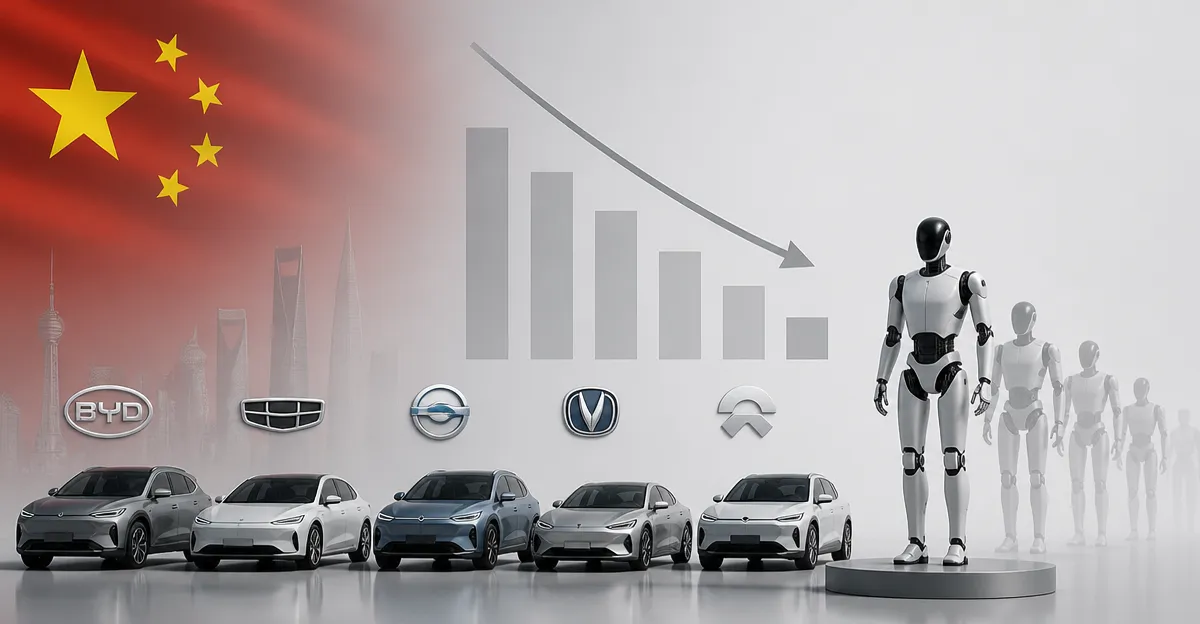
November 23, 2026, (Inside AI) — China's automakers are quietly scaling back their humanoid robot ambitions, a retreat that underscores the gap between robotic hype and real-world capability. Companies that once touted plans to deploy humanoids in factories and homes are now narrowing their focus to structured, repetitive tasks in controlled settings.
The shift comes as the industry confronts a hard truth: humanoid robots remain unreliable in unpredictable environments. Domestic life, with its clutter and chaos, is far beyond current capabilities. Even factory floors, while more standardized, pose significant challenges.
This pullback matters because China has been the most aggressive adopter of humanoid robotics. State-backed initiatives and private investment poured billions into the sector. Automakers like Xpeng and Nio showcased prototypes with grand visions. Now, those visions are being tempered by engineering reality.
The core problem is dexterity and adaptability. Humanoid robots struggle with simple tasks that humans take for granted, such as picking up irregular objects or navigating crowded spaces. The technology is far from ready for the unpredictable environments of domestic life, as industry insiders acknowledge.
Instead, carmakers are pivoting to more achievable goals. They are focusing on robots that can perform specific, repetitive tasks in enclosed environments. This includes assembly line work, material handling, and quality inspection. These tasks are standardized and controllable, making them ideal for early deployment.
This strategic retreat does not mean abandonment. It reflects a maturation of the sector. Companies are learning from past overpromising and are now setting realistic milestones. The shift mirrors the broader trajectory of AI and robotics, where initial hype gives way to incremental progress.
Why the Factory Floor Is the Proving Ground
The factory floor has become the testing ground for humanoid robots. Automakers already have the infrastructure and expertise to integrate robots into their operations. They understand the workflows and can measure ROI precisely.
"The technology is far from ready for the unpredictable environments of domestic life," said an industry executive who spoke on condition of anonymity.
Inside AI could not independently verify this claim, but it aligns with public statements from multiple companies. The consensus is that humanoids will first succeed in tasks that are dull, dirty, and dangerous, not in complex domestic chores.
This focus on factories also aligns with China's manufacturing priorities. The government has pushed for greater automation to maintain competitiveness amid rising labor costs. Humanoid robots, even limited ones, could help fill gaps in specific roles.
However, the scaling back of ambitions may dampen investor enthusiasm. The humanoid robot sector has attracted significant venture capital and public market interest. A reality check could lead to a correction in valuations.
Still, some experts argue that this is a necessary phase. Overpromising has plagued robotics for decades. The current recalibration may lead to more sustainable growth and fewer disappointments.
For now, China's automakers are taking a pragmatic approach. They are investing in research and development but with clearer eyes. The goal is to deliver functional robots that solve real problems, not to chase science fiction fantasies.
As the industry matures, the focus will shift from flashy demos to measurable results. The companies that succeed will be those that balance ambition with execution. The humanoid robot journey is far from over, but the path is now more grounded.

Tobias is less interested in what a robot or a prompt can do today than in what it means for tomorrow. He writes about prompt engineering and robotics for readers who want context, not just specs.