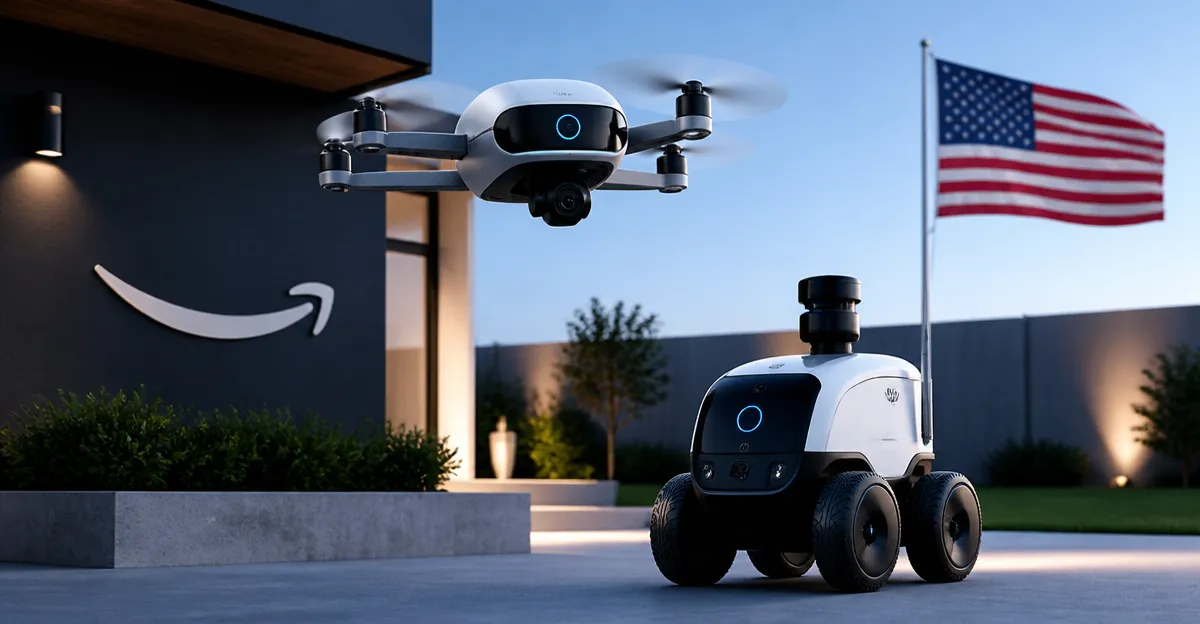
November 10, 2026, (Inside AI) — Amazon's Ring unit on Tuesday launched a new robotics division, unveiling two autonomous security products: a flying indoor camera for homes and a roving security robot for businesses. The move marks Ring's first major expansion beyond its core lineup of video doorbells and home security cameras, and signals Amazon's intent to compete in the emerging market for autonomous physical security systems.
The flying camera, which Ring calls the Always Home Cam, is a small drone that operates only indoors and flies to predetermined waypoints when triggered by a sensor or a user command. The business robot, still unnamed, is a wheeled ground vehicle equipped with cameras and sensors that patrols commercial spaces autonomously. Both products are designed to reduce reliance on fixed cameras and provide on-demand surveillance. Ring has not disclosed pricing or a release date for either device.
Why Ring Is Betting on Autonomous Security
Ring's expansion into robotics comes as the home security market grows increasingly crowded and commoditized. Traditional cameras and doorbells have become low-margin products, and competitors like Google's Nest and Arlo offer similar features. By moving into autonomous devices, Ring aims to differentiate itself and capture higher-value customers, particularly in the commercial sector where security budgets are larger.
The Always Home Cam, first announced as a concept in 2020, has been long delayed. Its launch now suggests Ring has solved technical challenges related to indoor navigation and battery life. The business robot enters a market that includes established players like Knightscope, which has deployed autonomous patrol robots in malls, parking lots, and corporate campuses. However, Ring's consumer brand recognition and Amazon's distribution network could give it an edge.
Read: Serve Robotics Launches Physical AI Services, Eyes AWS-Style Platform
"This is a natural evolution for Ring," said Jamie Siminoff, founder and chief inventor of Ring. "We started with the doorbell, and now we're expanding to autonomous devices that can move and see more. Our goal is to make security more proactive and less reactive."
The flying camera raises privacy concerns. Unlike fixed cameras, a drone can move through a home and potentially capture footage in private spaces. Ring says the device only flies to pre-set locations and has privacy features like a physical shutter. But privacy advocates remain skeptical. "A flying camera inside a home is a significant step beyond what consumers expect from a security device," said Evan Greer, director of the digital rights group Fight for the Future. "Ring has a history of privacy missteps, and this product demands strict safeguards."
Ring's new robotics business also faces regulatory hurdles. The Federal Aviation Administration (FAA) regulates indoor drones only minimally, but the business robot may fall under occupational safety rules if used in workplaces. Ring says it is working with regulators to ensure compliance.
Amazon acquired Ring in 2018 for about $1 billion, and the unit has since become a key part of its smart home strategy. Amazon has integrated Ring devices with its Alexa voice assistant and its Sidewalk low-power network. The robotics launch could deepen that integration, allowing Alexa to control the flying camera and the business robot.
The business robot will be sold through Ring's existing enterprise channels, which include partnerships with security firms and property managers. Ring has not announced any pilot customers but says it is in talks with several large commercial property owners.
Analysts see the move as part of a broader trend of tech companies investing in robotics. Amazon itself has deployed warehouse robots and is developing delivery drones. But consumer-facing security robots remain a niche market. "The market for autonomous security robots is still small, but growing," said Lian Jye Su, a robotics analyst at ABI Research. "Ring's entry could legitimize the category and attract more competitors."
Read: Global Industrial Robot Fleet Crosses 5 Million Units, IFR Says
Ring's announcement comes as Amazon faces increased scrutiny over its use of data and its impact on competition. The company is currently under investigation by the Federal Trade Commission for alleged antitrust violations. Ring's expansion into robotics could draw additional regulatory attention, especially if the devices collect sensitive data.
For now, Ring is positioning the products as tools for convenience and safety. The flying camera is aimed at homeowners who want to check on pets or elderly family members, while the business robot is marketed as a cost-effective alternative to human security guards. Ring says the robot can patrol a 10,000-square-foot area for up to 12 hours on a single charge.
The company plans to demonstrate both products at the Consumer Electronics Show in January 2027. Pricing and availability will be announced then.

Tobias is less interested in what a robot or a prompt can do today than in what it means for tomorrow. He writes about prompt engineering and robotics for readers who want context, not just specs.