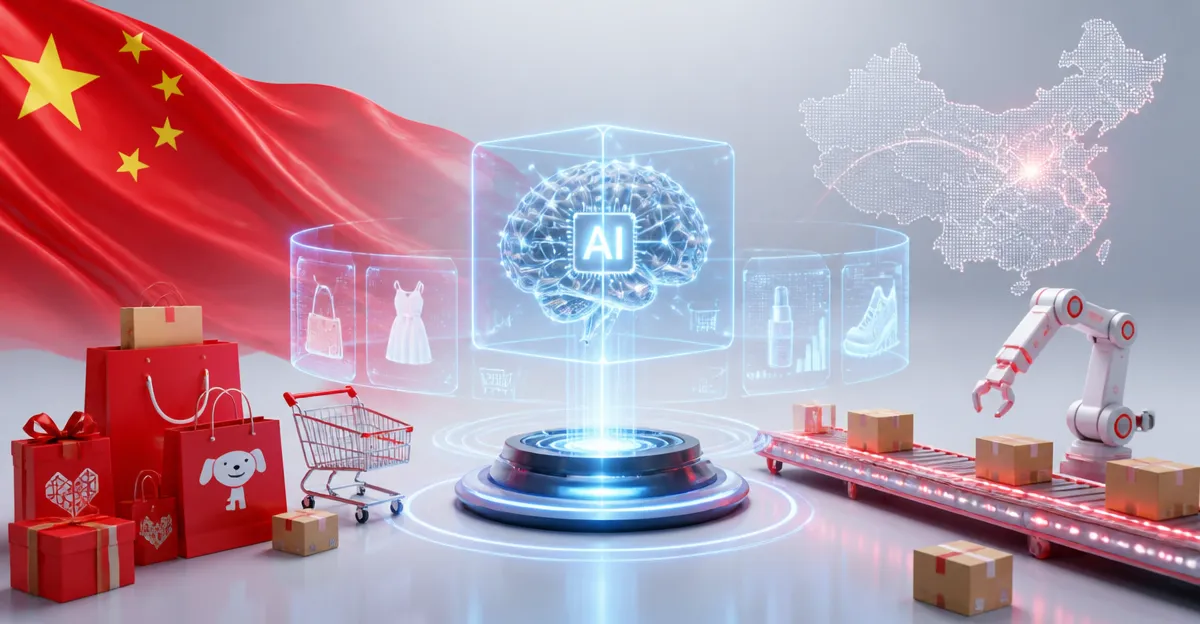
November 11, 2026, (Inside AI) — China's Singles Day shopping festival has become the world's largest real-time stress test for AI-driven commerce. As the month-long event concludes, early data shows that AI chatbots, virtual try-ons, and AI-powered product discovery are no longer experimental sideshows. They are now central to how millions of Chinese consumers shop.
The numbers tell a story of rapid adoption. Alibaba's AI shopping assistant, Dongdong, attracted nearly 80 million users seeking advice during this year's festival, more than triple last year's figure, according to JD.com. On Douyin, AI-driven purchases through chatbot links accounted for roughly 5% of total transactions in October, according to data from WPIC Marketing + Technologies. For considered purchases like supplements, that share exceeded 20%.
This shift matters because Singles Day, which began as a one-day discount event in 2009, has morphed into a month-long festival that serves as a bellwether for Chinese consumer sentiment. Total sales between October 7 and October 31 climbed 2.4%, according to third-party data platform Syntun, compared with a 1.1% rise in China's retail sales for the year through September. The festival's final tally, due Thursday, will reveal whether AI has genuinely boosted spending or merely redistributed it.
The stakes are high for Alibaba, JD.com, and PDD Holdings, which are locked in fierce competition for cautious consumers. AI offers a new way to keep them engaged. Alibaba's Tmall and Taobao platforms now deploy AI-driven research, virtual try-ons, and discount-finding tools. JD.com's Dongdong assistant helps users navigate product choices. On Douyin, chatbots recommend and complete purchases directly within the app.
Read: OpenAI Launches ChatGPT Business Profiles and AI Agents for US E-commerce
"This is still a very new gateway and discovery channel," Jacob Cooke, chief executive of WPIC Marketing + Technologies, said. "I expect it to account for a growing share of direct purchases, comparable to livestreaming or social commerce."
Yet the rise of AI shopping assistants raises a thorny question for brands. Those that adapt may thrive, but those that fail to appear in AI-generated recommendations could lose visibility entirely. "Some brands benefit more based on how the platforms are tuned or how the brands are pricing their products," Ben Cavender, managing director at Shanghai-based China Market Research Group, said. But brands can also be hurt "if they are no longer showing up in product searches because the consumer is defaulting to letting an AI assistant do the 'shopping'," he added.
That concern is not theoretical. As AI agents become more capable of conducting research, applying coupons, and completing transactions without the shopper ever opening a separate app, the balance of power shifts from brand marketing to platform algorithms. The dominance of super apps in China, where WeChat, Alipay, and Douyin serve as gateways to daily life, has accelerated this integration far beyond Western markets. In the U.S. and Europe, shopping is fragmented across websites and apps. In China, it happens inside a handful of ecosystems that now embed AI at every step.
The product categories benefiting from this shift are revealing. AI toys surpassed 100 million yuan ($15 million) in sales on Alibaba's platforms within one year of launching as a new category. Sales of AI companion robots rose nearly fivefold year-on-year in the second half of October. Tmall reported that sales of AI tokens, the units of computing that power AI models, rose more than 700% between October 15 and November 5, compared with the prior three-week period. Top livestreamer Austin Li featured AI products for the first time, selling 100,000 monthly subscriptions to Alibaba's QwenWork within 30 minutes.
For some shoppers, these tools have already become routine. Amanda Gao, a 40-year-old office worker in Beijing, said she uses Taobao's AI virtual try-on feature whenever she shops for clothes. "I find the function useful and fun," she said.
The broader significance extends beyond one shopping festival. China's approach to AI in commerce offers a preview of how the technology might reshape retail globally. The super-app model, combined with aggressive AI integration, has created a feedback loop: more data improves recommendations, which drives more purchases, which generates more data. Whether that loop benefits consumers or simply entrench platforms power remains an open question. For now, the 2.4% sales growth suggests AI has helped, but it has not yet reversed China's broader consumer caution.
Read: WhatsApp CEO Kunal Shah Plans Simpler App With AI and Payments
As the final Singles Day numbers arrive, the industry will be watching closely. If AI-driven purchases continue to climb, expect Western retailers to accelerate their own chatbot experiments. If growth stalls, the lesson may be that even the smartest assistant cannot overcome a hesitant wallet.

Shamil has a low tolerance for AI that only works in controlled demos. He covers agentic systems and generative AI with the skepticism of someone who has seen too many “revolutionary” tools quietly disappear six months after launch.