November 9, 2026, (Inside AI) — Two robot waitresses built by a Pakistani engineer are drawing crowds to The Sicilian restaurant in Karachi. The robots, named Robia and Jojo, were developed by Syed Osama Aziz, who also founded the restaurant. Since their introduction, customer numbers have increased, according to staff.
The robots were built through Aziz's robotics company, Cobot, using mostly locally manufactured parts. Aziz designed their circuit boards and programmed them in his own lab, with help from friends and some imported electronic components. His manufacturing workshop is in Multan.
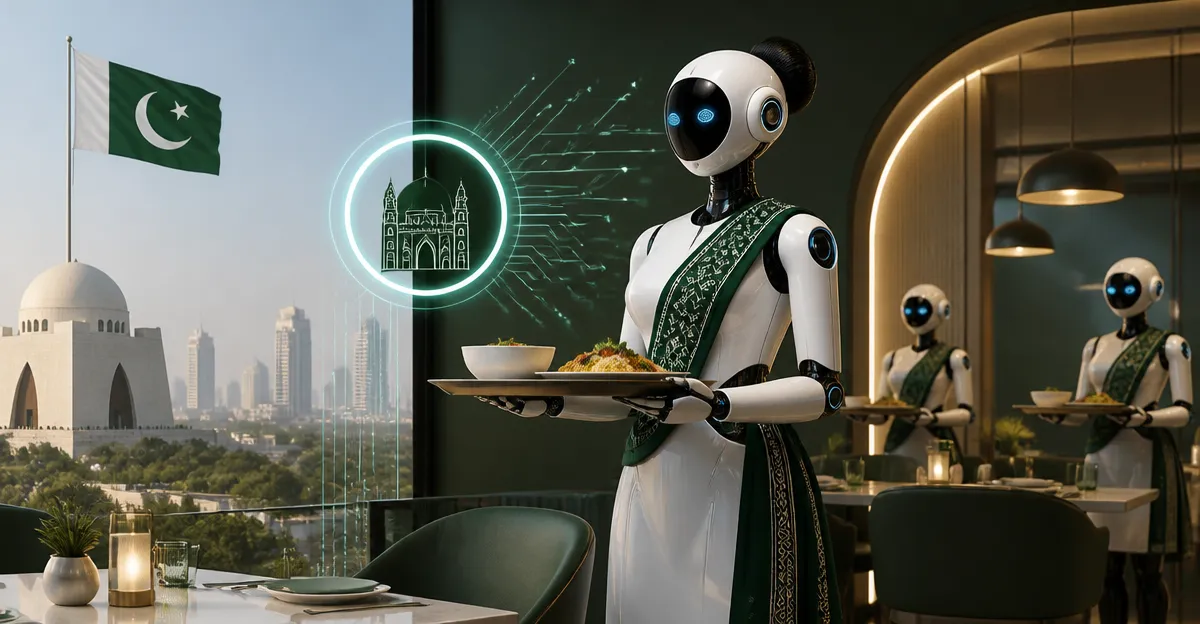
Robia greets diners with an electronic voice, introduces herself, and tells them what they can order. She then delivers food to tables on a serving tray. Customers must either take the food themselves or wait for a human staff member to assist. Both robots have spherical white heads with dark visors, similar to a motorcycle helmet, and wear black shawls styled after a dupatta.
Robotic staff are increasingly common in China and other East Asian countries, where they serve food in restaurant chains and perform tasks such as cleaning and greeting hotel guests. In Pakistan, they remain rare. The Sicilian's robots represent a homegrown attempt to join that trend.
Read: Global Industrial Robot Fleet
Aziz told AFP that sourcing components was a challenge. "The equipment, the things needed to make robots, are not so easily available here, so we had to arrange them," he said.
Families have been the main draw. Children reach out to touch the robots while parents take photographs and selfies. Customer Ahmer Zameer said the best feature is that the robot introduces itself. Another customer, Sonia Dilosker said she preferred the robots' approach to service because they are machines without emotions.
Restaurant staff member Hellen said business has grown, with some customers travelling from far across the city. "They have seen a robot for the first time here," she said.
Aziz plans to add camera-based and image-processing features. These would allow the robots to recognise returning customers, remember their previous orders, and offer better suggestions.
The deployment highlights a broader question: can locally built robotics succeed in markets where imported technology dominates? Pakistan's tech sector has struggled with limited access to advanced components and high import costs. Aziz's approach of designing circuit boards locally and sourcing parts from friends and imports suggests a scrappy, low-volume production model. Scaling such robots would require a more robust supply chain and quality control. For now, The Sicilian's robots serve as a proof of concept, drawing curious diners and testing whether novelty can translate into sustained business.
Local Innovation Meets Global Robot Trend
The robots at The Sicilian are a modest but notable entry in the global service robotics market. China has deployed thousands of robot waiters in restaurants, often with more advanced features like autonomous navigation and speech recognition. Pakistan's effort, by contrast, relies on basic voice playback and manual food delivery. Yet the local production angle matters. Aziz's company, Cobot, aims to show that developing countries can build robots tailored to local needs, even with limited resources. The robots' design, with dupatta-inspired shawls, reflects cultural adaptation. This could inspire other entrepreneurs in Pakistan and similar markets to experiment with low-cost robotics. However, the robots' current limitations, such as requiring customers to take food from trays, indicate that full automation remains distant. The planned camera and image-processing upgrades could bridge some gaps, but they also require more sophisticated hardware and software. Aziz's workshop in Multan, far from Karachi's tech hub, underscores the decentralized nature of innovation. Success will depend on whether Aziz can iterate quickly and find a market beyond novelty-seeking diners.
Read: China’s Humanoid Robot Startups
For now, The Sicilian's robot waitresses have achieved something rare in Pakistan: they have turned a restaurant into a local attraction. Whether that attraction endures after the novelty fades will test the robots' value. Aziz's plans for smarter features suggest he is aware of that challenge. The coming months will show if Robia and Jojo can evolve from curiosities into reliable staff.

Tobias is less interested in what a robot or a prompt can do today than in what it means for tomorrow. He writes about prompt engineering and robotics for readers who want context, not just specs.