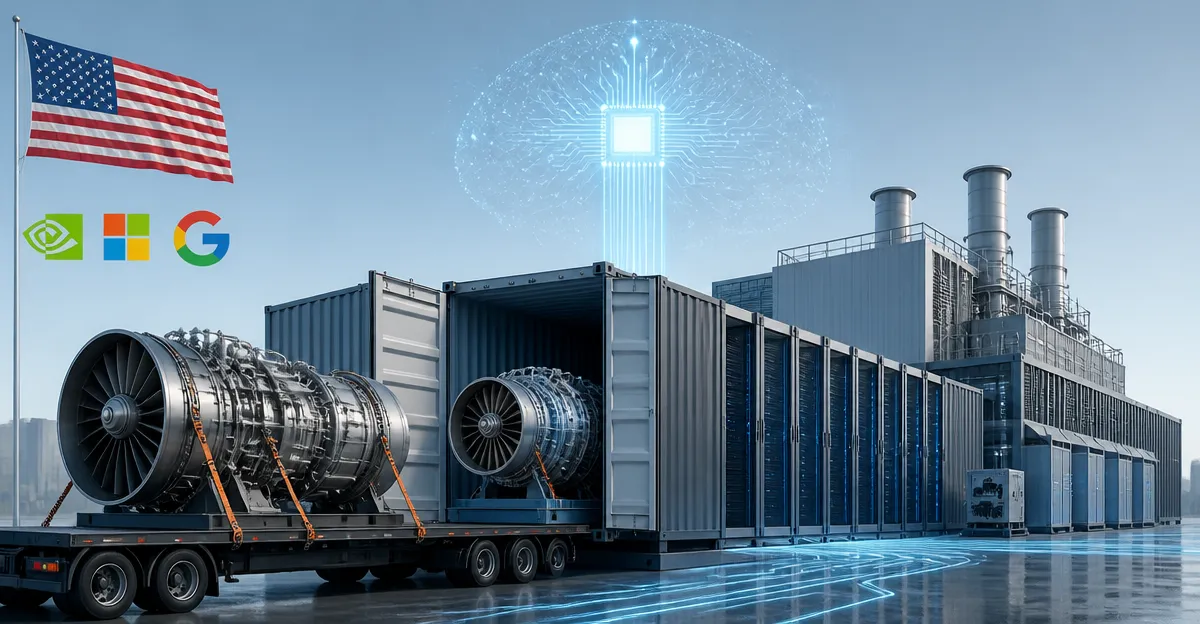
November 9, 2026, (Inside AI) — The global race to power artificial intelligence data centres has hit a hard physical wall. Utilities, developers, and infrastructure firms are now scouring the world for second-hand gas turbines, reviving mothballed machines, and converting retired jet engines into power generators. The reason: lead times for new, costly equipment now stretch into the next decade.
The bottleneck is not a lack of demand. Worldwide orders for gas turbines have topped 100 gigawatts (GW), according to energy consultancy Wood Mackenzie. Global production capacity sits at just 60 GW to 70 GW. That gap has turned the secondary market for used power equipment into one of the hottest corners of the energy industry.
"That secondary market is very, very hot right now," said Ana Amicarella, CEO of EthosEnergy, an equipment services provider. "We also have seen an escalation on the prices of what people are demanding."
The scramble reflects a deeper shift. Until a few years ago, gas turbines almost exclusively served traditional utilities. Today, data centre operators are among the largest buyers. Investment bank Jefferies estimates that US data centres alone account for nearly 17 GW of demand this year, a figure that could more than triple by 2028.
New turbine deliveries in the United States now take an average of six years, said Aurora Tenorio, senior analyst at Wood Mackenzie. "Delivery conversations (are) firmly focused on the 2030 to 2031 window," she said of the US market.
That timeline has pushed companies toward unconventional solutions. In April, AI infrastructure firm Crusoe ordered 13 aeroderivative gas turbines from US-based ProEnergy. These units, based on jet engines made by GE Aerospace, have a combined capacity of 650 megawatts (MW) and will be deployed at Crusoe's US data centre projects. Neither ProEnergy nor Crusoe responded to requests for additional information.
The used equipment market offers clear cost advantages. Well-maintained used units sell for about $1.5 million to $1.7 million per MW, and refurbished units for about $1.3 million, according to Zach Machuca, managing partner at Origin Partners. New turbines cost roughly $2 million to $2.5 million per MW, according to Aurora Energy Research.
For smaller units, the discount can be steeper. Dan Poole, general manager at ReflowX, said two 14.5-MW turbines made by Solar Turbines, a Caterpillar unit, recently sold for $12.5 million, or around $430,000 per MW. New ones would cost about $35 million and take five years to deliver, he said, without disclosing the buyer.
But the secondary market is not a cure-all. "The market is already constrained, with limited excess supply, so it is unlikely to offset a meaningful share of the delays," said Noor Qureshi, an associate at Enverus Intelligence Research. She noted that air permits, grid access, and other factors also cause delays.
Used equipment carries its own risks. Overhauled turbines can have unclear maintenance histories, limited remaining life, and weak long-term servicing, Tenorio said. Converted jet engines raise questions about their fitness for continuous duty as power generators.
Still, the waiting times ensure the market's appeal. "Every few weeks we get a request to say, 'Can you find a used gas turbine to put into a data centre?'" said Darayus Pardivala, who leads the US aftermarket business of Sulzer. He would not disclose client details or the centres' locations.
The supply squeeze is also reshaping the broader power equipment market. Siemens Energy, GE Vernova, and Mitsubishi Heavy Industries, which dominate turbine manufacturing, all say the AI boom has driven orders beyond their production capacity. Global manufacturing capacity is expected to rise to around 87 GW in 2028, according to Jefferies, but that will still fall well short of the 129 GW in expected turbine power demand.
Read: Nuclear Reactors Under Construction Hit 79, Highest in 40 Years, as AI Demand Surges
"What's driving the market? Lead times, lead times, lead times," said Anders Lindberg, president of the energy business at Finland's Wartsila. The company has booked around 3 GW of orders since spring last year from US data centres for power units running on gas engines instead of turbines.
The rush has not spared traditional utilities. The Tennessee Valley Authority, a federally owned US utility, said prices for all equipment, new, used, or refurbished, have "increased significantly" over the past two years.
Jim Matheson, CEO of the National Rural Electric Cooperative Association, which groups non-profit utilities owned by their customers, said its members face unprecedented lead times and surging prices. "Co-ops that need new capacity are turning to every viable option," including purchasing refurbished turbines, he said.
For data centre developers, the calculus is simple. Scott Schreeg, director of sales at US equipment supplier SVI Bremco, said developers sometimes deploy more than 100 small turbines at a single site, mixing models and brands to make up capacity.
The scramble for turbines is a visible symptom of a larger problem. AI's insatiable appetite for electricity is colliding with a power infrastructure system that was never built for this scale of demand. The secondary market offers a stopgap, but it cannot solve the underlying arithmetic. Until manufacturing capacity catches up, the race for gigawatts will keep pushing companies toward older, riskier, and more expensive equipment.

If a research paper dropped this week, Mahesh has already read it. He covers AI tools and vibe coding for builders who need to know what is worth their time and what is not.