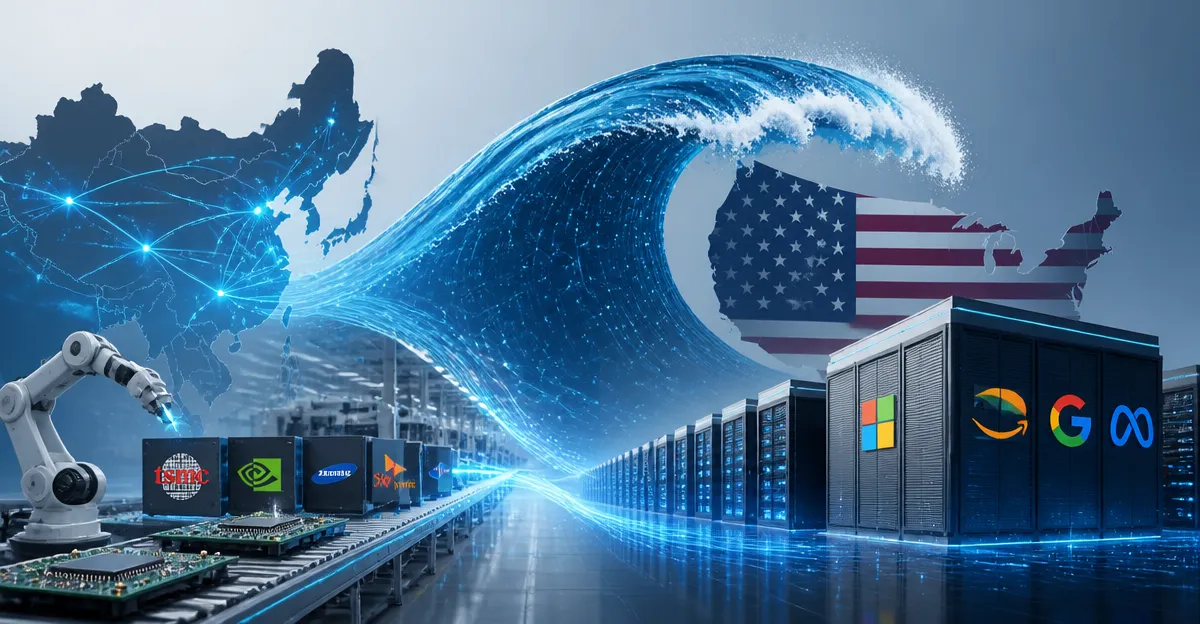
November 6, 2026, (Inside AI) — A strong showing by Democrats in this week's U.S. midterm elections is expected to slow, but not stop, the buildout of AI data centers across the United States, according to analysts tracking the sector. The assessment offers a measure of relief to Asian technology suppliers whose shares have been pressured by fears that a political shift in Washington could upend demand for chips, servers, and power equipment.
The core question for investors in Taipei, Seoul, and Tokyo is not whether AI infrastructure spending continues, but how fast. Analysts cited by regional media said a divided Congress and new state-level scrutiny will add permitting delays and compliance costs rather than kill projects outright. That distinction matters enormously for a supply chain that has come to depend on American hyperscaler orders.
A Blue Wave Meets A Red-Hot Buildout
Democrats made gains in Tuesday's midterms, according to results reported through Thursday. The shift is unlikely to reverse the federal incentives that have underpinned data center construction in recent years, analysts said. Instead, the practical effect is likely to appear in local approvals, grid connection queues, and environmental review timelines.
For Asian component makers, the exposure is direct. Companies that supply advanced chips, high-bandwidth memory, cooling systems, and power distribution hardware have seen order books tied closely to U.S. cloud expansion. Any slowdown in groundbreaking dates translates into delayed revenue recognition, even if the long-term pipeline remains intact.
Market sentiment had already turned cautious before the vote. Investor concerns about overbuilding and rising electricity costs have weighed on AI-linked stocks in recent months. The midterm outcome added a new variable rather than a new direction.
Why Permitting, Not Policy, Is The Real Battleground
The most immediate risk sits at the state and municipal level. Data center projects require land rezoning, water rights, and utility interconnection agreements. Local opposition has intensified in several U.S. regions over power consumption and water use. A political environment more receptive to that opposition could lengthen approval cycles.
Federal incentives for semiconductor manufacturing and clean energy remain largely intact, analysts noted. The CHIPS and Science Act funding pipeline and related tax credits have already been appropriated, making them difficult to unwind through a single election result. That structural support underpins confidence in the supply chain.
Asian suppliers have also diversified their customer base. Hyperscalers in the Middle East and Southeast Asia are expanding capacity, reducing reliance on any single market. Still, the United States remains the largest single destination for AI compute investment, and no other region matches its scale.
The analytical takeaway is that political risk in AI infrastructure is real but gradual. Elections change timelines and add friction. They rarely reverse capital commitments already made by companies racing to secure compute capacity. The more durable threat to Asian suppliers may come from efficiency gains in chip design, which could reduce hardware demand per unit of compute, rather than from any legislative shift in Washington.
Executives across the region are watching state-level races and utility commission decisions as closely as federal outcomes. Those local bodies control the practical levers of data center growth. For now, the consensus among analysts is that the blue wave reshapes the pace of expansion, not its direction.
Related developments bear watching in the coming weeks. Several large data center projects in Virginia and Texas face pending approval votes. Utility regulators in those states have signaled tighter review of power contracts. How those decisions land will offer the first concrete signal of whether the political shift translates into measurable delays for Asian suppliers.

If a research paper dropped this week, Mahesh has already read it. He covers AI tools and vibe coding for builders who need to know what is worth their time and what is not.