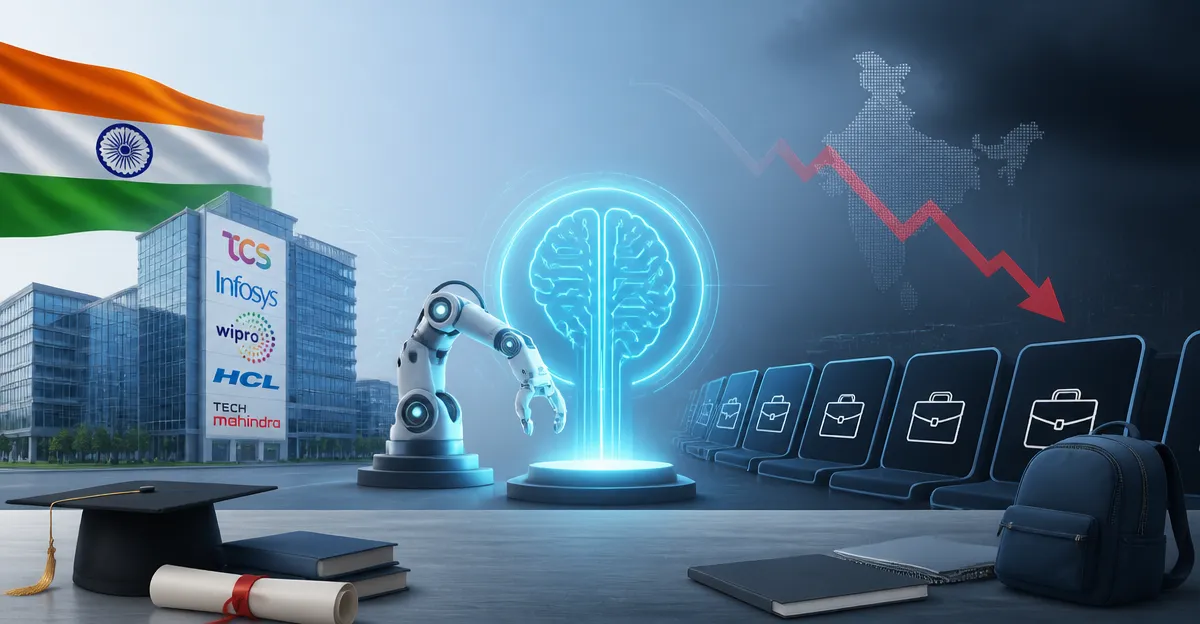
November 6, 2026, (Inside AI) — India's technology industry may be creating a generation of graduates its entry-level jobs are quietly disappearing from. Rajesh Nambiar, the top executive at the country's largest technology industry body, has warned that fresh graduates could struggle to land coding and software testing roles as companies automate that work with artificial intelligence.
Nambiar, who leads the National Association of Software and Service Companies (Nasscom), made the assessment in an interview with a regional news outlet. His warning lands on an economy that depends heavily on IT services exports and on the hundreds of thousands of engineers its colleges produce each year.
The concern is not that AI will erase software work outright. It is that automation is targeting the bottom rung of the career ladder, where Indian graduates have historically entered the workforce. Coding and testing tasks are among the most repetitive and rule-bound in software delivery, which makes them the easiest to hand to generative tools.
Entry-Level Jobs Are the First Casualty
India's IT services model was built on scale. Large firms won contracts by deploying thousands of junior engineers on client projects, then billed for the hours. That pyramid structure depended on a steady intake of graduates who could be trained on the job.
Read: Why AI-Curious Junior Employees Are Your Best Adoption Asset
If AI absorbs the routine coding and testing that juniors once handled, the pyramid loses its base. Companies can deliver the same work with fewer entry-level staff, and the traditional apprenticeship path narrows.
Nasscom has spent years positioning India as an AI talent hub rather than a low-cost outsourcing destination. Nambiar's warning suggests that transition carries a cost the industry has not fully priced in.
The broader labor picture is already strained. India produces well over a million engineering graduates annually, and a large share of them have historically sought work in IT services. A shrinking pool of entry-level roles would intensify competition for the positions that remain.
Industry observers note that automation rarely removes a job category overnight. It tends to compress it first, raising the bar for entry while leaving senior roles intact. That pattern is consistent with what Nambiar describes.
The practical implication is that graduates will need skills AI cannot easily replicate, such as system design, client judgment and domain expertise. Those are precisely the skills that entry-level roles once helped build.
There is a structural tension here that the industry has been slow to confront. The same firms warning about graduate unemployment are also under pressure to cut costs and improve margins through automation. Reskilling programs exist, but they are often aimed at mid-career staff whose roles are being displaced, not at students still in college.
Nasscom has not published a specific forecast for entry-level hiring, and the warning remains a qualitative assessment rather than a quantified projection. Inside AI could not independently verify the scale of the expected impact.
Read: IIM Ahmedabad Summer Placements 2028: AI, Fashion, and Finance Lead the Way
The stakes extend beyond individual careers. IT services remain a major source of foreign exchange and formal employment in India. A structural break in entry-level hiring would ripple through urban consumption, education demand and the country's broader growth outlook.
For now, the message from the industry's own leadership is a caution rather than a verdict. The automation of junior work is underway. Whether India's graduates adapt fast enough is the question that will define the next hiring cycle.

Shamil has a low tolerance for AI that only works in controlled demos. He covers agentic systems and generative AI with the skepticism of someone who has seen too many “revolutionary” tools quietly disappear six months after launch.