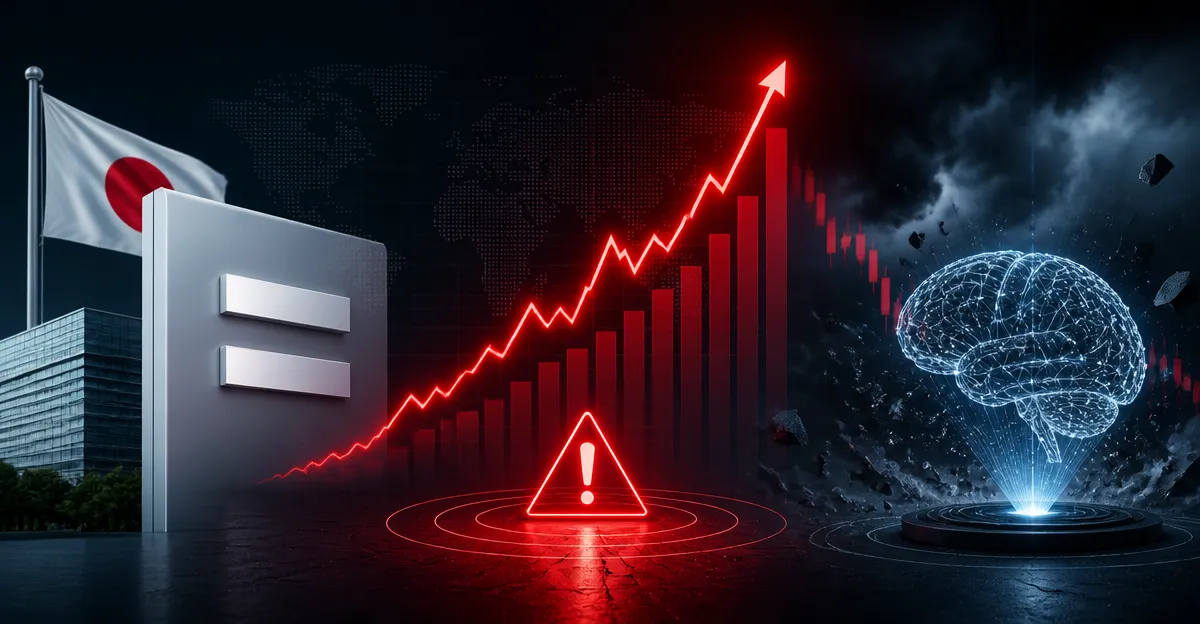
November 6, 2026, (Inside AI) — The cost of protecting against a SoftBank Group default surged to a four-year high on Friday, as mounting doubts about artificial intelligence profitability rattled global credit markets. The Japanese technology conglomerate's five-year credit default swap spread widened by 22 basis points to 466 basis points, according to Markit data, the highest level since October 2022.
The move underscores how quickly investors have turned on the companies financing the AI boom. SoftBank, led by billionaire Masayoshi Son, has bet tens of billions on the premise that artificial intelligence will reshape the global economy. Now, creditors are demanding a steeper premium to hold its debt.
The immediate trigger appears to be a combination of political and corporate news. This week's midterm elections handed sweeping victories to the Democratic Party in the United States. Investors fear that the new political landscape could slow the breakneck pace of AI infrastructure development, particularly data centers.
"The midterm election results have put one-third of US data centre capacity at risk as the planned data centres sit in states where governors may slow development," Rolf Bulk, head of semiconductors and infrastructure at the Futurum Group, wrote in a research report on Thursday.
The credit market reaction was swift. SoftBank has become a bellwether for AI investment sentiment due to its $64.6 billion stake in OpenAI and its 90% ownership of chip designer Arm. When confidence in AI returns falters, SoftBank's credit spreads often widen first.
Debt-Fueled AI Ambitions Face Investor Scrutiny
Investors have grown increasingly wary of SoftBank's balance sheet this year. The company has taken on record levels of debt at high yields to fund its OpenAI stake. At the same time, the timeline for a return on that investment has slipped. OpenAI has delayed its planned public offering to 2027, pushing back the liquidity event that many SoftBank backers had anticipated.
The widening of credit default swaps is not isolated to SoftBank. Other firms that have borrowed heavily to lead the AI buildout have also seen their credit risk rise. The pattern suggests a broader reassessment of the risks embedded in the AI supply chain.
For years, investors treated AI as a near-certain growth engine. Now, they are pricing in the possibility of delays, cost overruns, and political headwinds. The midterm results add a new layer of uncertainty. Data centers require massive capital and long lead times. If state governors slow permitting or incentivize other industries, the returns on those investments could shrink.
SoftBank's credit default swap spread is now wider than at any point since October 2022, a period when global markets were still recovering from the pandemic and tech valuations had slumped. The comparison is telling. Back then, AI had not yet become the dominant investment theme. Today, it is the central pillar of SoftBank's strategy, making the current spread widening a direct verdict on that strategy.
Read: Wall Street Fear Gauge Jumps Most Since 'Liberation Day' as AI Trade Stumbles
The company's shares have also come under pressure, though the credit market often moves first. Bond investors tend to be more conservative than equity holders, and their actions can signal deeper concerns about a company's ability to service its obligations.
Analysts note that SoftBank's debt load has grown as it pursued its AI vision. The company has issued bonds at yields that reflect its status as a prolific borrower with a complex holding structure. The cost of insuring that debt has now risen sharply, which could make future borrowing more expensive.
The political dimension is particularly thorny. The Democratic Party's wins in the midterms have raised questions about the pace of AI infrastructure development. Some governors may choose to slow data center construction, citing energy consumption, water use, or local opposition. With one-third of US data center capacity potentially affected, according to Futurum Group's analysis, the implications for AI compute availability are significant.
SoftBank's exposure to this risk is indirect but substantial. Its stake in OpenAI ties it to the company's ability to train and deploy models, which depends on compute. Its ownership of Arm ties it to the chip design ecosystem that powers data centers. A slowdown in infrastructure buildout would ripple through both.
The credit market's reaction also reflects a broader shift in sentiment. For much of the past two years, investors have rewarded companies that announced AI investments. Now, they are beginning to differentiate between those that can fund those investments internally and those that rely on debt. SoftBank falls into the latter category.
The company's leadership has not commented publicly on the credit default swap move. However, the market's message is clear. The era of cheap money for AI ambitions may be ending. Investors want to see a path to profitability, not just a vision of future growth.
As the year draws to a close, SoftBank faces a critical test. It must convince creditors that its AI bets will pay off, even as political and economic headwinds gather. The credit default swap spread is one measure of that challenge. It is now at a four-year high, and the trend is not yet reversing.

Shamil has a low tolerance for AI that only works in controlled demos. He covers agentic systems and generative AI with the skepticism of someone who has seen too many “revolutionary” tools quietly disappear six months after launch.