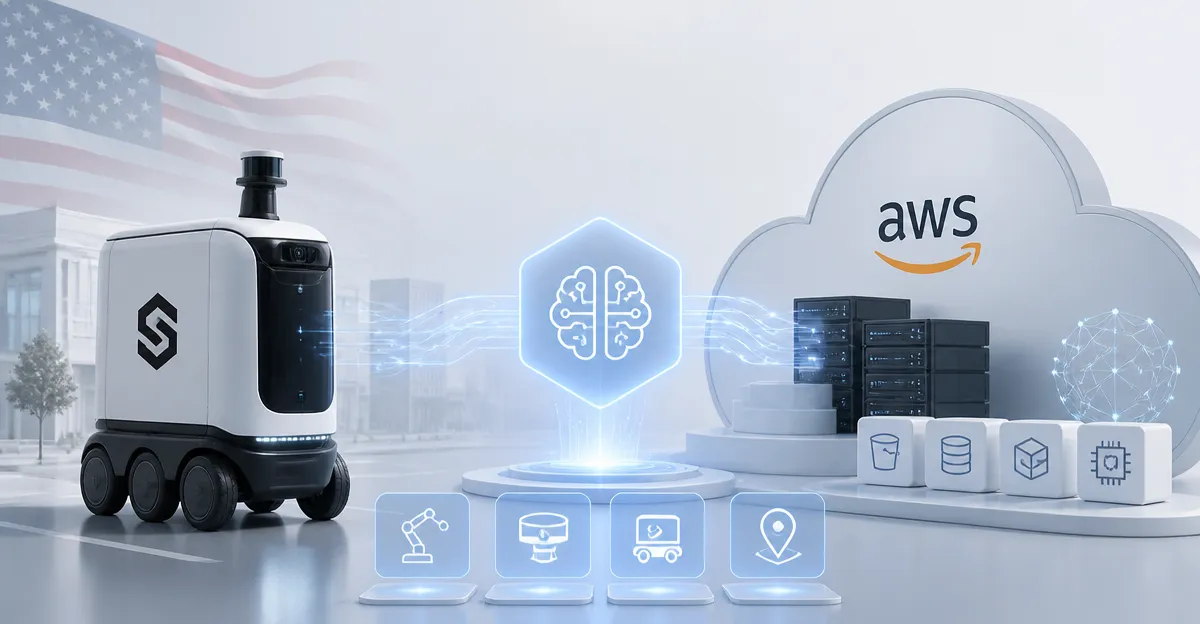
November 6, 2026, (Inside AI) — Serve Robotics, the publicly traded sidewalk delivery robot company, announced on Thursday a new business line called Physical AI Services. The offering will sell connectivity and data tools, originally built for its own fleet, to other robotics companies. CEO Ai Kashani compared the move to Amazon's creation of AWS.
"We are taking the technology we built for us, and opening it up for more people to build on," Kashani told TechCrunch.
The announcement comes as robotics companies face growing pressure to commercialize beyond niche deployments. Serve, which spun out of Uber's Postmates acquisition in 2021 and went public in 2024, currently operates two robot types: its signature googly-eyed delivery bot and a hospital assistant robot acquired through Diligent Robotics earlier this year. Delivery partnerships now extend beyond Uber to include DoorDash and Wonder.
The AWS comparison is deliberate. Amazon built AWS initially to run its own retail operations, then turned it into a standalone cloud business that now generates more profit than retail itself. Kashani believes robotics has reached a similar inflection point: when technology is new, companies build everything themselves; once it matures, they open the platform.
Read: GenRobot AI Raises $100 Million for Robot Training Data
Three Products Target Robotics Data Bottlenecks
Physical AI Services launches with three products. Serve Link connects robots in the field to AI systems in data centers, handling unreliable cellular networks to maintain high-performance connections. Many robots lack onboard computing power for large AI models. Serve also announced a partnership with T-Mobile to bring AI computing closer to robots through edge infrastructure.
The second product curates real-world data. Every autonomous machine generates enormous sensor data, but finding edge cases that improve AI models is like searching for needles in a haystack. Serve's data curator automates that search and feeds relevant examples into training pipelines.
The third offering is a foundation-model data catalog drawn from Serve's delivery fleet experience navigating sidewalks, pedestrians, and complex human environments. Other robotics companies can license this catalog to teach their AI models how real-world spaces work without collecting data themselves.
Serve already has its first customer. Bedrock Robotics, a startup developing self-driving construction equipment, uses the platform. Serve's core delivery business continues expanding.
Can Serve's Fleet Scale Justify Platform Ambitions?
The bigger question is whether the AWS analogy holds. Amazon had massive internal demand that validated its infrastructure before external customers arrived. Serve's fleet, while growing, operates at a far smaller scale. Turning internal tools into a commercially viable platform requires external demand that does not yet exist at volume. Kashani is betting it will.
Industry analysts note that robotics data platforms face a chicken-and-egg problem: without a large customer base, data catalogs remain limited; without rich data, customers see little value. Serve's early partnership with Bedrock Robotics suggests initial traction, but scaling will require convincing many robotics firms to abandon proprietary data strategies.
Read: LivSyn Robotics raises Series A funding for platform connecting robots with AI models
The T-Mobile partnership could provide an edge. Edge computing reduces latency for robot decision-making, a critical factor for autonomous operations in unpredictable environments. However, competitors like Nvidia already offer robotics simulation and training platforms, and cloud providers are expanding into physical AI services.
Serve's move reflects a broader trend: robotics companies seeking recurring revenue beyond hardware sales. Whether Physical AI Services becomes another AWS or remains a niche offering depends on execution and market timing. For now, Kashani is placing a calculated bet that the robotics industry will follow the cloud's playbook.

Tobias is less interested in what a robot or a prompt can do today than in what it means for tomorrow. He writes about prompt engineering and robotics for readers who want context, not just specs.