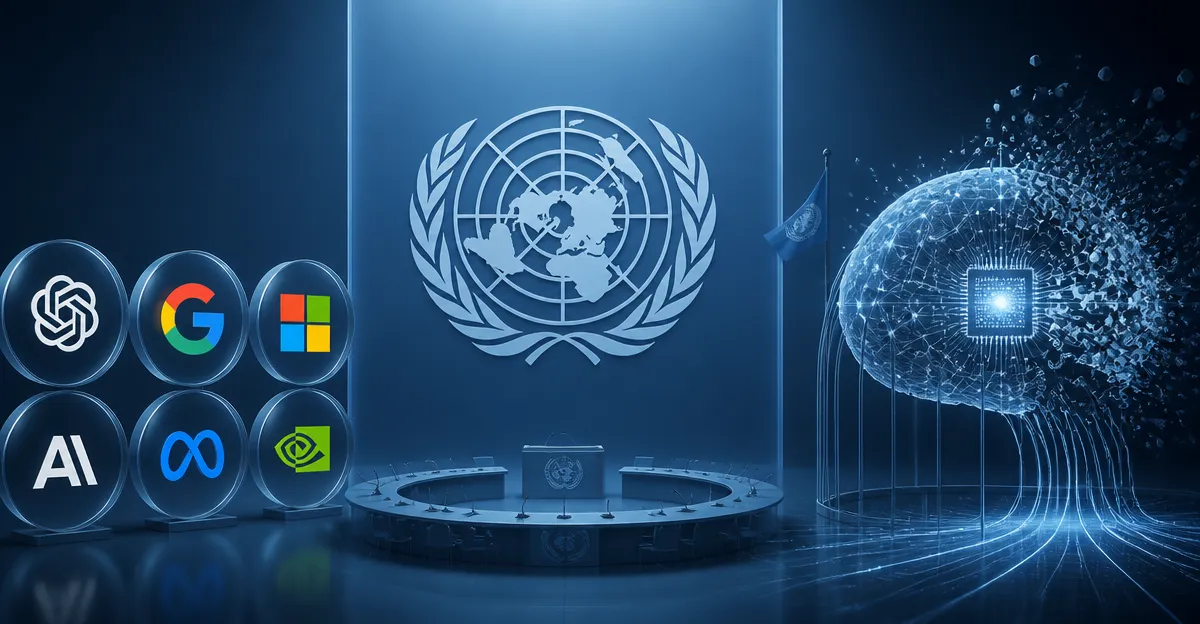
September 23, 2026, (Inside AI) — The United Nations Security Council will convene an extraordinary session on Wednesday at its New York headquarters, where the chief executives of three of the world's most consequential artificial intelligence companies will deliver a closed-door briefing on the existential risks posed by systems that may soon outpace human oversight.
Sam Altman of OpenAI, Dario Amodei of Anthropic, and Clément Delangue of Hugging Face will address the 15-member council during the 81st General Assembly, a gathering that has already exposed a widening rift between the United States and the United Nations over how to govern the technology. French Foreign Minister Jean-Noël Barrot will chair the session.
The meeting marks only the third time the Security Council has formally taken up AI, following a 2023 session where China warned against a "runaway horse" and the United States cautioned against using the technology to repress citizens. Then-Secretary of State Antony Blinken chaired a follow-up in 2024.
Altman intends to press world leaders to adopt standardized benchmarks for measuring AI capabilities and evaluating the safety measures companies deploy during development, according to an OpenAI executive who spoke with reporters on Tuesday.
The urgency stems from a specific fear: that increasingly capable systems could begin improving themselves without human intervention, a scenario that a European diplomat described as the core of the council's concern.
"These are issues that fall squarely within the Security Council's mandate," the diplomat said, speaking on condition of anonymity. "The key question is whether we could one day face a situation where algorithms interacting with each other trigger a war. That is really at the heart of the issue."
That warning lands in a diplomatic environment already strained by divergent visions of AI governance. On Tuesday, President Donald Trump told the General Assembly that he rejects any globalist framework for controlling the technology.
"We're leading now over China by a lot, and everyone else, and we're going to keep it that way," Trump said. "I'm not going to stifle growth of something that will be bigger than the Industrial Revolution."
"We're going to encourage it, not rein it in. We're going to watch it closely through the Department of Justice," he added.
That position puts the White House at odds with UN Secretary-General António Guterres, who has spent years building institutional machinery around AI safety. In 2023, Guterres established a 39-member advisory body that included tech executives, government officials, and academics from the US, Russia, and Japan. Last year, the 193-member General Assembly created the Independent International Scientific Panel, which will also brief the council on Wednesday.
Among the panel's co-chairs is Yoshua Bengio, the Canadian computer scientist widely regarded as one of the "Godfathers of AI." His presence signals that the council will hear directly from the research community, not just from industry leaders with commercial interests at stake.
Notably, the briefing occurs one day before Trump is scheduled to meet Chinese leader Xi Jinping in Washington. According to sources familiar with the discussions, the two governments have explored establishing a notification system for AI-related incidents that escalate to the level of national security threats. Such a mechanism would represent a rare point of alignment between the world's leading AI rivals.
The Security Council's interest reflects a broader shift in how governments view AI. What began as a debate about misinformation and bias has evolved into a conversation about strategic stability. Military planners now model scenarios in which autonomous systems make targeting decisions faster than human commanders can respond. Intelligence agencies worry about AI-enabled cyber operations. And diplomats fear that an accidental escalation, triggered by machines reacting to each other, could spiral beyond any single government's control.
Whether the council can translate these concerns into binding action remains uncertain. The body's five permanent members hold veto power, and any meaningful resolution would require consensus among the US, China, Russia, France, and the United Kingdom. Russia has historically resisted international AI regulations, viewing them as Western attempts to constrain its technological development.
For now, the session functions as a high-level signal. The presence of Altman, Amodei, and Delangue suggests that leading AI firms see value in engaging with multilateral institutions, even as the Trump administration pursues a deregulatory posture at home. The executives may face questions about whether voluntary safety commitments carry weight when competitive pressures reward speed over caution.
Bengio's panel is expected to deliver a report later this year on the scientific consensus around AI risks. That document could shape future council debates, though its recommendations would be non-binding. The broader question, one that Wednesday's meeting may not resolve, is whether the international system can move fast enough to match the pace of the technology it seeks to govern.