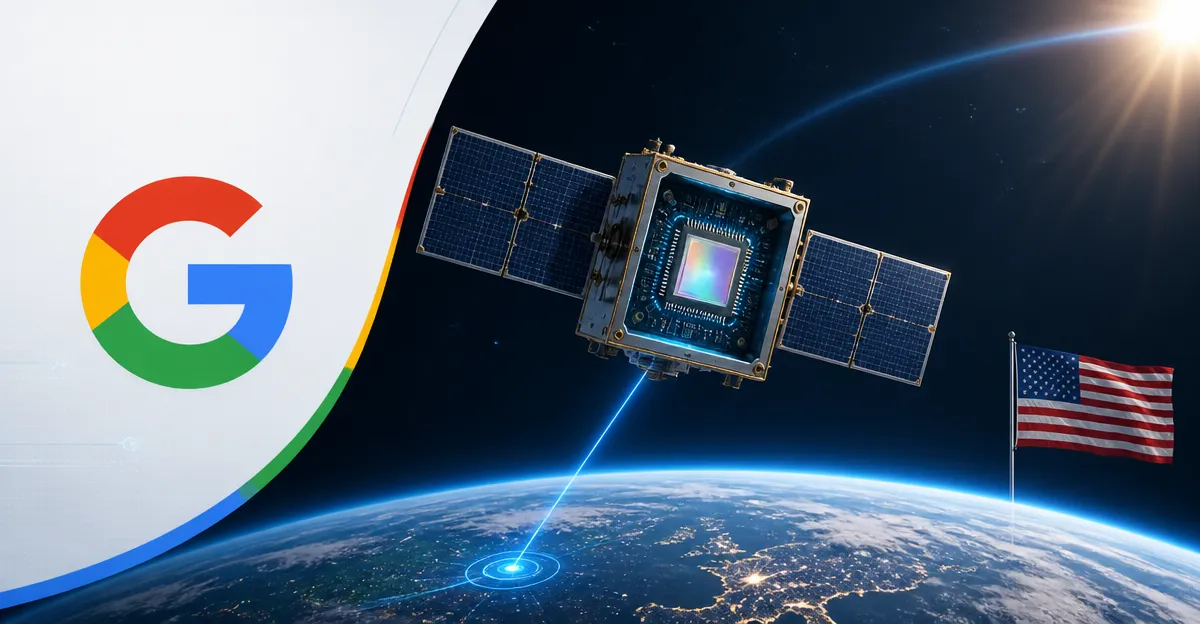
September 24, 2026, (Inside AI) — Google will launch a prototype satellite next week carrying its Tensor Processing Units into low Earth orbit, marking the company's first in-orbit test of Project Suncatcher, a research initiative to determine whether space can host large-scale AI computing infrastructure. The mission, scheduled to fly on SpaceX's Transporter-18 rideshare launch in partnership with Planet Labs, will assess how Google's AI hardware withstands launch forces, radiation, and extreme temperatures in LEO.
This test represents a critical step in Google's broader ambition to build orbital data centers powered by near-continuous sunlight, potentially sidestepping terrestrial constraints on electricity supplies that increasingly limit AI expansion. The company joins SpaceX and Starcloud in pursuing similar goals, though experts caution the concept remains years from commercial viability.
Radiation Threatens AI Chips In Orbit
Space radiation poses a significant threat to electronics, causing data errors known as bit flips that can corrupt computations. Google tested its TPUs running AI workloads at a facility at the University of California, Davis, but orbital testing was needed to understand real-world performance. The company will also evaluate its cooling design for power-intensive chips in the vacuum of space, where conventional airflow cooling is impossible, by combining heat pipes with radiators.
The first Suncatcher mission is designed to gather in-orbit data and identify potential failure points, rather than demonstrate an operational orbital data center, Google said. It aims to launch two satellites in 2027 to test the high-bandwidth laser links needed to connect future computing clusters.
Google's push into space mirrors a broader industry trend. SpaceX and Starcloud have announced plans to deploy data centers in low Earth orbit, aiming to harness near-continuous sunlight to power energy-intensive AI computing. The concept addresses a growing problem: terrestrial data centers consume massive amounts of electricity, and grid capacity is increasingly strained in many regions.
However, experts have said the concept remains years from being commercially viable given high launch costs, engineering constraints, and satellite production bottlenecks. Launch costs, while declining, still represent a major barrier. SpaceX's reusable rockets have reduced expenses, but sending heavy computing hardware to orbit remains expensive. Satellite production bottlenecks further complicate scaling.
Google's partnership with Planet Labs, a company specializing in Earth observation satellites, provides expertise in small satellite design and deployment. Planet Labs operates a large fleet of imaging satellites, giving it experience in managing orbital operations and data downlinks.
The Transporter-18 rideshare launch, scheduled for next week, will carry multiple payloads, reducing costs for Google. Rideshare missions have become a popular way for companies to test hardware in space without paying for a dedicated launch.
Google's TPUs are custom-designed chips optimized for machine learning workloads. They power many of Google's AI services, including search, translation, and image recognition. Testing them in space could reveal whether they can operate reliably in harsh conditions, potentially opening doors for orbital AI computing.
Radiation-induced bit flips can cause silent data corruption, a serious concern for AI models that require precise calculations. Google's test will monitor for such errors and assess whether shielding or error-correction techniques are needed.
Cooling is another challenge. In space, heat cannot dissipate through air convection. Google's design uses heat pipes to transfer heat from chips to radiators, which then emit infrared radiation into space. This approach must handle the high power densities of AI chips.
The 2027 mission will test laser links, which are essential for connecting multiple satellites into a computing cluster. High-bandwidth laser communication allows data transfer between satellites at speeds comparable to fiber optics, enabling distributed computing in orbit.
If successful, orbital data centers could offer advantages beyond energy. Space provides a stable thermal environment and avoids land-use conflicts. However, the concept faces competition from terrestrial solutions, such as improved energy efficiency and renewable power.
Google's Project Suncatcher remains in early research stages. The company has not announced timelines for commercial deployment. The upcoming launch will provide valuable data on hardware performance, guiding future development.
Industry analysts note that while the idea of space-based AI computing is compelling, economic viability depends on reducing launch costs and increasing satellite production. SpaceX's Starship, still in testing, promises lower costs per kilogram to orbit, which could make orbital data centers more feasible.
For now, Google's test is a small but significant step. It signals that major tech companies are seriously exploring space as a platform for AI infrastructure. The results will inform whether this vision becomes reality or remains a costly experiment.