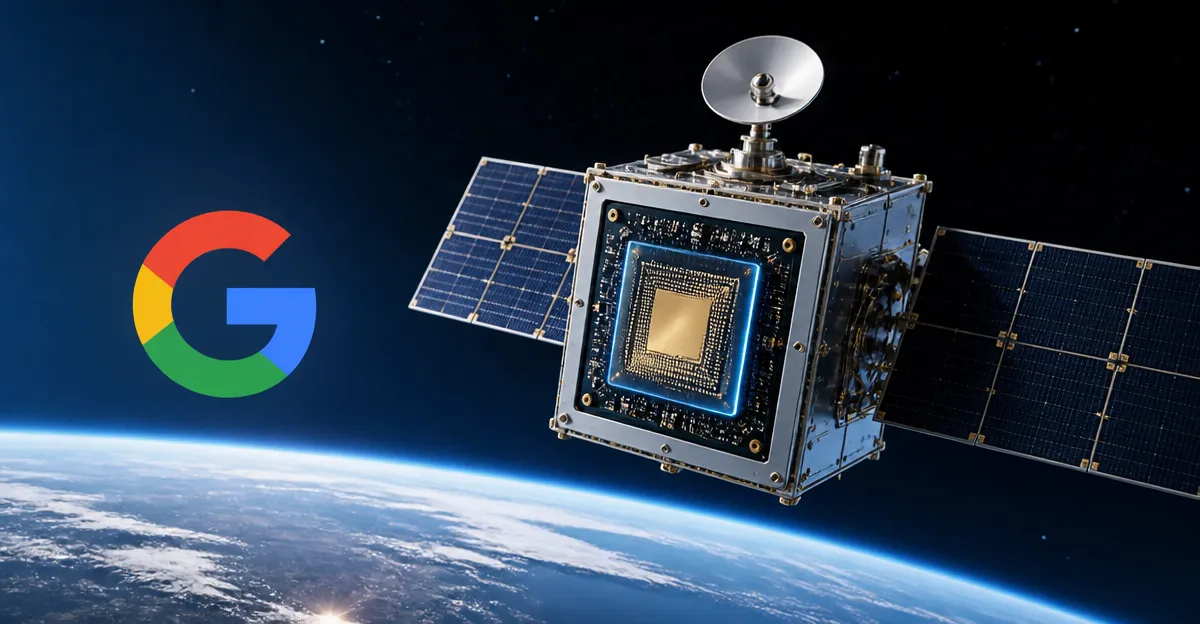
September 25, 2026, (Inside AI) — Google is preparing to launch its first prototype satellites to test Tensor Processing Units in orbit, a move that could reshape how the artificial intelligence industry powers its most energy-hungry workloads. The project, called Project Suncatcher, aims to demonstrate whether solar-powered satellite constellations equipped with Google's custom AI chips can operate sustainably in space, where solar panels capture up to eight times more energy annually than ground-based systems.
The first test satellites are scheduled to launch within days aboard SpaceX's Transporter-18 rideshare mission, with Planet Labs handling deployment. Google expects full prototype testing to begin in early 2027. The initiative represents a decade-long research effort, not a near-term commercial service, according to company statements.
The timing reflects mounting pressure on terrestrial infrastructure. AI model training and inference consume exponentially growing electricity, hyperscalers compete for limited land suitable for data centers, and water availability increasingly constrains cooling options. Space offers freedom from those constraints, if engineering barriers can be overcome.
Radiation Tests Show Promise, But Cooling Remains Unsolved
Google's approach centers on its Trillium v6e Cloud TPU, a custom machine learning accelerator. Researchers tested the chip in a 67 megaelectronvolt proton beam at UC Davis's Crocker Nuclear Laboratory while running AI workloads. Results showed the TPU can withstand radiation equivalent to five years of orbital operation without permanent damage.
Read: AI Data Center Backlash Reaches San Jose, Silicon Valley's Biggest City
Google wrote:
"Once the TPU chips make it to space, the level of radiation outside the Earth's atmosphere presents another challenge to overcome. Solar events and cosmic rays can wreak havoc on electronics, so our team tested TPUs in a proton beam facility at UC Davis's Crocker Nuclear Laboratory while running AI workloads. During the test, we monitored closely to see how errors, like a bitflip, would affect our workloads. Initial results have shown that our Trillium TPUs hold up remarkably well, and can survive a radiation total ionizing dose greater than what they would receive during a five-year space mission." (Google, official statement)
Thermal management presents immediate challenges. Traditional air cooling becomes impossible above the atmosphere. Google is testing heat pipe and radiator combinations to dissipate computation-generated heat into space. The company wrote:
"We're working on a number of different approaches for this, including a combination of heat pipes and radiators to cool the chips. So far, our team has tested the technology in a thermal vacuum chamber that simulates both the thermal and vacuum environment in space. We'll see how our new TPU cooling system works in space and refine our designs as we learn more." (Google, official statement)
Early bench tests confirmed 1.6 terabits-per-second bidirectional transmission using single optical transceiver pairs, validating laser-based communication between satellites. Orbital dynamics simulations using Hill-Clohessy-Wiltshire equations and JAX-based differentiable modeling suggest an 81-satellite cluster at approximately 650 kilometers altitude would require only modest station-keeping to maintain 100-200 meter spacing. Satellites at this altitude orbit Earth in roughly 90 minutes, balancing communication latency against atmospheric drag.
Google wrote:
"Exploring space as a viable location for scalable AI compute won't happen all at once. It takes methodical engineering, starting with proving our hardware can handle the physical and unpredictable realities of operating in orbit. This first launch is about seeing what works, identifying points of failure, and applying those findings to future missions." (Google, official statement)
Competitors Race Toward Orbital And Underwater Compute
Google is not alone in exploring alternative compute locations. SpaceX and Starcloud have announced parallel initiatives. China recently opened the world's first underwater data center in Hainan Province, reflecting broader urgency around finding new sites for AI infrastructure.
Google's timeline projects cost parity between orbital and Earth-based data centers by the mid-2030s. That projection depends on solving launch economics, currently the dominant constraint. Rideshare programs like SpaceX's Transporter flights reduce marginal costs, but building satellite constellations at scale remains capital-intensive.
Earlier validation at UC Berkeley confirmed TPU functionality and thermal behavior in controlled environments. Orbital testing now becomes essential because Earth-based labs cannot replicate space radiation, vacuum conditions, or true launch dynamics. Failed silicon in orbit costs far more than failed chips on ground, amplifying the stakes for every component qualification.
Realizing orbital AI infrastructure requires solutions to power distribution architecture, inter-satellite networking at latency-critical performance levels, and operational resilience across thousands of hours of unattended orbital operation. The sun emits more power than 100 trillion times humanity's current electricity production, and space offers near-perpetual sunlight for satellites positioned in dawn-dusk orbit, eliminating battery dependency.
Google's researchers emphasized this remains exploratory. The company framed Project Suncatcher as a decade-long research effort. Yet the underlying logic is practical. If engineering challenges can be overcome, space could host the next generation of AI compute infrastructure, free from the land, water, and power constraints that increasingly limit terrestrial data centers.