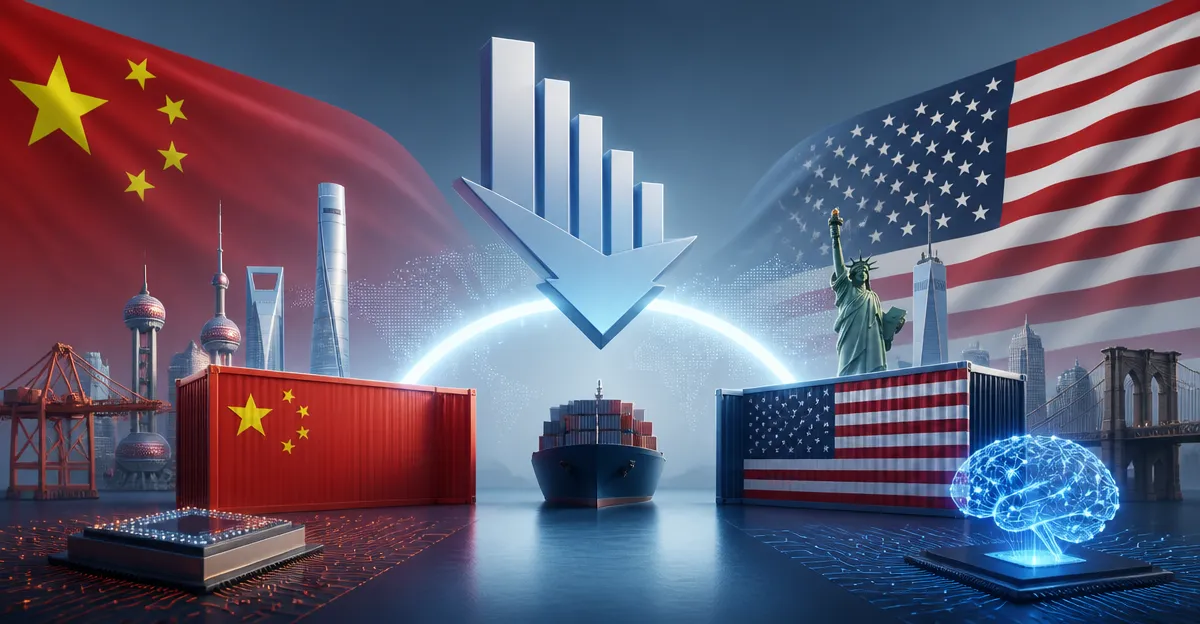
September 26, 2026, (Inside AI) — The United States and China have agreed to a $30 billion reciprocal tariff-reduction arrangement and a formal dialogue on artificial intelligence, according to Chinese state news agency Xinhua. The eight-point consensus emerged from Chinese President Xi Jinping's visit to the United States, which concluded on September 25 in Washington, D.C.
The agreement marks the first structured channel for AI policy talks between the world's two largest economies. Both nations have spent the past three years building separate regulatory regimes for artificial intelligence. Until now, no bilateral mechanism existed for coordinating rules on model safety, data flows, or chip exports.
President Donald Trump and Xi shook hands at the National Archives Museum alongside first lady Melania Trump and Xi's wife Peng Liyuan. The symbolic setting, a repository of foundational American documents, framed the visit as a diplomatic reset after years of escalating trade and technology restrictions.
The tariff reduction covers a broad range of goods, though Xinhua did not specify which sectors would benefit. The $30 billion figure represents a reciprocal cut, meaning both sides will lower duties on each other's imports. For technology companies, the immediate effect may be limited. Most advanced AI chips and semiconductor manufacturing equipment remain under separate export controls that this arrangement does not appear to address.
The AI dialogue component carries more long-term significance. Washington and Beijing have clashed repeatedly over access to advanced chips, with the US restricting exports of Nvidia's most powerful processors to China since 2022. China has responded by accelerating domestic chip development and restricting exports of gallium and germanium, materials critical to semiconductor production.
A formal AI dialogue could open channels on safety standards, risk assessment, and possibly a framework for verifying compliance with export rules. It could also create a venue for discussing military applications of AI, an area where both governments have expressed concern but avoided direct talks.
Analysts remain cautious about the practical impact. The eight-point consensus lacks enforcement mechanisms or timelines. Previous agreements between the two countries, including the Phase One trade deal signed in 2020, included purchase targets that China ultimately failed to meet. That history suggests the tariff reduction may face similar implementation challenges.
"We've had a tremendous visit from two spectacular people," Trump said during the visit, according to pool reports. The comment reflected the administration's public framing of the meetings as a diplomatic success.
Xi's visit included a stop at the National Archives, where both leaders viewed original copies of the Declaration of Independence and the Constitution. The choice of venue signaled an appeal to shared institutional history, even as the two nations compete for technological dominance.
The AI dialogue is expected to begin within months, though no date has been announced. Neither the White House nor China's Ministry of Foreign Affairs has released the full text of the eight-point consensus. Key details, including which agencies will lead the talks and whether they will include private-sector representatives, remain undisclosed.
For the AI industry, the agreement creates both opportunity and uncertainty. Companies like Nvidia, AMD, and Intel have lobbied for clearer rules on chip exports. A bilateral dialogue could produce a more predictable framework, but it could also lead to stricter controls if both sides agree on shared security concerns.
China's domestic AI sector, including companies like Baidu, Alibaba, and SenseTime, may benefit from reduced trade barriers on hardware components. However, the most advanced chips remain off-limits under US export rules, and the tariff arrangement does not appear to change that.
The agreement also comes amid ongoing global debate over AI governance. The European Union has implemented its AI Act, and the United Nations has convened advisory bodies on AI risks. A US-China dialogue could either complement these efforts or create a competing track that sidelines smaller nations.
Whether the eight-point consensus produces concrete results will depend on follow-through. The two governments have a history of announcing agreements that later stall. For now, the tariff cut and AI dialogue represent a diplomatic opening, not a resolution of the deeper conflicts over technology and security.