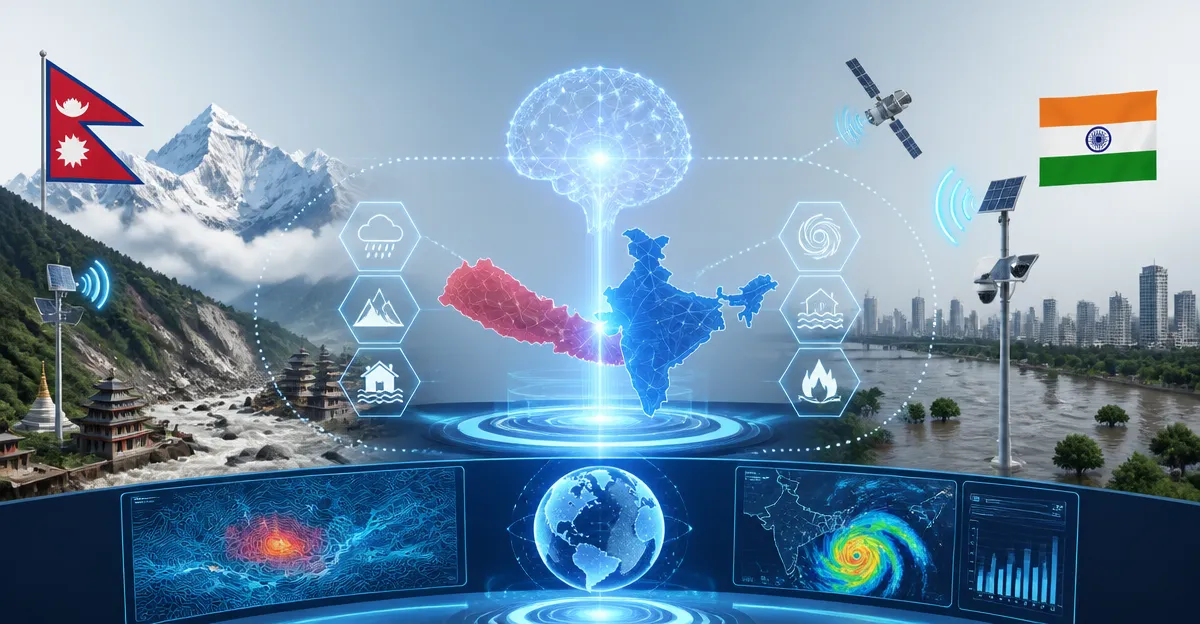
September 28, 2026, (Inside AI) — When catastrophic flooding swept through Nepal this year, an AI-powered web portal built by a single government IT engineer became a critical coordination tool for rescue operations. The platform, developed by Niraj Bhushal of Nepal's Finance Ministry, matched crowdsourced reports of missing persons against official lists of the dead and injured. It also mapped damaged buildings using open-source satellite imagery, according to Nepali news outlets.
Separately, private drone operator Manish Maharjan deployed thermal-camera-equipped drones to detect human heat signatures in debris, guiding rescue teams to possible survivors. These efforts, though modest against the scale of the disaster, signal a broader shift in how artificial intelligence is reshaping disaster management across South Asia.
The Nepal case is not isolated. From India's flood-prone cities to Thailand and Japan, AI tools are moving from experimental pilots to operational necessities. The reason is straightforward: disasters generate overwhelming volumes of data, and AI processes that data faster than any human team can.
Why Speed Matters More Than Model Size
Traditional weather forecasting relies on solving hundreds of physics equations to simulate atmospheric behavior. The more localized the forecast, the greater the computational burden and the higher the uncertainty. AI models take a different approach. They train on decades of historical weather data and learn patterns directly, producing forecasts in a fraction of the time.
Subimal Ghosh, head of the Centre for Climate Studies at IIT Bombay, has pioneered this approach for Mumbai's extreme rainfall events.
"It is very difficult to get hyperlocal forecasts by just working on physics equations. It requires a huge amount of computing resources, and usually takes a lot of time. But once an AI model has been trained effectively, very hyperlocal forecasts also become possible in almost real-time. We have shown this, and it is working fantastically for extreme rainfall and flooding events in Mumbai," Ghosh said.
Ghosh also emphasized why AI has become indispensable in disaster scenarios.
"The big advantage of the AI tools is their ability to process large volumes of data in a meaningful way, using natural language, speech and video, on an almost real-time basis. In disaster management situations, time is the most vital thing. That is the main reason why we are seeing increasing reliance on AI tools in disaster management. It's a great use case scenario," he said.
Google's Flood Hub exemplifies this trend. The platform aggregates data from weather agencies worldwide and generates flood advisories up to seven days in advance. It was first deployed during India's 2018 floods and has since predicted flooding in Thailand, Japan, and multiple Indian states. Other tools like GraphCast, DisasterAWARE, and SKAI offer early warning, hazard mapping, and satellite imagery analysis.
The Human Bottleneck Remains
Despite these advances, AI cannot replace human judgment. The UN Office on Disaster Risk Reduction recently cautioned that technology alone does not save lives.
"AI introduces new capabilities... but also new responsibilities. Its value will ultimately be measured not by technological sophistication but by lives saved, and resilience strengthened," the report said.
"The measure of success will not be model sophistication, but whether the integration of AI enables more timely, equitable, and trusted protection for those most vulnerable to disaster," it added.
During the response and rescue phase, AI's ability to parse unstructured data, including social media posts, local-language messages, and satellite feeds, has proven transformative. Bhushal's Nepal portal demonstrated this by synthesizing hundreds of disparate information sources into actionable intelligence. Post-disaster, AI tools help locate isolated communities, assess road conditions, identify helicopter landing zones, and prioritize aid distribution.
Yet the technology remains dependent on reliable data pipelines, trained personnel, and institutional support. Without these, even the most sophisticated model produces little value on the ground.
Read: AI's Measurable Impact on Global Challenges Documented in Decade Review
The trajectory is clear. As climate change intensifies extreme weather events across South Asia, the pressure to deploy AI at scale will only grow. The question is no longer whether AI belongs in disaster management, but whether governments and humanitarian organizations can build the infrastructure to use it effectively.