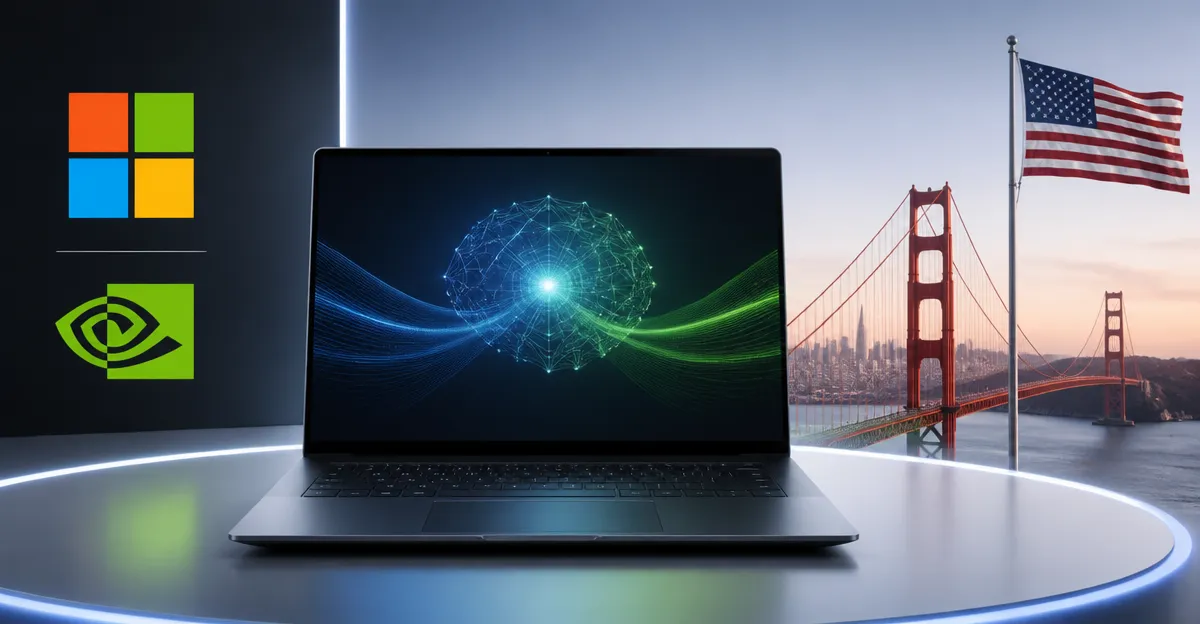
October 7, 2026, (Inside AI) — In a move that could reshape the economics of enterprise AI, Microsoft and Nvidia will unveil a new laptop on Wednesday at a San Francisco event, aiming to shift complex AI tasks from cloud data centers to local machines. The device, called the Surface Laptop Ultra, will be introduced by Microsoft CEO Satya Nadella and Nvidia CEO Jensen Huang, according to sources familiar with the plans.
The announcement, billed as an update on Windows and the Surface hardware line, represents a strategic bet by Microsoft that some work currently performed in its Azure cloud can be moved to high-powered Windows machines in businesses and homes. For Nvidia, cracking the Windows PC market opens a path into territory long dominated by Intel and AMD.
The event follows years of collaboration between the two companies to bring tasks such as writing code or managing complex business projects directly to desktops and laptops using Nvidia's RTX Spark chips, announced in June. The new laptop is the culmination of that effort.
Yet the timing is fraught. A memory-chip crunch has driven up prices for desktop and laptop machines, raising questions about whether the new offerings will be affordable for mainstream buyers. When Microsoft first pitched running AI tasks on PCs two years ago to save on cloud costs, laptops were mostly priced below $2,000. In recent weeks, Nvidia increased the price of its AI desktop machine, the DGX Spark, by about 75% to $6,950, due to surging costs of its 128 gigabytes of memory.
Read: 19-Year-Old Raises $11M to Build a $3,499 Personal AI Computer
"The software wasn't ready, but the hardware was. Now the software is ready and the hardware is too expensive to actually run it locally," Anshel Sag, an analyst at Moor Insights & Strategy, told Reuters. "So it's becoming this thing where only the people who have the budget can really afford to run AI locally."
The price surge stems from a global memory shortage, which has affected both Apple and Microsoft's efforts, Sag noted. This dynamic could limit adoption of the new Surface Laptop Ultra, particularly among small and mid-sized businesses that lack large IT budgets.
Beyond cost, safety remains a critical challenge. Microsoft and Nvidia must demonstrate that AI agents, long-running systems that can tackle complex problems autonomously, can be safely contained on personal computers. Nvidia is already working to prevent a repeat of the hack of AI hub Hugging Face, while Apple is tightening its process for giving AI agents full access to a Mac's hard drive.
The event underscores a broader industry shift toward edge AI, where processing happens on-device rather than in the cloud. This approach promises lower latency, better privacy, and reduced cloud costs, but requires powerful hardware. Microsoft's bet is that enterprises will pay for that hardware to avoid recurring cloud fees.
For Nvidia, success in the Windows PC market would mark a significant expansion beyond its dominance in data center GPUs. Intel and AMD have long controlled the PC processor market, and Nvidia's RTX Spark chips represent a direct challenge. However, the high price of these systems could slow adoption.
Analysts will be watching Wednesday's event for pricing details and demonstrations of agent capabilities. The outcome could influence how quickly AI moves from centralized clouds to distributed devices, a shift with major implications for Microsoft's Azure revenue and Nvidia's growth trajectory.
Read: Nebius raises AI cloud prices again as demand for computing power soars
As the industry grapples with memory shortages and rising costs, the Surface Laptop Ultra will test whether local AI can be both powerful and practical. The answer may determine the next phase of personal computing.