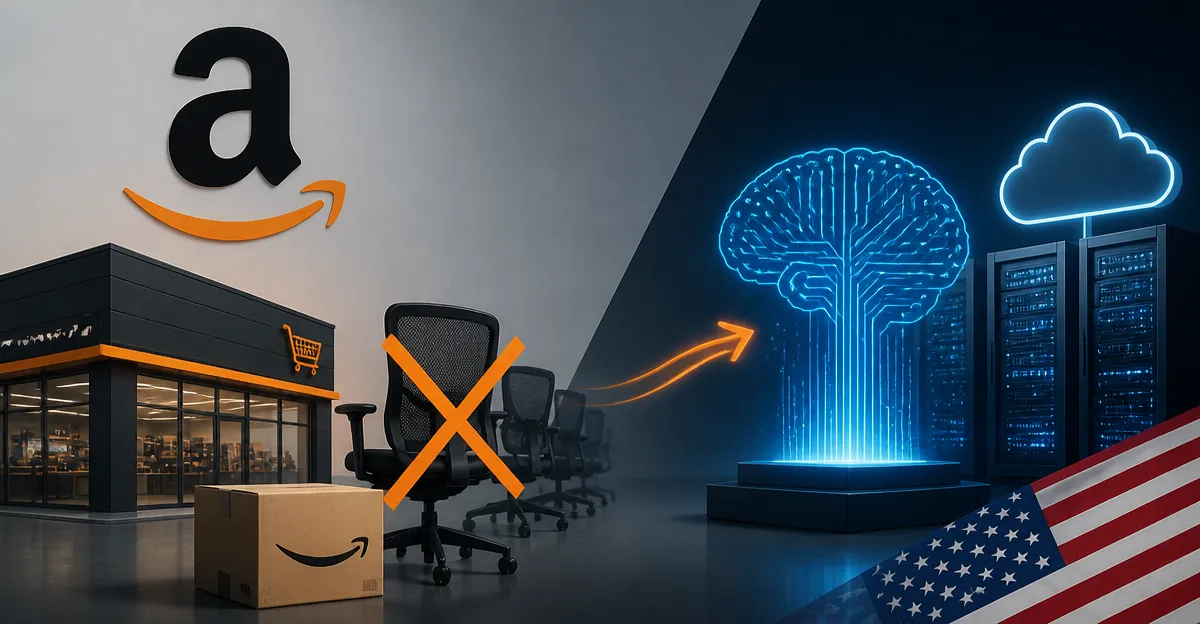
October 8, 2026, (Inside AI) — Amazon has confirmed a fresh wave of layoffs inside its core Stores division, the unit responsible for its flagship retail website. The cuts, announced on Wednesday, October 7, affect fewer than 1,000 employees, according to sources familiar with the matter. The move lands just days after the company's largest annual shopping events and signals that its cost-reduction strategy remains active even as it prepares to spend massively on artificial intelligence infrastructure.
The reductions form part of a broader restructuring that began in late 2025 and has now eliminated roughly 30,000 roles across the company. This latest round, while smaller in scale, touches multiple business units including marketplace support, customer service, and engineering positions tied to the retail operation. Internal messages indicate the cuts extend to teams in India and the United Kingdom.
Amazon's spokesperson confirmed the company had cut a small number of jobs on Tuesday, primarily in the stores business. The company stated it had restructured the business to better support its priorities and that affected employees would receive support during the transition. Inside AI could not independently verify the exact number of affected workers.
The layoffs arrive as Amazon accelerates a historic capital commitment. The company plans to invest $220 billion in data centres, custom chips, and other AI infrastructure. That figure dwarfs the cost savings from workforce reductions, raising questions about whether the job cuts represent genuine efficiency gains or a strategic pivot toward automation and AI-driven operations.
Read: HSBC Plans Sweeping Job Cuts in UK Wealth Business Amid AI Push
Tech's Broader Layoff Wave Accelerates
Amazon is far from alone. Meta laid off around 8,000 employees in May while reassigning 7,000 others to new AI-focused initiatives. Microsoft has eliminated 5,300 jobs so far this year, with 4,800 cut in July and another 500 in September. Uber announced one of the largest single rounds, affecting about 3,300 employees. Workday cut 525 positions, and Oracle, Apple, Expedia, Thinkific, and Trustly also announced reductions in September.
According to Layoffs.fyi, 131,382 tech employees have been laid off across 314 companies in 2026 alone. The data reflects a mix of restructuring, cost reduction, and shifting business priorities, with AI increasingly influencing how major technology companies organise their workforces.
Inside Amazon, the news spread quickly through internal channels. Affected employees wrote in a Slack channel with 37,000 members that they received emails informing them their roles were being eliminated. The channel subsequently saw queries about severance packages, internal job postings, and whether more notifications were coming. The messages indicated cuts across marketplace support, customer service, and engineering roles in retail business, in both India and the UK.
The pattern is consistent with what labour economists have observed across the sector. Companies are trimming legacy operational roles while hiring aggressively for AI research, infrastructure, and product positions. Amazon's own job postings reflect this shift, with a growing share of openings tied to machine learning, cloud computing, and generative AI projects.
Amazon's AI spending spree includes significant investments in custom silicon. The company has developed its own AI chips, Trainium and Inferentia, to reduce reliance on Nvidia hardware and lower long-term computing costs. It has also expanded its partnership with Anthropic, committing up to $8 billion in the AI startup. These moves position Amazon to compete with Microsoft, Google, and Meta in the race to build and deploy large-scale AI systems.
Yet the human cost of this transition is becoming harder to ignore. The 30,000 jobs eliminated since late 2025 represent one of the largest workforce reductions in Amazon's history. The company has not disclosed how many of those roles were backfilled or shifted to AI-related functions. Nor has it provided a timeline for when the restructuring will conclude.
For now, the affected employees face an uncertain job market. Tech hiring has slowed across the board, and competition for remaining roles has intensified. Severance packages and internal mobility options will determine how quickly displaced workers can land on their feet. Amazon has said it will provide support during the transition, though specifics remain unclear.
The broader implication is unmistakable. As AI infrastructure spending surges past $200 billion at a single company, the workforce that built the e-commerce empire is being reshaped. The question is no longer whether AI will change tech employment. It already has.