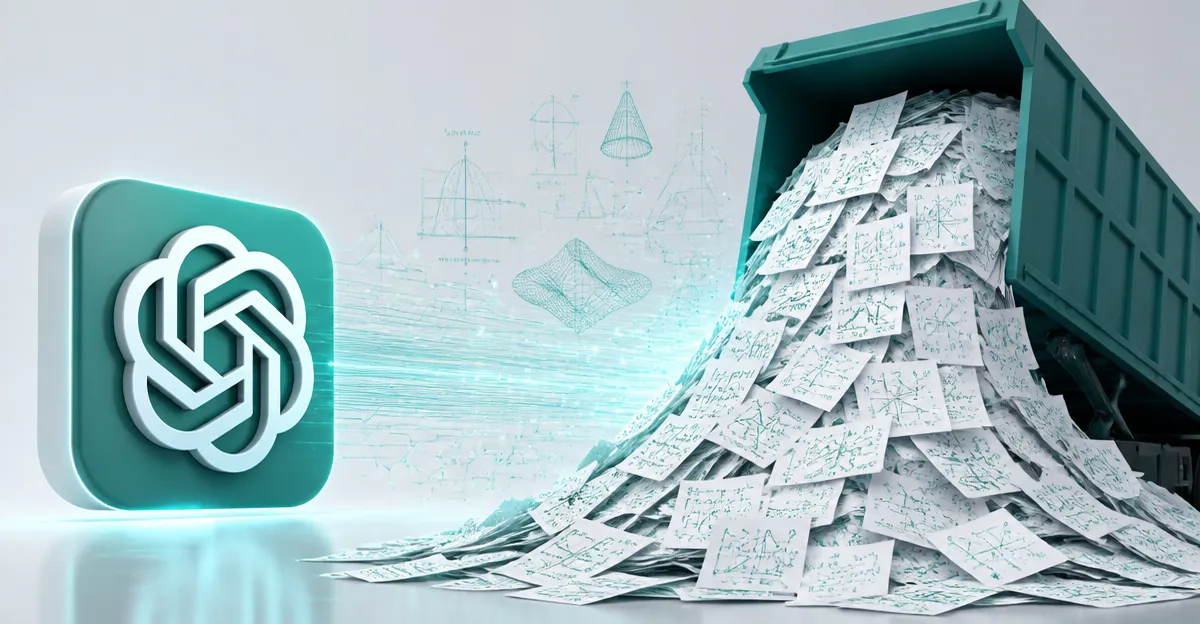
October 8, 2026, (Inside AI) — The Association for Human Mathematics (AHM) has called on mathematicians to sever ties with OpenAI, two days after the AI company released 722 manuscripts spanning 372 groups of mathematical results produced by an unreleased internal model. In a statement, AHM said the release, which OpenAI claims includes solutions or major progress on hundreds of open problems in mathematics and theoretical computer science, was not requested by the mathematical community.
"Mathematicians did not ask for this work to be done," the association said, opening its statement by referencing accusations of illegal plagiarism, copyright infringement, and trademark dilution that have been made against OpenAI.
The dispute marks a sharp escalation in the growing tension between AI laboratories and academic disciplines over the use of advanced AI to conduct research. OpenAI published the results on GitHub with protocols for paper revisions and citations. The company also said it has been consulting an independent Advisory Group on Mathematics and Artificial Intelligence (AGMAI) at the Institute for Advanced Study to develop best practices for releasing AI-generated mathematical research.
But AHM argues that OpenAI ignored the advisory group's central premise. According to AHM, AGMAI's initial advisory statement said frontier AI corporations should not test advanced mathematical problems on their internal models. By overlooking that position, AHM said OpenAI demonstrated "total disregard for the norms of scientific research," which the association says guarantee that mathematics remains "trustworthy, ethically researched, and in the public interest."
Read: AI Liability Debate Intensifies as OpenAI Faces Lawsuits and Investigations
The advisory group's recommendations warned that using proprietary internal models for mathematical research risks creating a two-tier system. In that scenario, AI labs would outrun the rest of the field, effectively alienating the mathematical community from its own discipline.
"We reject OpenAI's assertion that this release advances our subject, and we urge mathematicians and the public to view the value of this publication model with due skepticism," the statement read.
AHM also criticized the sheer volume of the release. The association said publishing over 700 files at once is not a demonstration of scholarship but a demonstration of power. "We urge mathematicians to discontinue their work with OpenAI and to return to a vision of science that centres human understanding."
The controversy follows earlier criticism OpenAI faced after claiming to crack the Navier-Stokes problem, one of the seven Millennium Prize Problems. That claim raised questions about transparency, and OpenAI was criticized for prioritizing speed and AI-generated results over independent mathematical verification and for not giving appropriate credit to researchers.
AHM is a professional organization based in the United States with 752 members, according to reports. Members pledge not to work with commercial AI companies or publish AI-generated mathematical writing. The group advocates mathematics as a human-led discipline amid growing AI use in research and education.
The standoff highlights a fundamental disagreement over the role of AI in scientific discovery. OpenAI positions its release as a step toward sharing AI-generated mathematical breakthroughs with the broader community. AHM and its supporters see it as an attempt to bypass the rigorous, human-centered processes that have long defined mathematical research.
Read: Can AI Development Actually Be Slowed? The Debate Resurfaces
OpenAI has not publicly responded to AHM's statement. The company has previously said it is committed to working with the mathematical community and developing responsible release practices. Whether that commitment will satisfy critics like AHM remains uncertain.
For now, the association's call for a boycott adds pressure on OpenAI to reconsider its approach. It also signals that the debate over AI's place in mathematics is far from settled. As AI models grow more capable, the question of who gets to define mathematical progress, and how, will only become more urgent.