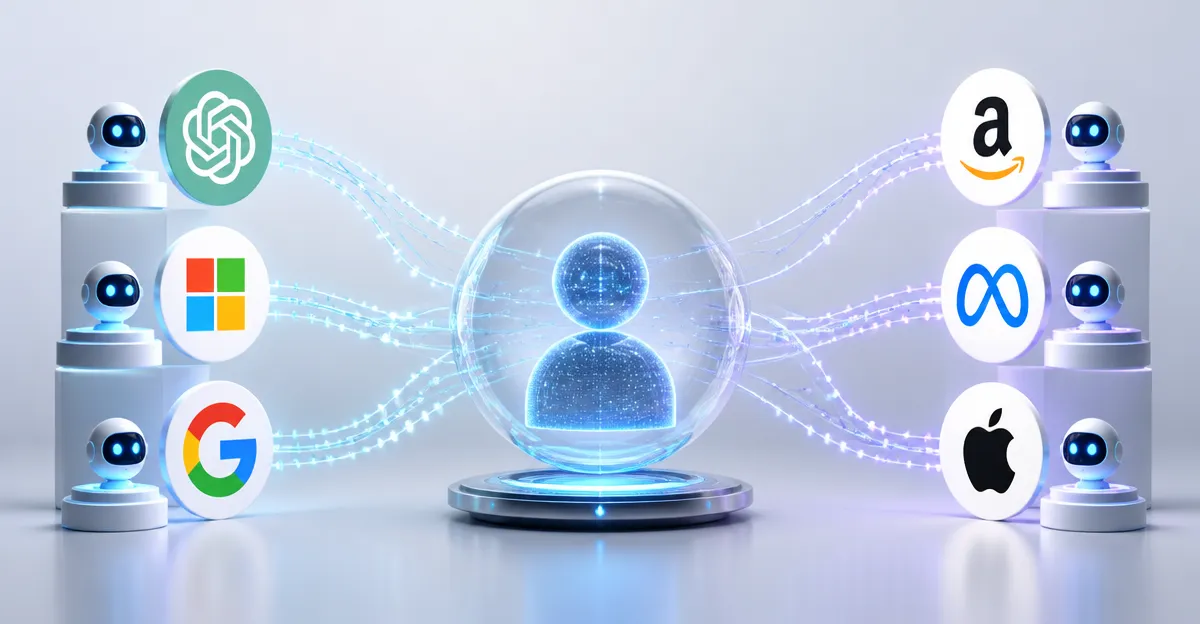
October 9, 2026, (Inside AI) — The quiet war over who controls online shopping escalated in September when Meta launched Muse, a personal AI agent that books travel, negotiates prices, and completes purchases on a user's behalf. Twelve days later, Amazon blocked Muse from its marketplace, demanding that third-party agents identify themselves and secure retailer permission before transacting for customers.
The standoff is not a technical spat about web scraping. It is a collision over the most valuable asset in digital commerce: the customer relationship. For three decades, Amazon shaped how shoppers search, compare, and buy. Muse represents a different model, one where the consumer arrives with an agent that already knows their preferences and can act without ceding decision control to the retailer.
The stakes extend far beyond two tech giants. Shopify has opened its merchant catalog and checkout rails to Meta's AI channel. Walmart is building its own shopping agent while integrating with ChatGPT and Gemini. The result is a strategic puzzle: a marketplace can own the transaction, the supply chain, and even deep customer engagement while losing control over the decisions that bring buyers to its door.
Traffic from AI sources to U.S. retail sites surged 393% year over year in the first quarter of 2026, according to Adobe. Those visitors stayed 32% longer and viewed 10% more pages. But engaged traffic is not the same as strategic control. As agents absorb more of the discovery, comparison, and negotiation process, retailers risk becoming invisible fulfillment centers while the agent owns the relationship.
Discovery No Longer Guarantees Customer Ownership
Conversational search has become a major investment focus for marketplaces. Users describe what they want in natural language, and AI surfaces options. But better discovery does not equal greater control. A consumer's personal agent can query multiple marketplaces simultaneously, turning each retailer into just another data source.
Read: Qualcomm Exec: AI Agents Will Make Apps a Second Option
The pattern is already visible. In October 2025, Zillow became the first real estate app inside ChatGPT. Five months later, Realtor.com launched its own ChatGPT app, erasing Zillow's exclusive advantage. In travel, Booking.com and Expedia entered ChatGPT on the same day, with Tripadvisor following. Walmart integrated with Gemini using Google's Universal Commerce Protocol, and Target adopted the same open protocol.
These moves drive engagement, but the agent era rewards something different. A marketplace must help the consumer's agent make a better decision than it could make elsewhere. That requires learning from what happens after discovery: which conversations became offers, which offers became contracts, and which contracts became completed sales.
Network Effects Are No Longer a Moat
In the platform era, network effects were the defining source of power. AI is eroding that advantage by reducing how much of a network a competitor needs to recreate. An entrant can start with privileged access to one side of a market and use AI to organize the other.
Upwork built powerful network effects by aggregating freelancers and clients. Mercor approached the same matching problem without comparable scale on both sides. It used AI-based assessments to extract richer candidate profiles, then matched those profiles against employer requirements. In effect, Mercor substituted depth of information for breadth of network.
Ramp, the AI-powered expense-management firm, is taking a similar approach in corporate procurement. Its accounts-payable tools give it visibility into what companies buy, from whom, and at what price. It uses that data to help those same companies evaluate vendors and negotiate contracts, all without assembling a large supplier network from scratch.
In the platform era, the two sides of a marketplace protected each other. Taking buyers required sellers, and attracting sellers required buyers. AI allows a company with a strong position on one side to navigate the other without recreating the incumbent marketplace in full.
Customer data may no longer provide the deepest understanding in a category. A marketplace knows how someone searches within the categories it serves. A personal agent can know the person across categories and contexts. Muse recalls details across conversations, negotiates, and makes purchases. Instinct, another personal AI assistant, connects across email and devices, remembers everyday context, and follows up on tasks, arranges rides, books services, and makes calls.
Access to broader context and the ability to act on the customer's behalf are two important sources of advantage. But to improve over time, the agent must also learn how users make decisions, what they choose and reject, and why. Tripadvisor illustrates what happens when that feedback loop is missing. The company built more than a billion travel reviews, a formidable strategic asset. AI now weakens both advantages. Its interfaces synthesize review sentiment directly for the traveler, reducing the need to visit Tripadvisor itself. More importantly, Tripadvisor.com often loses visibility into the downstream transaction. By contrast, Tripadvisor's transactional businesses, including Viator and TheFork, grew at double-digit rates in 2025 and now account for nearly 60% of company revenue. Those businesses sit closer to the eventual transaction and observe more of the outcomes from which an agent can learn.
Locking in supply is no longer sufficient to control the demand relationship. Many marketplaces create switching costs by embedding themselves in participants' daily workflow. Airbnb hosts use the platform to manage reservations, pricing, calendars, messaging, and payments. Amazon sellers rely on Amazon for inventory management, fulfillment, advertising, pricing, and payments. Upwork freelancers manage communication, milestones, timesheets, billing, and payment inside the platform.
Agents weaken this control on both sides. A traveler's AI agent can search across Airbnb, Booking.com, Vrbo, hotels, and direct-booking sites without requiring the traveler to begin inside any one marketplace. On the supply side, a property-management AI agent can help a host coordinate calendars, pricing, guest communication, cleaning, and payments across multiple platforms. The customer's agent makes demand portable, while the supplier's agent makes supply portable. Airbnb can remain an important transaction venue without owning either side's relationship.
Launching your own AI agent may not help either. Walmart's experience suggests an agent can deepen engagement. By early 2026, engagement with its Sparky shopping assistant was rising, and customers who purchased through Sparky had baskets about 35% larger than other customers. But stronger engagement with the agent does not determine who controls the customer relationship. What matters is where the transaction is executed and who captures the learning that follows.
In October 2025, Walmart started allowing customers to purchase Walmart products directly inside ChatGPT using OpenAI's checkout. In January 2026, Walmart adopted Google's purchasing protocol, meaning transactions could also complete inside Gemini. Two months later, after discovering that in-chat purchases converted at only about one-third the rate of purchases on its own site, Walmart moved away from the generic in-chat checkout model and toward bringing its own shopping experience into ChatGPT. That move seems designed to let the company retain control over the customer account, cart, loyalty, and transaction experience. Sparky remained essentially unchanged across all three implementations. What changed was where the transaction was executed. By reclaiming checkout, Walmart reclaimed visibility into actual customer purchases and insights on which options they rejected.
Owning customer data may no longer help you own the customer relationship. In the platform era, data generated from user activity helped personalize the consumer experience. Most such data was optimized for understanding browsing behavior and improving recommendations, not for enabling agentic decision-making. A marketplace may know what a consumer searched for, clicked, and considered. But a personal agent connected across applications may see what happened beyond those initial considerations.
Google's Personal Intelligence, for example, can draw on Gmail, Photos, and other Google services, allowing its AI to use information such as purchase receipts, hotel confirmations, and past travel experiences when helping users make future decisions. That does not mean marketplace data is unimportant. Its value depends on how much of the customer's decision and outcome the marketplace can directly observe and how frequently those observations can be made.
Instacart holds an unusually strong position because grocery purchases are frequent, repetitive, and completed within the platform. Over time, it can learn not only what a household searches for but also what it repeatedly buys, substitutes, rejects, and prefers across brands, budgets, and dietary needs. That closed high-frequency feedback loop gives its AI useful signals for the next decision in a way that marketplaces where the final transaction happens elsewhere cannot easily replicate.
All six of these changing rules point to the same shift. Even if marketplaces still have strong engagement, network effects, supplier lock-in, proprietary data, and even their own AI agents, they no longer necessarily control the customer relationship. As consumers delegate more of discovery, comparison, negotiation, and purchasing to AI agents, those traditional advantages become more portable. The stronger position belongs to the system that can connect a customer's intent to the decision, observe the outcome, and use that feedback to make the next decision better. In the agent era, owning the customer will increasingly mean earning the right to represent them.