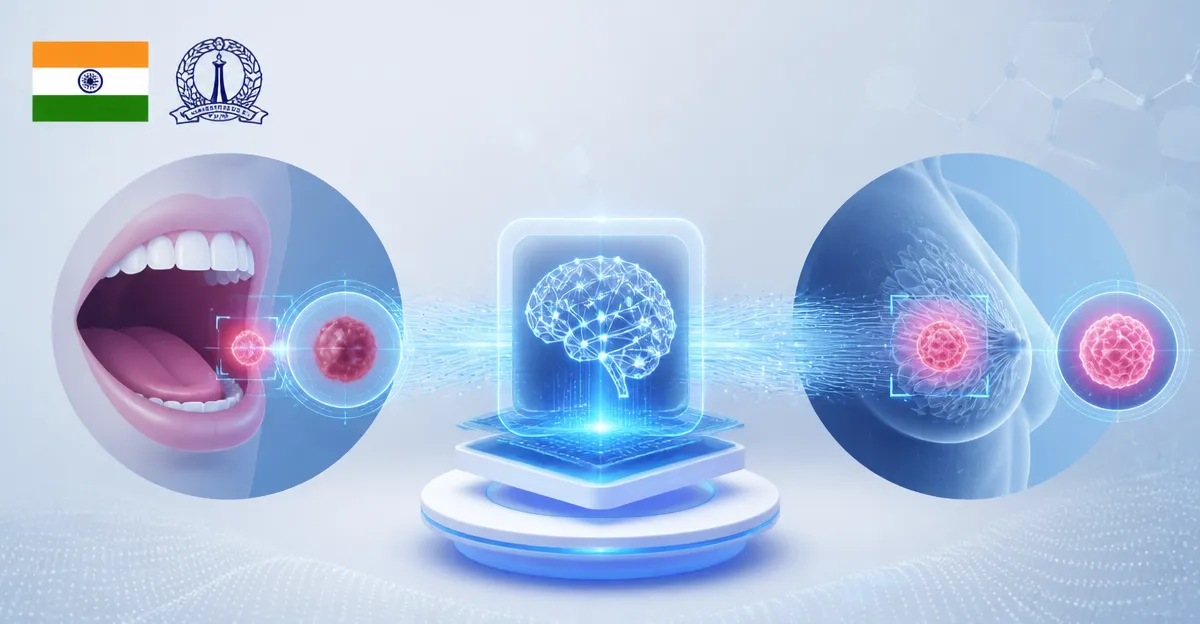
October 10, 2026, (Inside AI) — A government-backed research center in Bengaluru is quietly building artificial intelligence tools that screen for oral and breast cancer, two diseases that kill hundreds of thousands of Indians every year because they are caught too late.
The effort is led by Prof Phaneendra K Yalavarthy, Chief Project Manager of Translational AI for Networked Universal Healthcare (TANUH), an AI Centre of Excellence in Healthcare hosted at the Indian Institute of Science (IISc). TANUH is a non-profit that develops and deploys AI-driven diagnostics and decision-support systems for early detection and management of non-communicable diseases across India.
Yalavarthy is also a professor in IISc's Department of Computational and Data Sciences. His research spans AI for medical imaging, computational methods in medical imaging, medical image processing, and cyber-physical systems.
The timing matters. India records roughly 1.4 million new cancer cases each year, according to the Indian Council of Medical Research. Breast cancer is the most common cancer among Indian women, and oral cancer ranks among the top cancers in men. Both are treatable when found early. Both are routinely found late in rural and semi-urban India, where pathologists and radiologists are scarce.
Read: IIT Hyderabad and S&P Global Launch AI Innovation Lab for Finance Research
That scarcity is the problem TANUH is designed to attack. A 2023 report from the World Health Organization found India has roughly one radiologist for every 100,000 people, far below the density in the United States or Europe. Screening programs that depend on human specialists cannot scale to a population of 1.4 billion. AI that reads images at the point of care can.
Yalavarthy's academic path is unusually broad. He holds a postgraduate degree in Physics from Sri Sathya Sai University, an M.Sc. in engineering from IISc, and a PhD in Engineering Sciences from Dartmouth College in the United States. That mix of physics, engineering, and computational science is common among medical imaging researchers, but less common among those who also manage deployment programs.
That dual role is the notable part. Most academic AI labs publish papers and stop there. TANUH's stated mission is translation, meaning the tools must reach clinics, not just journals. The center describes its work as building and deploying diagnostics, not merely prototyping them.
The specific claim that TANUH builds tools to detect oral and breast cancer comes directly from Yalavarthy. Inside AI could not independently verify the deployment status of these tools, including how many clinics use them or what accuracy they achieve in real-world conditions.
That gap is worth naming. Medical AI has a long history of strong retrospective results that weaken in prospective clinical use. A model trained on curated hospital images often struggles with the poor lighting, low-resolution cameras, and inconsistent staining found in primary health centers. Oral cancer screening adds another layer of difficulty because it depends on visual examination of the mouth, a task that varies widely between clinicians.
Breast cancer screening in India leans heavily on clinical breast examination and ultrasound rather than mammography, since mammography machines remain concentrated in cities. AI tools built for Western mammography workflows do not transfer cleanly to that reality. Any system TANUH deploys must be designed for the equipment and staff actually available in Indian clinics.
The Indian government has pushed hard in this direction. The Ayushman Bharat Digital Mission, launched in 2021, aims to build digital health infrastructure that AI tools can plug into. The IndiaAI Mission, approved in 2024 with an outlay of ₹10,372 crore, explicitly funds AI applications in healthcare. TANUH sits inside that policy current.
Read: World Bank ranks India among top 10 in AI readiness
Yalavarthy's center is not the only player. Several Indian startups and hospital chains have piloted AI screening for diabetic retinopathy, tuberculosis, and cervical cancer. Oral and breast cancer remain less crowded fields, partly because image capture is harder to standardize.
What TANUH has that many startups lack is institutional backing from IISc, one of India's premier research institutions, and a mandate tied to public health rather than profit. That structure could help it reach government-run primary health centers that commercial vendors find hard to serve.
The open questions are the ones that decide whether this work saves lives. Can the tools hold up outside controlled settings? Will state health departments adopt them at scale? And will the data used to train them reflect the diversity of Indian patients, from Kashmir to Kanyakumari? Those answers will take years to arrive.