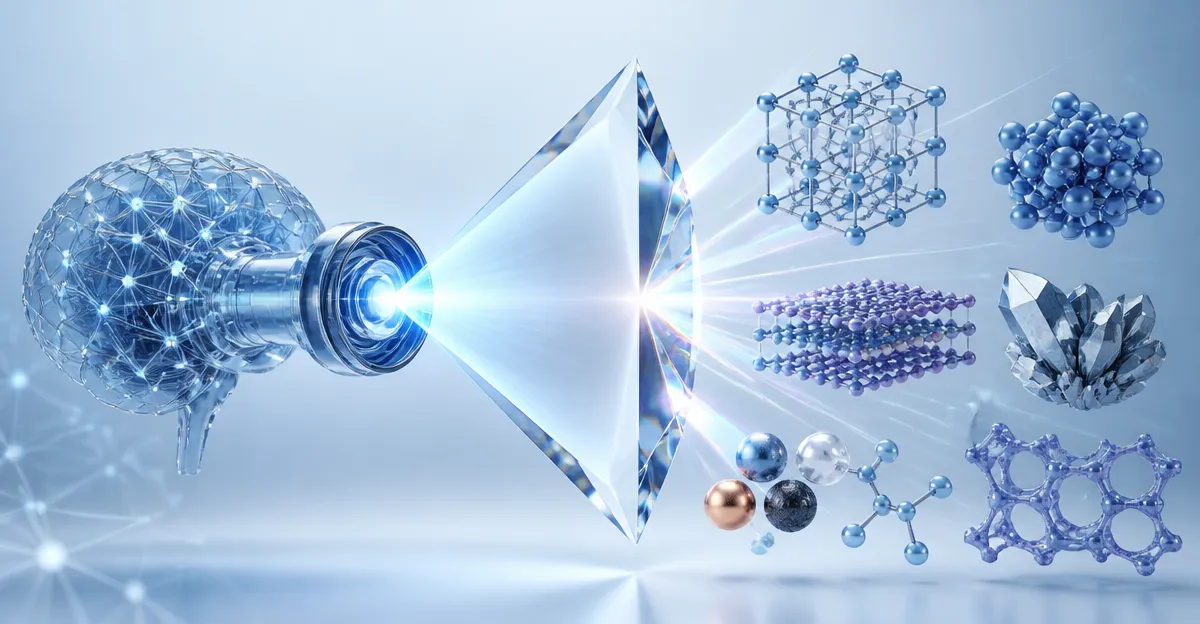
October 18, 2026, (Inside AI) — A team of researchers at the Massachusetts Institute of Technology (MIT) has developed a multimodal artificial intelligence model that can interpret the three-dimensional atomic structure of crystalline materials and connect it directly to their physical properties. The work, published in Nature Communications, addresses a fundamental limitation in applying large language models to materials science: most AI systems are trained on text, but crystals are inherently spatial objects.
The new model combines 3D atomic arrangements with natural language descriptions generated from both experimental literature and first-principles computational databases. This dual-stream approach allows the system to reason about a material's composition, structure, processing considerations, and potential applications in a single unified framework. In tests, the model outperformed text-only baselines when asked to identify promising solid-state lithium-ion battery electrolytes, surfacing candidates that had been independently validated by other research groups.
The research was led by Ju Li, the Carl Richard Soderberg Professor in Power Engineering at MIT's Department of Materials Science and Engineering, along with first author Yang Jeong Park, a former MIT postdoc, and Elsa Olivetti, the Jerry McAfee (1940) Professor in Engineering. The work was supported in part by the U.S. Defense Threat Reduction Agency, the U.S. Defense Advanced Research Projects Agency, and the National Research Foundation of Korea.
The core challenge the MIT team tackled is one of representation. Crystalline materials, which make up more than 90 percent of solid materials on Earth, are typically stored in specialized formats that encode atomic coordinates and bonding patterns. Large language models, by contrast, are trained on streams of text. This mismatch has limited AI's ability to reason about the physical world at the atomic scale. The experimental literature also skews heavily toward a small number of well-studied crystal classes, meaning models trained on papers alone tend to reproduce existing biases rather than explore new material spaces.
Read: MIT’s GeoPT Teaches AI Physics Using Synthetic Particle Data, Cuts Training Needs by 60%
To overcome this, the researchers used a technique called contrastive learning, which trains a model to align similar examples across different data types while separating dissimilar ones. In this case, the model learned to match 3D crystal structures with synthetic textual descriptions generated from computational databases. The approach is analogous to how vision-language models align images with captions, but applied to atomic geometry rather than photographs.
"Structure is really at the heart of the materials science field," says Ju Li, the Carl Richard Soderberg Professor in Power Engineering in the Department of Materials Science and Engineering. "If you understand the structure, you can infer quite a lot about the properties and performance of materials. We wanted to build the connection between a material's atomic structure and its properties and processing for the model."
The MIT work arrives at a moment when the materials science community is increasingly looking to AI to shorten discovery cycles. The Nature Communications paper follows years of effort to apply machine learning to crystal structure prediction, including graph neural networks that treat atoms as nodes and bonds as edges. Those approaches have yielded impressive results for specific tasks, but they often lack the broad reasoning capabilities that language models bring. The MIT model attempts to bridge that gap by giving a language model a form of spatial awareness.
The researchers compared two versions of their model: one trained on the AI-generated descriptions and another trained on text from published papers only. The version trained on synthetic narratives successfully learned to align geometric structures with text, while the paper-only version did not. This finding suggests that the bottleneck for materials AI is not just data volume but data type. Text alone cannot convey the spatial relationships that determine a crystal's behavior.
"We wanted to create an AI model that works broadly across materials," Li says. "That's why we decided to synthesize narratives rather than rely solely on existing papers. We found when we used that narrative dataset, the models are better at predicting the function."
The model's performance on solid-state electrolyte discovery is particularly notable because it points to a real-world application. Solid-state batteries are widely viewed as a safer, higher-energy-density alternative to conventional lithium-ion cells, but finding the right electrolyte material has proven difficult. The MIT model's top candidates included materials that other researchers had already flagged as promising, a sign that the system is learning meaningful structure-property relationships rather than memorizing patterns.
Read: Argonne Lab Uses ChatGPT Transformer Tech for Nuclear Reactor Modeling
Olivetti framed the work as part of a broader shift in how materials scientists use computational tools.
"There are sometimes these step changes within materials science around algorithmic integration toward useful tools, which the community uses to further advance the field," Olivetti says. "This approach helps us see more deeply into three-dimensional structures and link structures to property and processing. I hope this can be one of those step changes."
Li compared the model to AlphaFold, the AI system developed by DeepMind that predicts protein structures and has transformed structural biology. The analogy is instructive but imperfect. Proteins are linear chains that fold into 3D shapes, while crystals are periodic lattices with repeating unit cells. The data structures are different, and so are the failure modes. Still, the comparison signals the ambition: to create a general-purpose tool that links structure to function across a wide range of materials.
The researchers believe their approach can extend beyond battery materials to catalysts, semiconductors, and structural alloys. They have made the model available for other scientists to use, though broader adoption will depend on how well it generalizes to new crystal families and how easily it integrates with existing computational workflows.
"Being able to see a three-dimensional crystal and how its atoms are connected is super foundational," Li says. "I think this will be useful to anyone who practices materials science."
The work also raises questions about the role of synthetic data in scientific discovery. The MIT team generated descriptions for crystal structures that may never have been synthesized in a lab. If those descriptions contain subtle errors or biases, the model could learn incorrect relationships. The paper does not fully address how the researchers validated the accuracy of their synthetic narratives, though the contrastive learning framework is designed to tolerate some noise by focusing on relative similarities rather than exact matches.
For now, the MIT model represents a proof of concept for a different kind of materials AI, one that treats structure as a first-class citizen rather than an afterthought. Whether it becomes a standard tool for the field will depend on the same thing that determines the fate of any scientific instrument: whether it helps researchers find something they could not find without it.