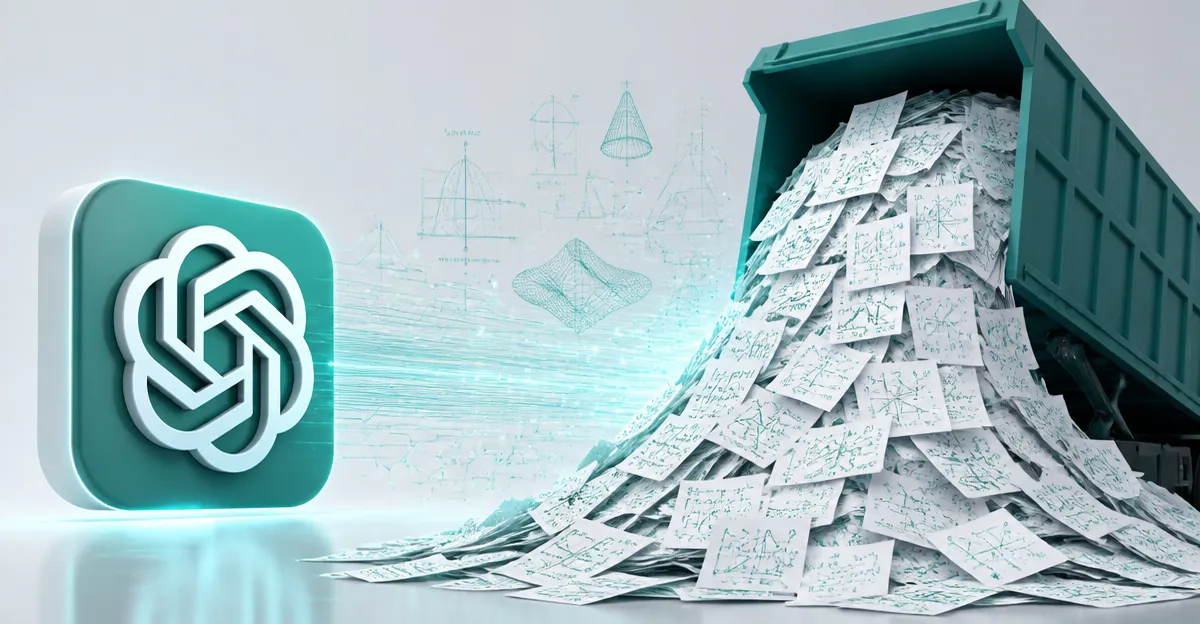
October 8, 2026, (Inside AI) — OpenAI has published 722 mathematical manuscripts generated by an internal frontier model, marking the largest public release of AI-produced mathematics to date. The company posted the results on GitHub on October 6, organizing them into 372 related result families. Many manuscripts include computer-checkable Lean proofs, and OpenAI said it will add more formalizations over time.
The release stems from an evaluation of roughly 4,000 math problems. Each result consumed about three hours of compute, equivalent to ChatGPT Pro "thinking" time. OpenAI also published 10 abridged summaries of the model's reasoning process. The company described the internal model as "significantly more capable" than GPT-6 Astra, and its training remains ongoing.
OpenAI consulted the Advisory Group on Mathematics and Artificial Intelligence (AGMAI) at the Institute for Advanced Study in Princeton to shape the release. The advisory group includes Fields Medal winner Timothy Gowers and theoretical physicist Edward Witten. OpenAI said it followed the group's public recommendations on responsible disclosure of AI-generated mathematical results.
This release builds on a series of increasingly bold claims from OpenAI throughout 2026. In May, an internal model disproved a 1946 conjecture by Paul Erdos on unit distances. In July, GPT-5.6 Sol Ultra proved the 50-year-old Cycle Double Cover Conjecture in roughly an hour using 64 subagents. Then in August, OpenAI published ten advances in mathematics and theoretical computer science from an internal version of Astra.
The most dramatic claim came on September 8, when OpenAI announced that roughly 10,000 coordinating AI agents had resolved the Navier-Stokes existence and smoothness problem in about 88 hours. This is one of the seven Clay Millennium Prize Problems, each worth $1 million. OpenAI said it does not intend to claim the prize. The Clay Mathematics Institute still lists the problem as unsolved, and independent verification has barely started.
The announcements have also sparked controversy. NYU professor Tristan Buckmaster and Anthropic researcher Levent Alpoge questioned whether OpenAI pursued research directions learned from their private work on related Euler equations. OpenAI denied accessing their specific data but acknowledged it cannot rule out that de-identified usage data improved its models. Mathematician Terence Tao warned at ICM in July that "we will transition from an era of proof scarcity to an era of proof abundance," and called it "a crisis in the foundations of mathematical values and practices."
The October 6 release therefore represents the broadest public dump of AI-generated mathematics to date. OpenAI said it plans to fund workshops and conferences on understanding major AI-produced results. However, the mathematics community still needs years to verify whether these manuscripts hold up under scrutiny.