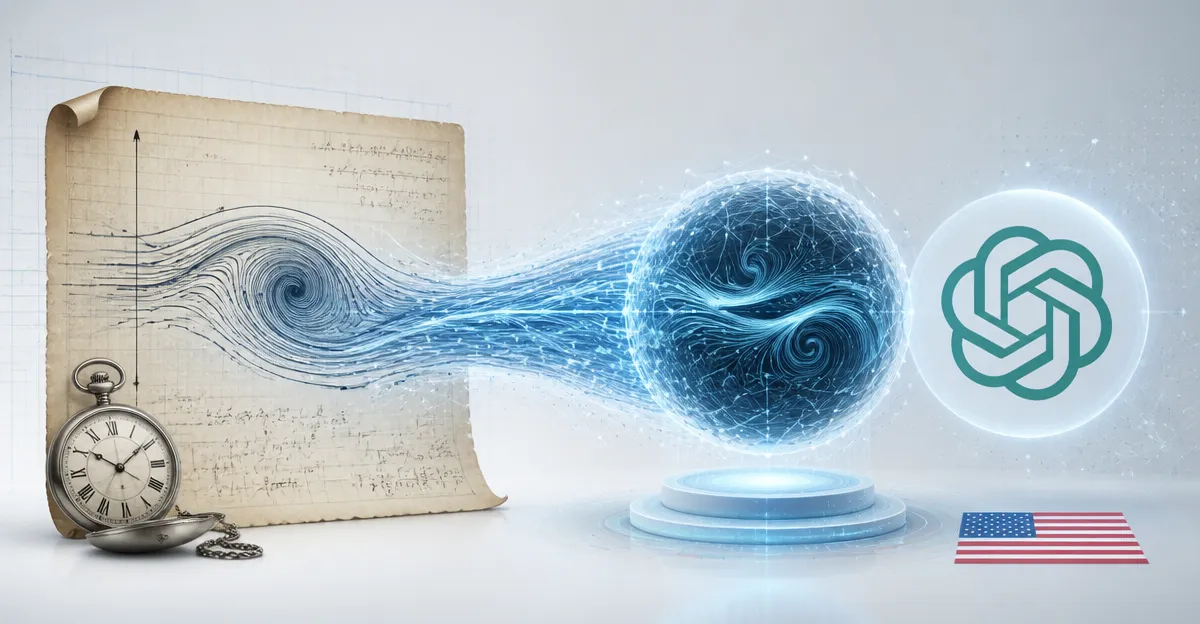
September 9, 2026, (Inside AI) — OpenAI has claimed a breakthrough on one of mathematics’ most stubborn open questions. On Tuesday, the company said its internal AI system produced a proof resolving the Navier-Stokes existence and smoothness problem.
The problem is one of the seven Millennium Prize Problems identified by the Clay Mathematics Institute in 2000. Each carries a $1 million prize for a verified solution. The Navier-Stokes question asks whether smooth solutions to the equations governing fluid motion can break down in finite time. It has resisted proof for roughly 90 years.
OpenAI’s claimed proof shows that a singularity can indeed form. The company described a vortex that spirals inward while being stretched. As the central region shrinks, fluid speed increases until the mathematical singularity appears. Crucially, the fluid retains finite energy, meaning the breakdown emerges from the equations’ own dynamics, not an external infinite force.
The proof was formally verified using Lean, a computer system that checks mathematical proofs step-by-step. OpenAI said about 10,000 AI agents worked on the problem simultaneously. They generated 2.7 million messages and used 130 billion output tokens. The agents found the result in 88 hours, with formal verification taking another 17 hours.
OpenAI also stated the AI model behind the proof is significantly more capable than the newly launched GPT-6 Astra. This detail suggests a specialized internal system, not a public product, drove the discovery.
Caution Before the Prize
The broader mathematical community has not yet validated the result. OpenAI released the proof for examination but said it does not intend to claim the $1 million prize. The company’s announcement has already sparked a dispute involving mathematicians Tristan Buckmaster of New York University and Levent Alpöge of Anthropic.
Both had been working on related problems. They raised questions about whether their unpublished work could have influenced OpenAI’s research. OpenAI denied accessing their work and said its proof is substantially different.
“I have not seen OpenAI’s proof. I do not know what their model did, or how. I do not know whether our data was used. I am not accusing anyone of anything,” Buckmaster said in a statement.
The Navier-Stokes equations describe how fluids like water, honey, and air flow. They underpin weather forecasting, aircraft design, and ocean current prediction. The core difficulty is turbulence. Tiny changes in starting conditions can lead to wildly different outcomes. This is why weather cannot be predicted reliably more than a week ahead.
If the proof withstands scrutiny, it would mark a major milestone. An AI system would have helped resolve a problem that has stumped humans for about a century. But history counsels patience. Millennium Prize claims have collapsed before, and formal verification in Lean does not automatically equal mathematical acceptance.
What Comes Next
Independent mathematicians must now dissect the proof. The dispute over research conduct adds another layer of scrutiny. OpenAI’s decision to forgo the prize money may reduce financial incentives for challenge, but it does not lower the scientific bar.
The use of 10,000 AI agents working in parallel also raises questions about reproducibility. Can other teams recreate the result without the same computational scale? Will the proof be understandable to human mathematicians, or will it exist only as a machine-checked artifact?
For now, the claim is precisely that: a claim. The Navier-Stokes problem remains officially unsolved until the mathematical community says otherwise.