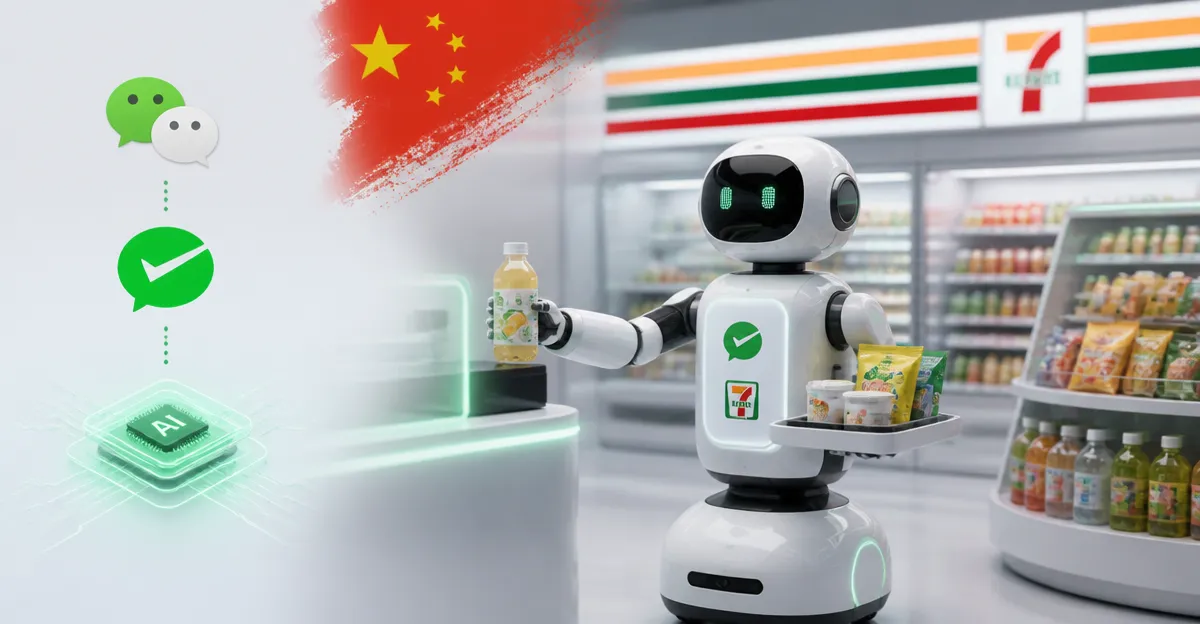
November 2, 2026, (Inside AI) — Tencent's WeChat Pay has deployed an AI-powered sales robot at a 7-Eleven store in Shenzhen, marking the company's first in-store retail robot. The robot debuted on October 29 at the opening of Guangdong's 2,000th 7-Eleven location, located on Tencent's headquarters campus. Powered by Tencent's Hunyuan AI models, the robot greets customers, recommends products and promotional bundles, and helps place orders through conversation. Customers then scan a code to complete payment themselves.
The deployment signals Tencent's push to embed its AI models into physical retail, a sector where Alibaba and JD.com have invested heavily. WeChat Pay, China's dominant mobile payment platform, is using the robot to test whether conversational AI can handle routine customer interactions, freeing store employees for tasks like restocking and food preparation. The move comes as China's convenience store sector grows increasingly competitive, with chains racing to adopt automation.
Hunyuan's Retail Debut Tests Noisy-Environment Speech
The robot relies on Tencent's audio technology to recognize speech in a noisy shop environment, a technical challenge that has stymied many retail AI deployments. Store noise from refrigeration units, customers, and announcements can degrade speech recognition accuracy. Tencent claims its system can filter out background noise, though independent verification is lacking. The robot's conversational flow is powered by Hunyuan, Tencent's large language model family, which the company has been integrating across its products since 2023.
WeChat Pay said the robot is intended to handle some routine customer interactions, allowing store employees to spend more time restocking shelves, preparing food, and assisting shoppers. The company did not disclose the robot's cost, deployment timeline, or whether it plans to expand to other stores. A 7-Eleven spokesperson confirmed the opening but declined to comment on the robot's performance.
Read: Apple Confirms Qwen Integration for China AI Rollout, Beta Starts November 4
The deployment fits a broader pattern of Chinese tech giants testing AI in controlled environments. Tencent's headquarters campus offers a semi-captive audience of employees, reducing the risk of customer frustration if the robot malfunctions. Similar pilots have preceded larger rollouts in China's retail sector, though many have stalled after initial trials.
Industry analysts note that retail robots have struggled to gain traction globally. SoftBank's Pepper robot, once hyped as a retail assistant, was discontinued in 2020 after failing to deliver returns. Walmart ended its shelf-scanning robot program in 2020, citing mixed results. Tencent's approach differs by focusing on customer interaction rather than inventory management, but the economics remain unproven.
The robot's launch also raises questions about data privacy. WeChat Pay already processes millions of transactions daily, and adding conversational AI could expand its data collection. Tencent did not respond to questions about how the robot handles customer data or whether conversations are recorded.
For 7-Eleven, the partnership with Tencent could offer a competitive edge in Guangdong, where the chain operates 2,000 stores. The province is a key battleground for convenience stores, with local chains like Meiyijia and Tianfu competing aggressively. 7-Eleven's parent company, Seven & i Holdings, has been under pressure from activist investors to improve performance in Asia.
The robot's debut comes as Tencent ramps up its AI investments. The company reported that Hunyuan models are now used in more than 180 internal products and services. Tencent has also been expanding its cloud AI offerings, competing with Alibaba Cloud and Baidu AI Cloud.
Read: Kuaishou's Kling AI unit completes a near $3 billion funding round
Whether the 7-Eleven robot becomes a permanent fixture or a limited pilot remains unclear. Tencent has not announced plans to deploy similar robots in other retail partners. The company's focus may be on gathering data and refining its models rather than immediate commercial rollout.