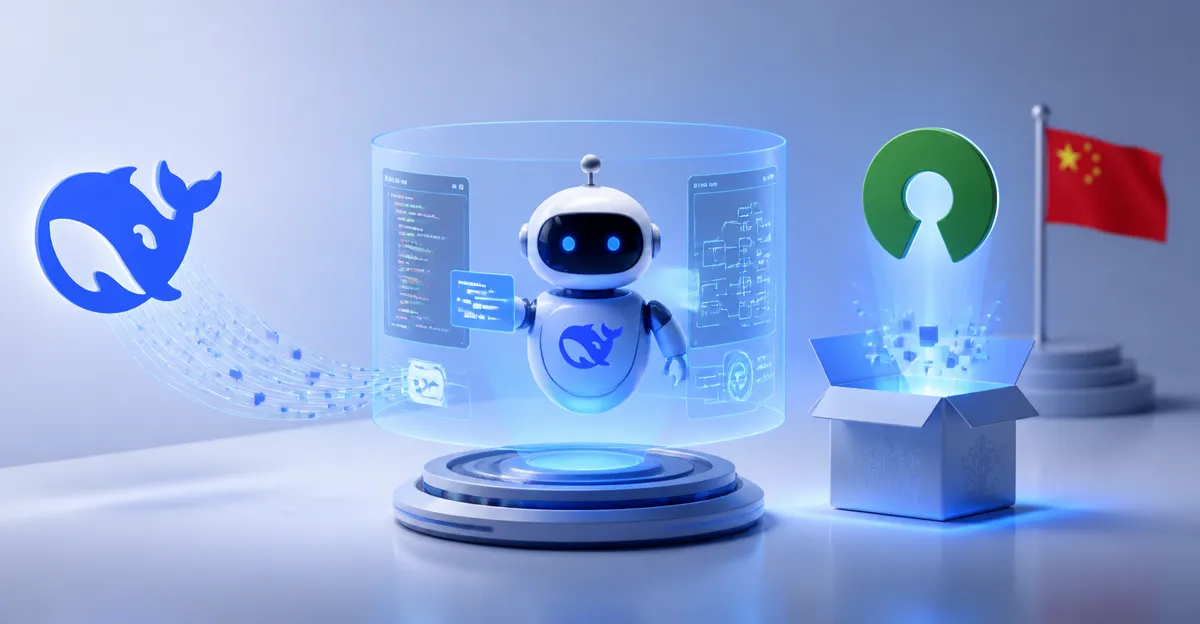
November 2, 2026, (Inside AI) — DeepSeek's Harness team has open-sourced dsh-superagent, a research prototype that accepts development requests through GitHub and optionally Feishu, processes each request in its own isolated session, and returns results such as pull requests to the originating conversation. The release, published under the MIT license, is available as a bundle for DeepSeek Harness and is configured around a single GitHub repository.
The prototype marks a shift in how coding agents are framed. Rather than acting as a chat assistant that answers a prompt and stops, dsh-superagent is built to carry out longer-running work with less human coordination. It converts authorized requests into work items, assigns each task its own working directory and agent session, and surfaces matters requiring human attention through a web panel. The project grew out of the team's daily development workflow, according to the company.
Why A Coding Agent That Waits For GitHub?
The architecture is deliberately narrow. dsh-superagent binds to one repository and listens for authorized requests. That constraint is the point. By limiting scope, the team avoids the coordination overhead that sinks broader agent frameworks, where multiple repositories, permissions, and handoffs create failure points before any code is written.
Each request becomes a work item. Each work item gets a working directory and a dedicated agent session. That separation matters because coding agents that share state tend to contaminate each other's context, producing patches that reference the wrong files or repeat failed attempts. The web panel adds a human-in-the-loop checkpoint, showing tasks that need attention rather than forcing developers to poll logs or chat threads.
Read: Anthropic six-step code modernization
The Feishu integration is optional, which suggests the team designed the prototype for internal use first and external experimentation second. Feishu, a workplace collaboration platform popular in China, is where many DeepSeek engineers likely already coordinate. Wiring an agent into that surface reduces the friction of adopting it.
DeepSeek has built a reputation for releasing capable models under permissive licenses. The company's GitHub presence has become a reference point for open-weight AI development. dsh-superagent extends that pattern from models to agent scaffolding, though the prototype is a research artifact, not a production product.
The timing is notable. Coding agents have moved from demos to deployment over the past two years. Tools like GitHub Copilot's coding agent and open-source frameworks such as OpenHands and SWE-agent have shown that agents can resolve issues and submit pull requests. The open question is reliability. Long-running agent work often degrades when tasks span hours or require multiple human checkpoints. dsh-superagent's session isolation and attention panel are direct responses to that failure mode.
The MIT license lowers barriers for teams that want to inspect or fork the implementation. That matters for enterprises with strict security review processes. A permissive license does not guarantee adoption, but it removes a legal obstacle that has slowed agent experimentation in regulated industries.
One limitation is visible in the design. The prototype supports a single repository. Real engineering organizations work across many repositories with dependencies between them. A coding agent that cannot reason across repository boundaries will struggle with monorepo-adjacent workflows or microservice architectures. The team frames this as a research prototype, so the constraint is expected. Still, it signals where the next iteration must go.
The web panel's focus on "matters that need human attention" is a pragmatic admission. Fully autonomous coding agents remain unreliable for complex tasks. By designing for human oversight rather than pretending it away, dsh-superagent aligns with how engineering teams actually operate. Developers want agents that handle drudgery and escalate ambiguity, not agents that silently merge broken code.
Read: Anthropic six-step code modernization
DeepSeek's Harness team has not published benchmarks or evaluation results alongside the release. That absence is worth noting. Open-source agent frameworks often ship with task completion rates or SWE-bench scores to demonstrate capability. Without those numbers, dsh-superagent reads as an infrastructure contribution rather than a performance claim. The team is sharing how it structures agent work, not asserting that its agent outperforms others.
That framing may be deliberate. Agent evaluation remains immature. Benchmarks like SWE-bench measure isolated issue resolution, not sustained collaboration over days. A prototype that emphasizes workflow integration over leaderboard scores reflects a realistic understanding of where the field stands.
The release also highlights a broader trend. AI labs are increasingly open-sourcing not just models but the operational scaffolding around them. This shift matters because the value of an agent depends as much on its harness as on its underlying model. A capable model with poor session management produces worse outcomes than a modest model with disciplined task isolation.
For developers, dsh-superagent offers a reference implementation. For researchers, it provides a concrete example of how to structure long-running agent work with human oversight. For DeepSeek, it reinforces a reputation for practical, permissively licensed contributions that others can build on.
The prototype is available now. Whether it becomes a foundation for production coding agents or remains a research curiosity will depend on how the community extends it beyond a single repository and how the team measures its reliability in real workflows.