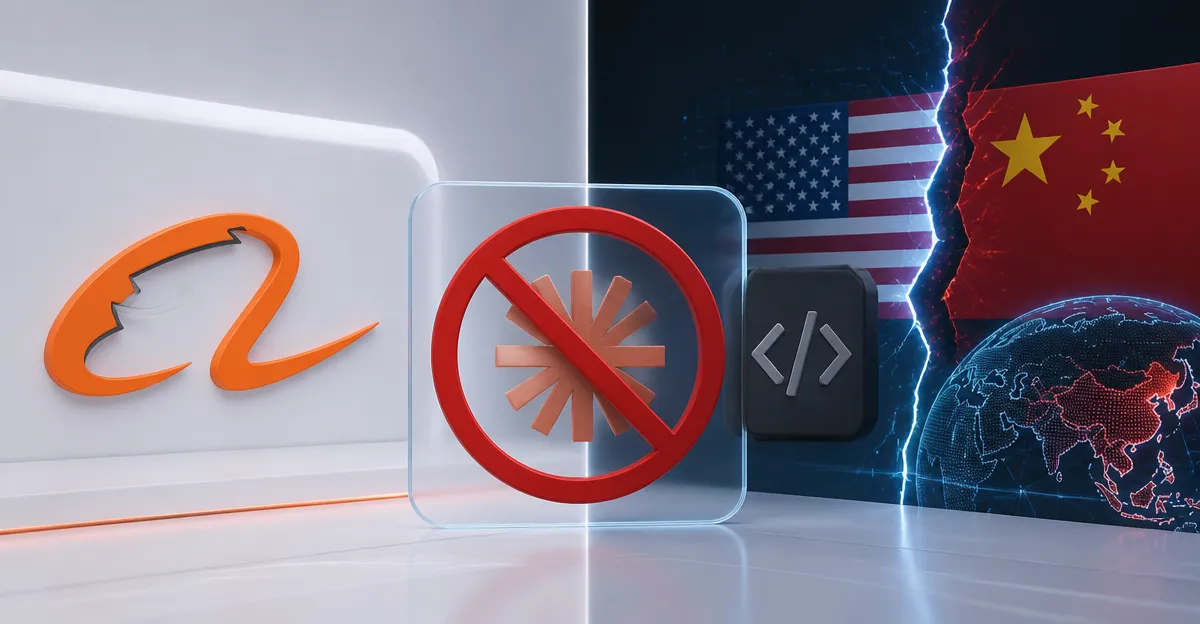
July 5, 2026, (Inside AI) — Alibaba will prohibit all employees from using Anthropic’s AI coding tool, Claude Code, starting July 10. The Chinese tech giant has classified the software as high-risk and directed staff to switch to its in-house alternative, Qoder.
The move escalates a tit-for-tat tech cold war. Anthropic already bans Chinese firms from accessing its models, but loopholes have let China-based users slip through. Alibaba’s ban mirrors a broader decoupling as both nations weaponize AI tools.
Anthropic recently tried to plug those gaps by covertly embedding location-tracking spyware into a Claude version, The Information reported. The experiment, launched in March, aimed to thwart unauthorized resellers and model distillation. But the company has since backtracked.
Anthropic’s Thariq Shihipar addressed the reversal on X:
“This was an experiment we launched in March that was meant to prevent account abuse from unauthorized resellers and protect against distillation. The team has landed stronger mitigations since then and we've actually been meaning to take this down for a while.”
Alibaba’s internal mandate underscores growing reliance on homegrown tools. Qoder, its proprietary coding assistant, is now the sanctioned alternative for over 200,000 employees. The company did not respond to requests for comment.
The ban arrives as Chinese AI models gain ground. Last month, Beijing-based startup Z.ai released GLM-5.2, a model with coding and agentic capabilities that rival leading U.S. systems at a fraction of the cost. Some experts call it a “mini DeepSeek moment,” referencing the 2025 shock when a Chinese model matched GPT-4.
U.S. export controls have inadvertently boosted Chinese alternatives. Earlier this month, the U.S. Department of Commerce lifted restrictions on Anthropic’s Claude Fable 5 and Mythos 5, but the damage was done. Global developers, wary of access bans, are testing Chinese models.
Anthropic’s spyware episode reveals the messy reality of AI containment. Embedding surveillance into a developer tool risks trust, yet the company saw it as necessary to enforce its own bans. The backtrack suggests the tactic was either ineffective or too controversial.
For Alibaba, the calculus is simpler: reduce dependency on U.S. tools that could be cut off. The company’s cloud division already offers Qoder to external clients, positioning it as a sovereign alternative. Analysts note that Chinese firms have accelerated internal AI adoption since the first U.S. chip sanctions in 2022.
The GLM-5.2 launch adds pressure. Its agentic abilities—executing complex tasks with minimal prompting—are closing the gap with Claude and GPT models. Z.ai claims it achieves 90% of Claude’s coding benchmark scores at 10% of the inference cost.
Meanwhile, the U.S. policy whiplash continues. Lifting export curbs on Fable 5 and Mythos 5 may be too late to reverse the perception that American AI access is unreliable. Chinese models are now seen as stable, affordable alternatives in many markets.
Alibaba’s July 10 deadline gives employees just days to migrate. The company has set up internal training sessions for Qoder, but developers familiar with Claude Code’s workflow may face a steep learning curve. The ban applies to all subsidiaries, including cloud and e-commerce units.
The broader AI arms race shows no signs of cooling. Both nations are stockpiling proprietary tools, and the developer community is caught in the crossfire. As one Shanghai-based engineer told Inside AI, “We’re just trying to write code, but now our tools have geopolitics.”