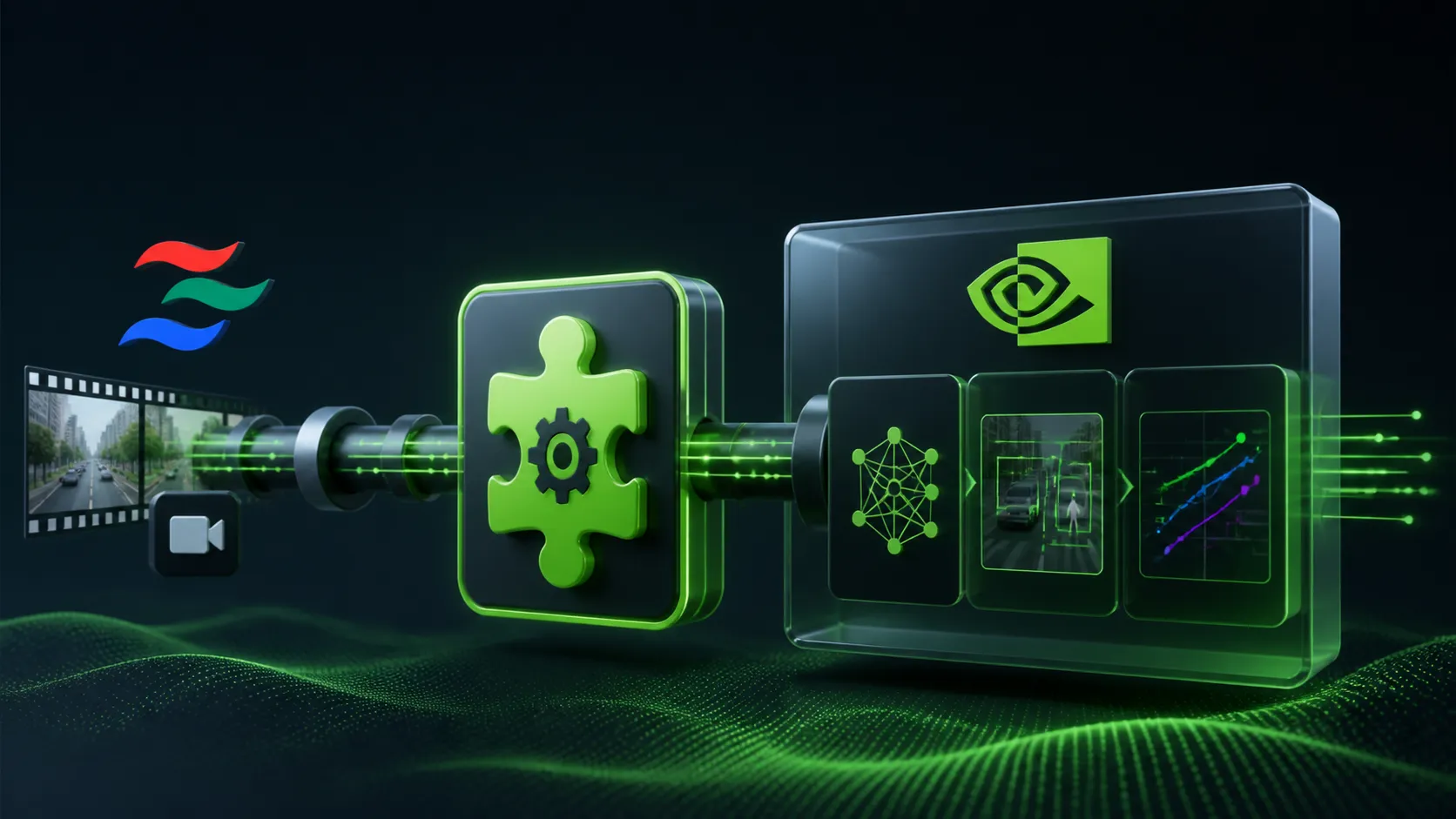
June 20, 2026, (Inside AI) — NVIDIA’s DeepStream framework promises a production-ready pipeline for multi-stream video analytics, but its default inference engine, nvinfer, often falls short when teams need custom models or post-processing. A new approach uses a custom Python GStreamer plugin to replace nvinfer without sacrificing throughput, leveraging DeepStream’s metadata contract.
The Metadata Contract That Unlocks Flexibility
DeepStream’s pipeline relies on a shared metadata structure attached to every buffer. This structure—a hierarchy of NvDsBatchMeta, NvDsFrameMeta, and NvDsObjectMeta—is not owned by any single element. Instead, it acts as a common data contract that any GStreamer element can read or write. This means a custom plugin can inject detections directly, and downstream elements like nvtracker and nvdsosd will function identically.
A critical constraint exists: NvDsObjectMeta instances cannot be created directly in Python. Attempting to do so raises a runtime error because DeepStream manages these objects through pre-allocated memory pools on the C++ side. The correct method is to request an instance from the batch meta using acquire_obj_meta_from_pool, ensuring predictable memory usage.
Building a Python Plugin Without Compilation
To interact with DeepStream from Python, the article uses pyservicemaker, NVIDIA’s supported Python SDK. By subclassing GstBaseTransform and implementing the transform_ip method, developers gain direct access to buffer metadata. The plugin is discovered by GStreamer when placed in a specific directory structure under GST_PLUGIN_PATH, requiring no compilation.
The skeleton involves registering the element with GStreamer, defining pad templates with caps that specify NVIDIA memory, and exposing properties like model-path and config-file. Verification is done via gst-inspect-1.0. This approach maintains zero-copy inference by using DLPack to hand GPU frames directly to TensorRT.
Zero-Copy Inference and Batched Preprocessing
The inference loop uses Ultralytics YOLO as an example, processing batched frames entirely on the GPU. Frames are letterboxed to fit the model’s input size without CPU involvement, and detections are attached as NvDsObjectMeta. A known compatibility issue between TensorRT Python bindings and pyservicemaker requires a surgical override of the __getattr__ method in the Ultralytics backend to prevent segmentation faults.
This pattern is model-agnostic. The article notes that swapping YOLO for Roboflow’s rfdetr or integrating vision-language models via vLLM requires minimal changes. NVIDIA’s own deepstream_reference_apps repository includes a similar example for VLMs.
Practical Implications and Future Directions
The custom plugin approach offers a bridge between DeepStream’s optimized pipeline and the flexibility of Python-based inference stacks. It enables hot-swapping models, custom post-processing, and integration of architectures beyond standard object detectors. While DeepStream-Yolo provides a C++ alternative for YOLO models, this Python method lowers the barrier for teams without C++ expertise.
The full plugin code is available as a GitHub Gist, and the author invites feedback on extensions like multi-stream setups or VLM integrations. This work underscores a growing trend: combining NVIDIA’s hardware acceleration with the rapid iteration cycles of Python ML ecosystems.