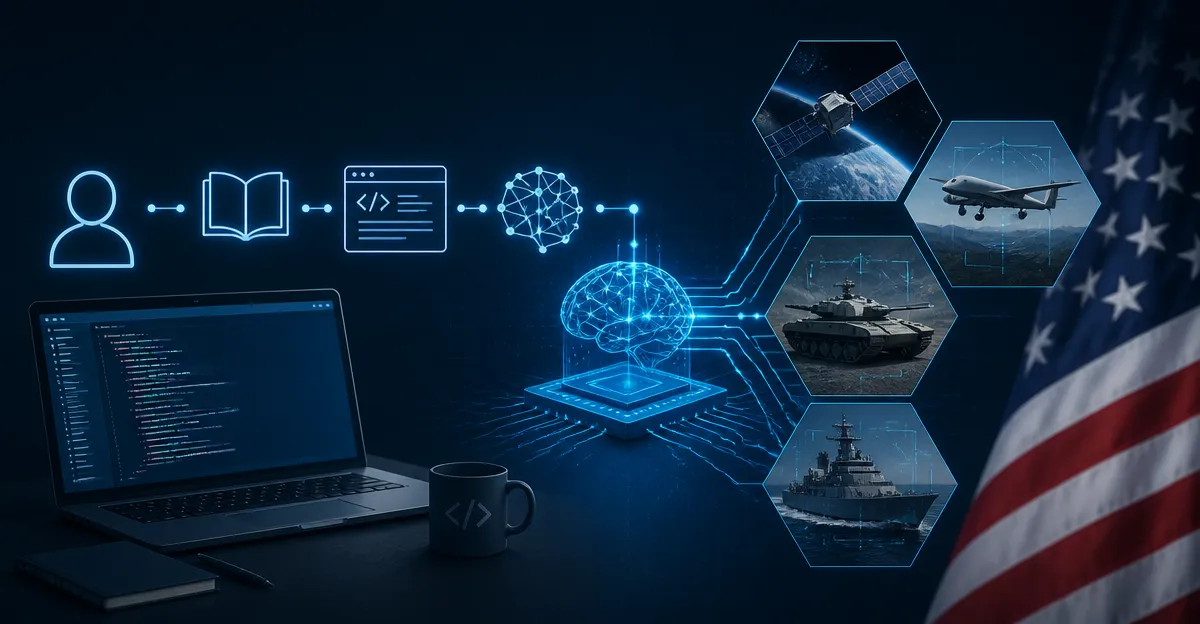
July 8, 2026, (Inside AI) — A U.S. Air Force cadet with no coding experience has built a functional military application using only AI chatbots, raising questions about the future of software development in defense. The project, part of the Department of the Air Force-MIT AI Accelerator’s Phantom Program, tested whether “vibe-coding”—relying entirely on generative AI prompts to write code—could bypass traditional bottlenecks.
Cadet Joshua Lynch, mentored by MIT Lincoln Laboratory’s Laura Niss, spent three months prompting Anthropic’s Claude, OpenAI’s ChatGPT, and Google’s Gemini to create the Remote Operating Modular Augmentation Device (ROMAD-AI). The prototype, initially envisioned for battlefield use, was scaled back to document processing tasks like analyzing tactical maps and generating mission plans.
The Experiment: From Zero Code to a Working Prototype
Lynch’s goal was to see if a nontechnical service member could build software for their specific operational needs. He started with no programming skills, relying on the chatbots’ web interfaces—not integrated development environments. The final version used Google AI Studio App to interface with Gemini’s API.
Niss observed Lynch’s shifting perceptions. “The Phantom student wanted to see if he could create a useful application through self-identified vibe-coding, without any previous experience. Within this project, I wanted to understand how his perception of AI changed over time with use. We both wanted to understand better where and how AI could be used by nontechnical users in the military.”
Lynch quickly hit hurdles. Chatbots often lacked hierarchical focus, altering unrelated code. He learned to break problems into tiny parts, frame questions precisely, and redirect conversations. “Learning to recognize the chatbots’ limitations and effectively work around them took up most of the project timeline,” the report notes.
By the end, ROMAD-AI could process documents but wasn’t secure for operational use. Lynch had to abandon original features like AI-assisted target recognition and autonomous striking. Still, Niss was impressed: “I was quite impressed with this final product, and it showed me how powerful these systems can be at prototyping designs from nonexperts. I’m now of the opinion that these can be powerful tools for nontechnical experts to convey problems and possible solutions to technical experts, and aid in communicating desired outcomes.”
Security Gaps and the Collaboration Imperative
The project exposed critical risks. Lynch unknowingly sent sensitive documents to Gemini’s cloud for analysis instead of processing locally. This oversight underscores the danger of deploying AI-generated code without rigorous review—a bottleneck that persists even as code generation accelerates.
Lynch’s trust in the chatbots also fluctuated. He found them helpful as tutors but noted glaring inaccuracies on familiar topics. Surveys showed Claude’s perceived traits like likeability and intelligence remained more stable than ChatGPT’s across updates. This aligns with broader industry concerns about consistency in large language models.
Niss emphasized the enduring need for human expertise: “For me, this project reinforced the expanse between experts in different fields. No matter how good AI gets, I think we’ll always need to collaborate to get to the best solutions for the most important problems.”
The experiment, sponsored by the Department of the Air Force under Cooperative Agreement FA8750-19-2-1000, suggests vibe-coding can democratize prototyping but not replace traditional development for critical systems. It mirrors a growing trend: the U.S. military is exploring generative AI for everything from logistics to decision support, yet faces a stark gap between rapid prototyping and secure deployment.
For now, ROMAD-AI serves as a proof of concept. Its real value may lie in helping non-coders communicate ideas to engineers, a low-cost bridge across the military’s technical divide. As AI tools evolve, the challenge will be to harness their speed without compromising security—a balance that demands both human judgment and robust vetting pipelines.