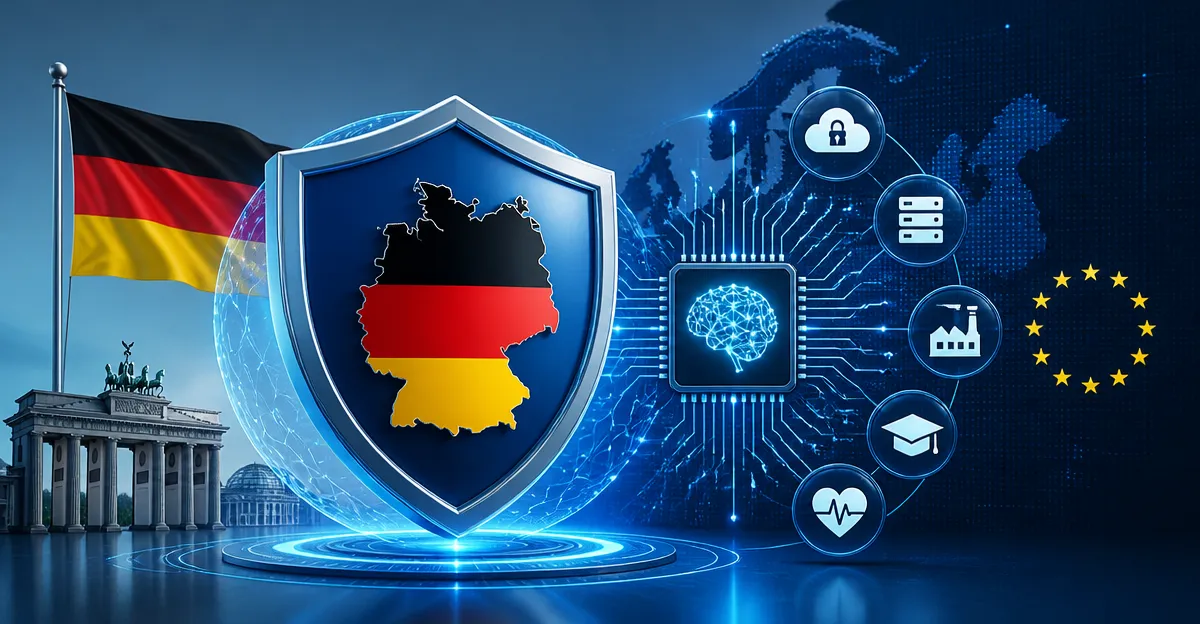
November 2, 2026, (Inside AI) — German Chancellor Friedrich Merz used a Berlin AI conference on Monday to frame digital sovereignty as a survival issue, warning that Germany and Europe risk losing control of the technology stack if they keep relying on outside providers. Merz said the bloc must develop its own artificial intelligence capabilities faster, calling the sovereignty question "truly existential" as AI spreads through the economy.
The remarks land at a moment when Germany's AI ambitions look stronger on paper than in practice. Berlin adopted a national AI strategy in 2018, and a wave of startups has integrated the technology. Yet the country still trails peers on the digital plumbing that makes AI useful at scale. Merz's speech was less a victory lap than a warning about a gap that has widened for years.
Merz Puts Sovereignty At The Center
Merz told the conference that dependence on third parties is the central risk. "That is why we must, at all costs, avoid becoming entirely dependent on third parties when it comes to developing and using this technology," he said. He then sharpened the point: "And that is why the issue of digital sovereignty in the context of AI becomes a truly existential question."
The chancellor described the response as a heavy lift rather than a policy tweak. Adapting would require "an enormous technological and organisational effort, a far-reaching modernisation of our state and our economy," he said, pledging to speed up digitalization. His stated goal is control across the full chain: "After all, the aim is to be able to produce and manage technologies independently, securely and autonomously throughout the entire value chain, from hardware to software."
Read: Japan Asks Anthropic, OpenAI for More Access to Advanced Models
Merz has built institutional muscle around the message. He appointed a minister for digitalization and modernization when he took office last year, and his government has promised to close the technological gap with European economies that moved faster, including the Netherlands and Denmark. Last week he spent five days in Singapore, Japan and South Korea, and he said Germany would seek like-minded partners such as Canada and France.
The sovereignty push mirrors a broader shift in European capitals, where governments now treat AI compute, models and data pipelines as strategic assets rather than ordinary procurement. Germany's industrial base gives it a credible claim in engineering and manufacturing data, but the hardware layer remains dominated by U.S. chip designers and Asian foundries. Merz's value-chain language implicitly acknowledges that gap.
Paper Files And A Thin Tech Sector
The Ifo economics research institute offered a blunt assessment of the starting point. It said Germany is not ready to capture the full benefits of an AI boom, citing a small high-tech sector, poorly digitalized public services and skill shortages. Many public administrative bodies and companies still lean on physical paper correspondence and record keeping.
That diagnosis cuts against the image of Europe's largest economy as a digital laggard only in rhetoric. Paper-based workflows slow the data collection that AI systems need, and a thin domestic tech sector limits the suppliers that could build sovereign tools. Merz acknowledged the scale of the task without naming the bottlenecks. His emphasis on industrial engineering strengths suggests a bet on manufacturing AI and industrial software rather than consumer platforms.
The political test will be whether digitalization funding and procurement rules move fast enough to matter. Germany's federal structure gives states and municipalities heavy influence over administrative modernization, which complicates any national push. Merz's new digitalization ministry can set priorities, but it cannot rewrite local processes by decree.
Read: South Korea's Lee Proposes Record Budget With $15.97 Billion for AI
For European AI vendors, the speech signals potential demand for domestic alternatives in public administration and regulated industries. For Germany's startups, it offers a rhetorical tailwind but no guarantee of contracts. The gap between sovereignty as a slogan and sovereignty as a supply chain remains the story to watch.