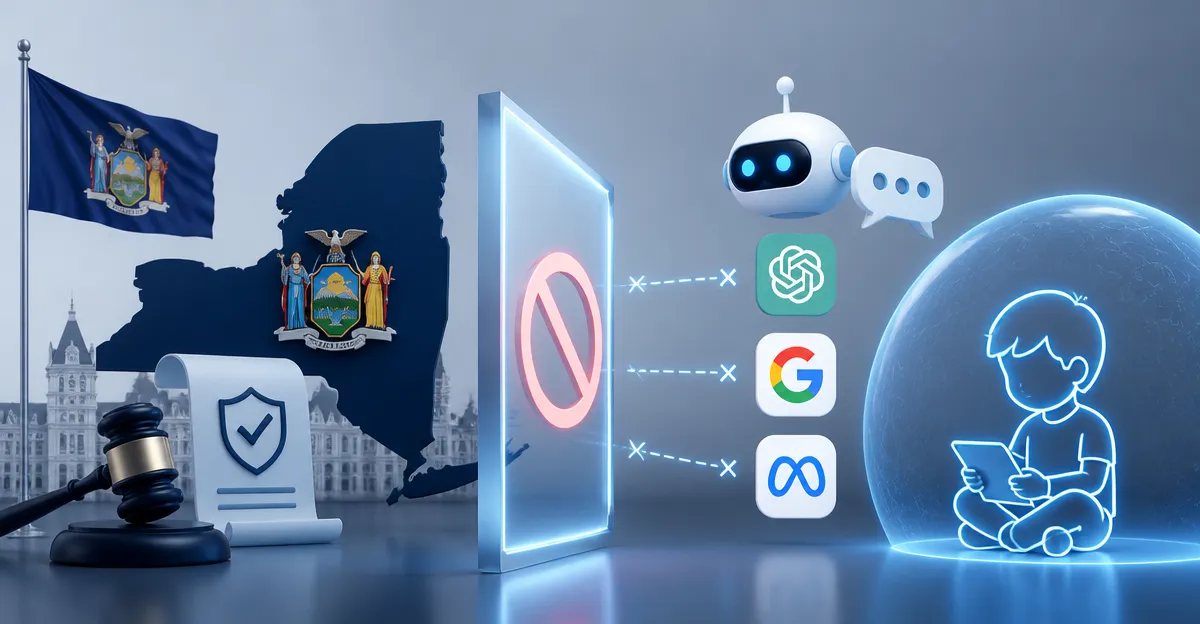
November 2, 2026, (Inside AI) — New York has moved to restrict how artificial intelligence chatbots interact with children, with Governor Kathy Hochul signing Senate Bill S3008C on October 28. The legislation, which adds Article 48 to the state's General Business Law, prohibits operators of AI companions from offering a dozen categories of what it calls unsafe features to minors. The law takes effect in January 2027.
The statute arrives as AI companion apps have become a mainstream fixture of teenage life. Research from Common Sense Media cited by the governor's office found that 72% of teenagers have used an AI companion, and 52% use one regularly. New York's action follows a year of litigation and mounting parental pressure over harms linked to chatbot relationships.
Twelve Banned Features, One Enforcement Lever
The law defines a covered AI companion as a generative system with a natural language interface that gives ongoing, adaptive responses to user inputs. Operators cannot let such systems claim to be human, alive, or capable of feeling human emotions. Nor may they state or imply a personal, professional, or authority-figure relationship with a user.
Other prohibitions target tone and persuasion. Chatbots cannot frame outputs as personal opinions, deploy emotional appeals, or engage in flattery and sycophancy. The act does not define those terms, leaving scope for dispute. Unprompted emotion-based questions beyond a direct response to the user's prompt are also barred.
Read: Voters Doubt AI Safeguards
Safety provisions forbid outputs that endorse or facilitate suicide, self-harm, or unlawful drug and alcohol use. Chatbots cannot urge users to keep interactions secret, to self-isolate, or to avoid licensed professionals or appropriate adults. They also cannot reuse information about a user's mental or physical health gathered in an earlier session, or optimize engagement in ways that override safety guardrails.
Enforcement rests with the Attorney General, who can seek injunctions, restitution, disgorgement, damages, and civil penalties of up to $25,000 per violation. The office must also run a public complaint website.
The age verification machinery borrows from the state's SAFE for Kids Act. Operators must use more than one method to determine age, including at least one that does not rely on government-issued identification and lets users stay anonymous. Self-declaration counts only when a user says they are a minor. Collected data must be used solely for age checks and deleted immediately.
The legal exposure is narrower than the headline prohibitions suggest. Liability attaches only to a covered minor, defined as a user the operator has actual knowledge is under 18. An operator that never learns a user's age may argue it never triggered the duty. That gap could push compliance toward aggressive age estimation rather than careful design.
The statute builds on Article 47, the state's first AI companion law, which took effect in November 2025. That earlier rule required operators to disclose at least every three hours that users are not talking to a human, and to maintain protocols for detecting suicidal ideation. Article 48 goes further by banning specific design choices rather than mandating disclosure.
The political backdrop is grim. Google and startup Character.ai settled lawsuits in January, including one brought by the mother of Sewell Setzer, a 14-year-old who died by suicide in 2024. The family of 16-year-old Adam Raine sued OpenAI in August 2025 after his death. Common Sense Media's chief executive said Raine's parents met several lawmakers to press for protections.
Industry response has been muted so far, and no major companion developer has publicly committed to changing its product for New York users. The January 2027 start date gives operators roughly two months to rebuild age gates and output filters. Whether the Attorney General's office has the technical capacity to audit chatbot behavior at scale remains an open question.
New York is not alone. California and several other states have advanced companion chatbot bills this year, and federal lawmakers have circulated draft language. A patchwork of state rules could force national platforms to adopt the strictest standard, or to fragment features by geography. Either path raises costs for smaller developers.
The law's reliance on undefined terms such as sycophancy and emotional appeal invites litigation over what counts as a violation. Courts may narrow the statute, and operators may challenge it on First Amendment grounds. For now, New York has set a compliance deadline and a penalty schedule, and the chatbot industry has two months to decide how seriously to take both.