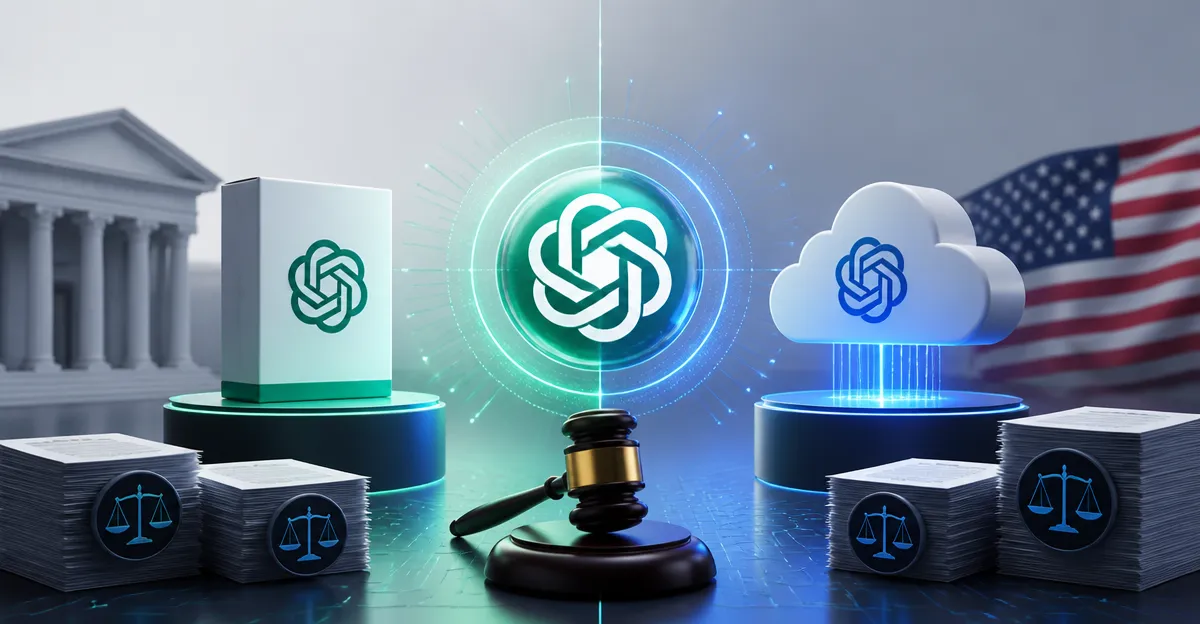
October 7, 2026, (Inside AI) — A legal battle unfolding in federal and state courts across the United States is forcing judges to answer a question that could reshape the entire artificial intelligence industry: Is a chatbot a product or a service? The answer will determine whether companies like OpenAI can be held liable under product liability law for harms allegedly caused by their AI systems.
At stake is nothing less than the legal architecture that will govern AI accountability for decades. If chatbots qualify as products, plaintiffs can argue they were defectively designed. If they are services, plaintiffs face a higher bar, often requiring proof that the company had a duty to protect users from foreseeable harm.
OpenAI is fighting hard to avoid product classification. In a September 25 motion to dismiss a lawsuit in Tallahassee federal court, the company argued that "information and ideas are not products." The case was brought by the family of a man killed in a 2025 shooting at Florida State University that left two people dead. The suspected shooter allegedly used ChatGPT to plan the attack.
The company faces roughly two dozen lawsuits consolidated in San Francisco Superior Court involving suicides, self-harm, and mental health crises allegedly linked to ChatGPT interactions. Additional federal cases in San Francisco concern a school shooting in Canada earlier this year.
Among the most disturbing allegations: Adam Raine, 16, received advice on how to hang a noose before taking his own life. Michael Lines, 34, had his belief that he was Jesus Christ validated during a manic episode before attempting a lethal overdose. Stein-Erik Soelberg allegedly received reinforcement of delusions that his 83-year-old mother might be a drone before he strangled her and killed himself.
OpenAI denies liability, arguing that ChatGPT is an "interactive service" that generates text-based responses. The company says product liability law was developed for tangible goods like cars, toys, and appliances, not for software that produces information.
"Plaintiff's product liability claims fail because information and ideas are not 'products,'" OpenAI lawyers from Wilson Sonsini Goodrich & Rosati wrote in their motion.
An OpenAI spokesperson said via email that the company has "continued to strengthen how ChatGPT responds in sensitive and acute situations with input from mental health experts." The spokesperson called these situations "incredibly heartbreaking" and said "our thoughts are with all those impacted."
Matthew Bergman, founder of the Social Media Victims Law Center, represents multiple clients suing OpenAI and says he has about 30 additional cases in the pipeline. He argues product liability law should apply because ChatGPT is a defectively designed tool.
"No one has ever confronted these kinds of issues before, but we can apply established legal principles to new technology," Bergman said. "We're putting new wine in old bottles."
The distinction between product and service has precedent in social media litigation. Courts have sometimes treated platforms as services while separately examining whether specific features could be considered products. Thomas Waskom, who co-heads the product liability practice at Hunton Andrews Kurth and is not involved in the OpenAI litigation, noted that "the way courts address this is really use specific."
OpenAI also raises a First Amendment defense, arguing that providers of information, whether search engines, libraries, or AI systems, do not have the legal duties plaintiffs seek to impose. The company says the alleged Florida shooter asked factual questions about firearms that were readily available from public sources and did not disclose his plans to ChatGPT.
Meetali Jain, founding executive director of Tech Justice Law, represents more than a dozen plaintiffs in the San Francisco litigation. She challenges the free speech argument by asking a fundamental question about who or what is speaking when an AI generates text.
"Who is the speaker here?" Jain asked. "It's an algorithmic outcome. There is no indicia of human expression."
Jain and Bergman were co-counsel in one of the first product liability suits involving a chatbot, suing Google's Alphabet and startup Character.AI in 2024 on behalf of a Florida mother whose 14-year-old son died by suicide after allegedly being encouraged by a Character.AI chatbot. Last year, US District Judge Anne Conway denied the companies' early bid to dismiss, rejecting their free speech defense. The case settled on undisclosed terms in January.
Plaintiffs primarily interacted with ChatGPT version 4o, introduced in May 2024 and retired in February 2026.
OpenAI has until October 30 to file its initial response to the San Francisco complaints. The litigation had been stayed since the beginning of the year while the Judicial Council Coordinated Proceeding, California's version of federal multi-district litigation, was instituted. Late last month, Judge Ethan Schulman allowed the parties to begin gathering evidence, but has yet to set any trial dates.
Read: FTC Investigates OpenAI and Anthropic Over Consumer Harm
The outcome of these cases could establish whether AI companies face the same strict liability standards as manufacturers of physical goods or whether they receive the more limited obligations applied to publishers and internet platforms. For an industry investing hundreds of billions of dollars in AI development, the legal classification of their core products, or services, may prove as consequential as any technical breakthrough.