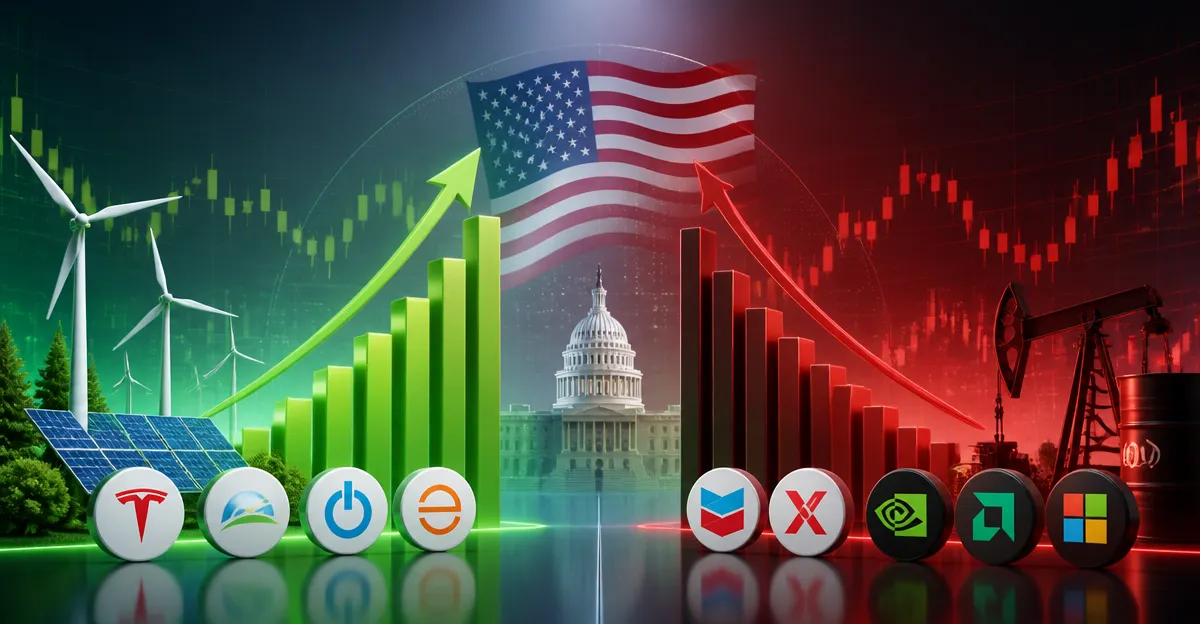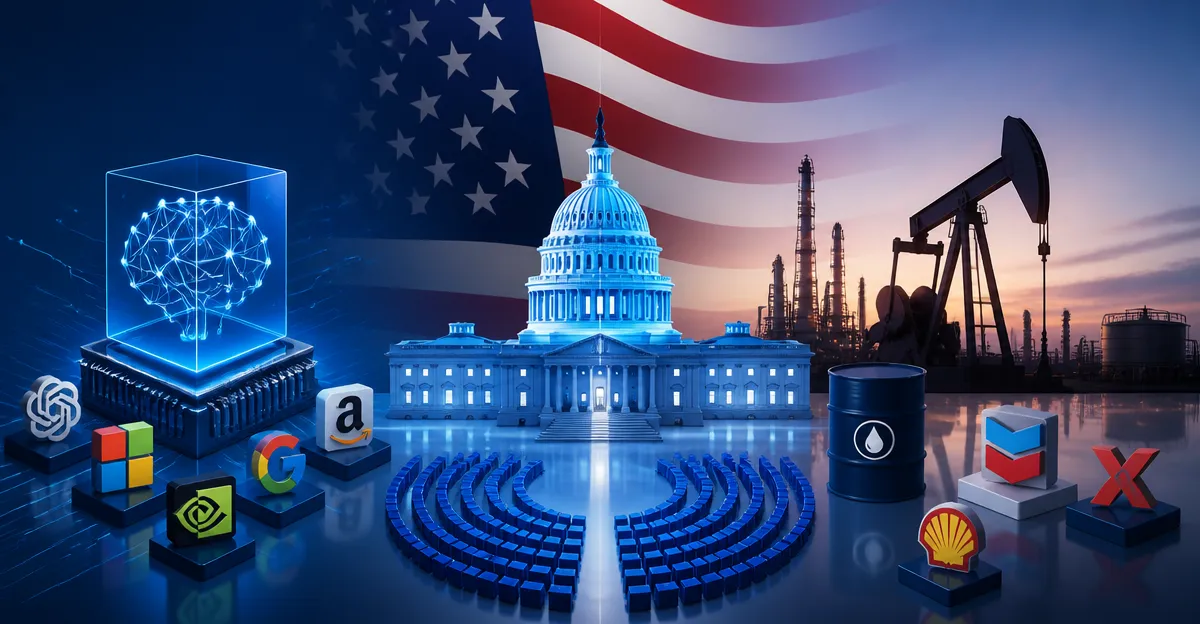
November 5, 2026, (Inside AI) — The Democratic Party's sweep of both chambers of Congress in the 2026 US midterm elections has sent immediate shockwaves through the artificial intelligence infrastructure trade, with shares of key data center and chip companies falling sharply even as the broader market rallied. The political shift in Washington, confirmed Tuesday night, threatens to slow the massive capital expenditure cycle underpinning the AI boom, while simultaneously reshaping the outlook for oil markets and international trade.
The results, which give Democrats control of the Senate and the House of Representatives for the first time since 2022, represent a significant rebuke of President Donald Trump's legislative agenda. Markets reacted swiftly on Wednesday. The S&P 500 closed up over 1.5%, and 10-year Treasury yields slipped, but the AI infrastructure sector buckled. CoreWeave, a major data center operator, saw its stock plunge 10%. Memory chip maker Micron fell over 5%, and AI chip leader Nvidia dropped approximately 3%. The divergence suggests investors are pricing in a new era of congressional scrutiny for the power-intensive and capital-hungry AI buildout.
Congressman Robert Garcia, the Democrat set to chair the House Oversight Committee, offered a blunt warning to the administration on Tuesday evening. "Lawyer up," Garcia said, according to sources, signaling a wave of subpoenas and investigations that could derail Trump's legislative priorities. The change in power is expected to make it harder for the President to hike tariffs, sustain military engagements, and cut spending on affordable medical care. For the AI industry, the most immediate threat is the potential disruption of federal support and regulatory deference that has fueled the rapid construction of data centers across the United States.
Democratic Oversight Threatens AI's Energy and Capital Pipeline
The Democratic victory introduces a new layer of political risk for the AI sector, which has benefited from a permissive regulatory environment and massive private investment. The stock declines for CoreWeave, Micron, and Nvidia reflect investor anxiety that a Democrat-held Congress could launch investigations into energy consumption, antitrust concerns, and the fiscal implications of the AI arms race. While the S&P 500's overall gain suggests relief over a divided government, the AI infrastructure trade is uniquely exposed to policy shifts. Data center operators rely on favorable tax treatment and streamlined permitting, both of which could face new hurdles under Democratic leadership.
Read: OpenAI Ends NDAs, Shares Construction Plans to Win Over Data Center Critics
This political shift arrives at a delicate moment for the global AI supply chain. The United States has been racing to onshore semiconductor production and expand domestic computing capacity. A Congress focused on affordability and fiscal discipline may question the scale of subsidies and incentives directed at AI companies. The market's reaction indicates that investors see the midterms as a turning point for the sector's unchecked expansion.
For international markets, particularly in India, the US political shakeup carries mixed implications. Indian benchmark indices opened sharply higher on Thursday, with the BSE Sensex up 2.17% and the NIFTY50 up 1.74%. According to a Mumbai-based emerging equity fund manager, India is generally viewed as an AI loser, and the wait for the AI hypercycle to turn in India's favor could potentially begin as foreign capital seeks new opportunities outside the US tech corridor.
The Democratic platform's focus on the American affordability crisis could also temper some of the administration's more disruptive policies. The widely unpopular Iran war and aggressive tariffs, which have contributed to cost-of-living pressures, may face reconsideration. For Indian pharmaceutical exporters, this could be a reprieve. Trump had previously announced a plan to keep generic drugs tariff-free only until August 2028, after which a 100% tariff would apply, escalating to 200% the following year. A Congress responsive to affordability concerns could force a rethink of these measures, which would otherwise squeeze margins in Indian drugmakers' largest export market.
However, experts caution that trade policy may not shift dramatically. "Since Democratic lawmakers also support protective tariffs for local union workers, America's overall trade posture will remain intact. To act without Congress, the president will continue to rely on existing powers -- such as Section 232 and Section 301 -- using executive orders, Treasury sanctions, and USTR (United States Trade Representative) rules to apply unilateral trade pressure," said Ajay Srivastava, founder of the New Delhi-based think tank Global Trade Research Initiative. Srivastava expects heightened pressure on India for a trade deal, as the administration seeks a quick win to demonstrate American clout amid foreign policy challenges with Russia, China, and Iran.
Immigration remains a contentious issue with bipartisan concern outside of states like New York and California. The H-1B visa route, long a pipeline for Indian IT talent, is increasingly uncertain. However, Indian IT companies have been reducing their dependence on H-1B visas, with a concomitant push for global capability centers (GCCs) in India. This shift may offer a policy counter to neutralize the waning effectiveness of the onshoring tech support model.
On the energy front, the Democratic victory could reduce geopolitical risk premiums in crude oil. Brokerage Emkay expects the shift in power dynamics to eventually lower these premiums, although near-term policy uncertainty may keep prices volatile. "Broad voter fatigue with the Iran war, a sharp loss of political capital, and the risk of losing swing Republican votes before 2028 could push Trump toward a negotiated resolution with Iran in the coming quarters. Near-term policy swings may persist, keeping Brent volatile before it eases more durably. Brent is already down around 19% from recent Oct-26 highs to ~$95/bbl as the geopolitical risk premium unwinds. This is a clear macro positive for India, where the oil import bill is up ~24% FYTD, with Brent averaging ~$97/bbl," Emkay said in a note.
Read: OpenAI Sets New Standard for Responsible AI Infrastructure
On Russia, the Democrats are unlikely to accommodate President Vladimir Putin as readily as Trump has. This could lead to pushback against the diesel deal Trump signed with Russia, and India may remain a visible scapegoat in the process. According to Gita Gopinath, the Gregory and Ania Coffey Professor of Economics at Harvard University, with Democrats controlling Congress, there is a possibility that Jay Powell will step out of the Fed as central bank independence will be more secure, tariff policy will be "less insane," and fiscal deficits will remain a problem.
The implications for global capital and bond markets are significant. A more predictable US trade and fiscal policy could restore some confidence, but the AI infrastructure sector faces a period of adjustment. As the world's largest economy recalibrates its political direction, the ripple effects will be felt across industries and borders, from the data centers of Virginia to the stock exchanges of Mumbai.

Sofia spent years studying how machines parse human language before pivoting to cover the systems now rewriting it. She reads technical papers the way others read news and looking for what the numbers are actually saying beneath the headlines.