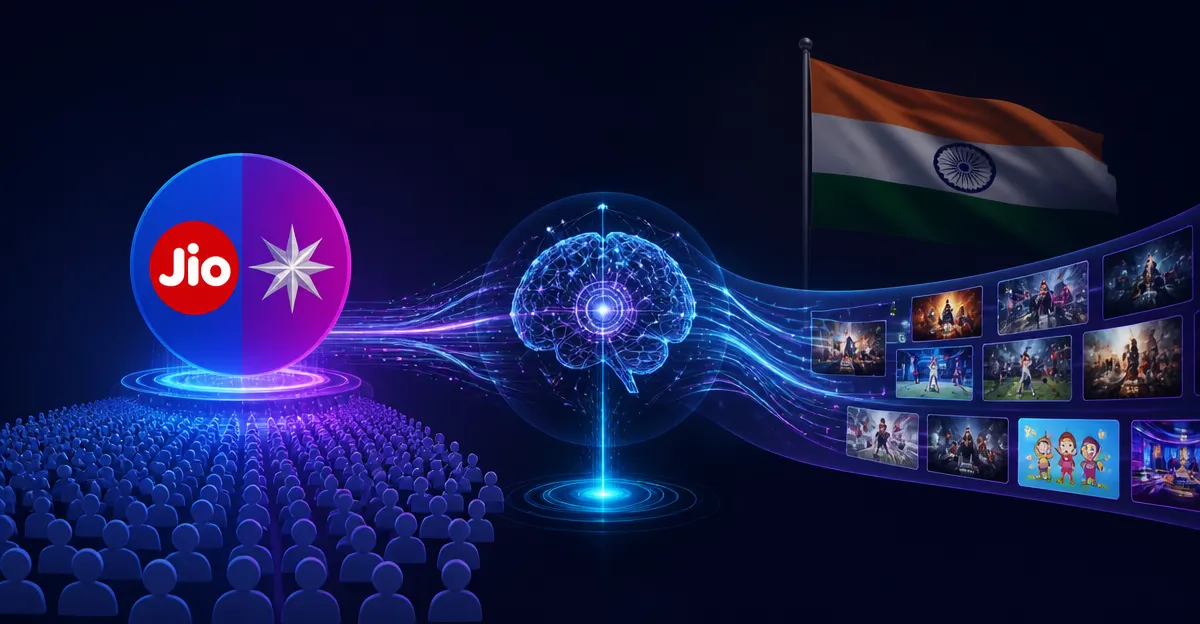
November 12, 2026, (Inside AI) — JioStar, the entertainment and sports streaming giant serving over 500 million users, has built a conversational AI assistant into its JioHotstar platform that lets viewers find movies, live cricket moments, and detailed statistics using natural voice or text. The system, developed in roughly eight weeks across more than 15 languages, handled up to 72.5 million concurrent viewers during major cricket tournaments. The details emerged from a conversation between Vijay Seshadri, Chief Architect at JioStar, and Sidharth Sharma, OpenAI's Head of Go-to-Market for ASEAN, at OpenAI's Executive Summit in Singapore.
The project underscores a broader shift in enterprise AI: moving from experimental demos to production systems that must balance accuracy, latency, and cost at massive scale. JioStar's experience offers a rare window into the tradeoffs and lessons from deploying AI where millions of users expect instant, reliable answers.
Why Voice-First Discovery Changes the Game
Content discovery has barely evolved in 25 years, according to Seshadri. Recommendation algorithms were the last major leap, and most subsequent changes have been incremental. But choosing what to watch is deeply personal, and traditional systems often miss the nuance. A viewer might say, "I'm feeling sad. Show me something that will cheer me up." A recommendation engine may struggle to interpret that emotional context. Conversation, Seshadri argues, gives viewers a way to explain their mood and intent. JioStar calls this a voice-visual interface.
The company found that more than 60% of its users prefer voice over text. That preference shaped the technical design from the start. "Very early, we framed the problem as a three-way tradeoff among accuracy, latency, and cost," Seshadri said. "Every engineering decision had to balance all three at once."
Read: Singapore Airlines Reports 2x Chatbot Satisfaction With OpenAI Models
Building for two distinct audiences, entertainment viewers and cricket fans, added complexity. An entertainment viewer might ask for a surprise movie on a Friday evening. A sports fan might want a specific update like fall of wickets or a series of sixes. Cricket experts may demand ball-by-ball statistics. JioStar worked to unify these discovery problems into a single experience across multiple languages.
The eight-week timeline, driven by a major cricket tournament in February, forced the team to prioritize. They started with a small group of data scientists and engineers, working alongside OpenAI's forward-deployed engineers. The first decision was scope: defining what the system should not answer. Guardrails came before features.
The Hidden Cost of Moving Fast
JioStar's rapid build relied on a maker-checker pattern: one model helped determine how to answer a question, while another acted as a validator, an LLM as judge with a competing objective. That raised a meta-question: who tests the judge? Designing the validator became an evaluation problem in itself. Codex, OpenAI's code generation tool, accelerated work such as generating eval cases and updating the system. But faster building did not remove the need for human judgment and validation.
Domain experts proved essential. For sports-statistics evals, JioStar worked with sports-magazine editors who understood what serious fans might ask. "You cannot begin with a prompt alone; you need to seed the system with deep human expertise," Seshadri said.
Looking back, Seshadri would invest earlier in production monitoring for model efficacy. Traditional infrastructure metrics like P99 latency remain important, but they are not enough. You also need to monitor how well the model performs in production, not just how fast it responds.
The JioStar case illustrates a broader pattern in enterprise AI: the gap between a working demo and a reliable production system is often underestimated. Many companies focus on input metrics like lines of code generated, which do not necessarily translate to meaningful value. Seshadri warns against mistaking visible motion for progress. "Most enterprises underestimate the human skill and agency required," he said. "This cannot be only a generic skilling program. Leaders need people who can apply these tools with judgment."
That judgment extends to validation and guardrails. "Give a strong engineer a tool like Codex and the impact can multiply; without the judgment to validate production systems, the risk multiplies too," Seshadri added. His closing advice: "You have a rocket in your hands. Especially in production systems, you need validation and guardrails, and you need to give the keys to the right people."
Read: Gilbert + Tobin CEO Sam Nickless Deploys Agentic AI in Legal Workflows
As AI moves from experimentation to core infrastructure, JioStar's experience suggests that success depends less on the latest model and more on disciplined engineering, domain expertise, and a culture of validation. The company's eight-week sprint may have delivered a working product, but the real work of monitoring and improving it has only just begun.

Shamil has a low tolerance for AI that only works in controlled demos. He covers agentic systems and generative AI with the skepticism of someone who has seen too many “revolutionary” tools quietly disappear six months after launch.