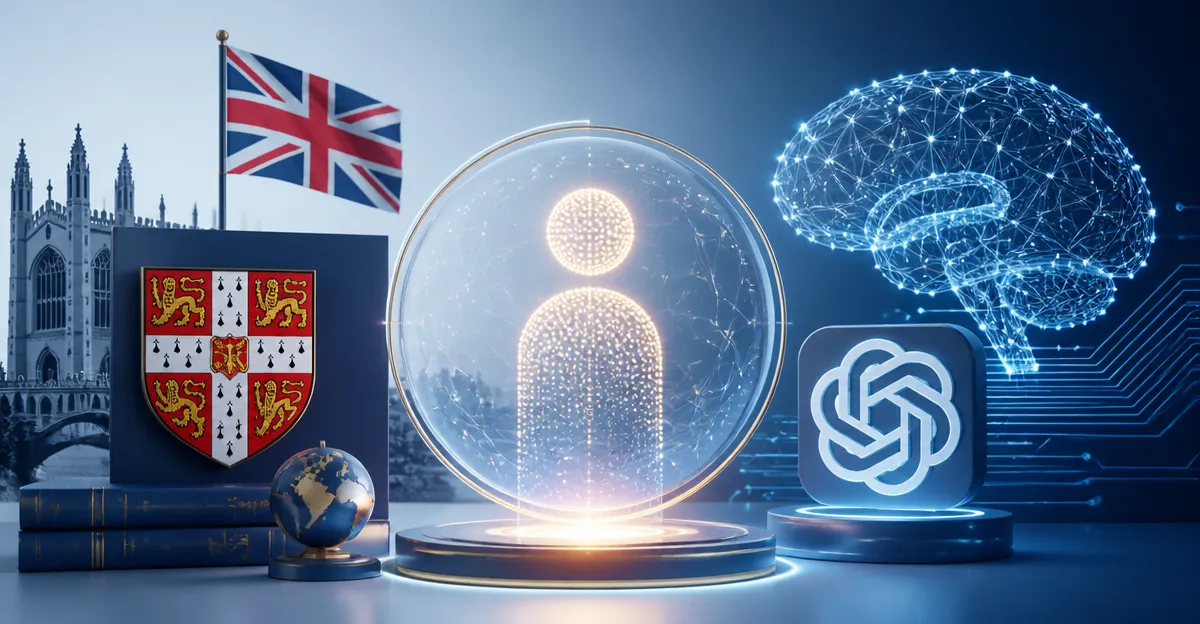
November 18, 2026, (Inside AI) — Cambridge Dictionary has named 'human' its Word of the Year 2026. The announcement comes as artificial intelligence systems increasingly perform tasks once considered uniquely human, from writing to reasoning. The choice, revealed this week, is not a celebration of the species but a marker of a cultural moment. It reflects a growing unease about what distinguishes people from machines.
Cambridge's selection follows a sequence of AI-inflected picks: 'hallucinate' in 2023, 'manifest' in 2024, and 'parasocial' in 2025. Each word tracked a shift in public conversation. Now 'human' has become the lexical battleground. The dictionary's lexicographers say the word's usage has changed. New compounds like 'human-made' and 'human-written' have proliferated, used to separate human work from AI output. The word has acquired a new job: drawing a line.
The timing is not accidental. AI models now generate essays, images, and code at scale. Debates over AI safety, copyright, and authenticity dominate policy circles. In this environment, the word 'human' has become a legal and ethical boundary marker. It appears in contracts, regulations, and product labels. The dictionary's choice captures a linguistic response to technological change.
"Every year, dictionaries select a Word of the Year to capture something larger than language itself: the cultural mood, collective anxieties, aspirations and preoccupations of a particular moment in history," said Radhika Dua, English Language and Verbal Reasoning Faculty at Career Launcher. She added that the choice is not necessarily the newest or most frequently used word, but one whose usage and cultural resonance make it representative of its time.
Cambridge Dictionary lexicographer Colin McIntosh pointed to the growing use of expressions such as 'human-made', which distinguish work created by people from that generated by AI. "AI is changing how we talk about being human," McIntosh said in a press statement.
The selection also highlights a paradox. The more capable machines become, the more urgently people ask what makes them human. Dua called the choice deeply ironic. "The more sophisticated our machines become, the more urgently we seem to be asking ourselves what it means to be human," she said.
This irony has practical consequences. As AI systems produce text, art, and decisions, institutions are scrambling to define human authorship. The EU AI Act, for instance, requires transparency about AI-generated content. The US Copyright Office has ruled that AI-only works cannot be copyrighted. These legal frameworks rely on a clear distinction between human and machine. The word 'human' has become a regulatory tool.
But the distinction is not always clear. AI systems can mimic empathy, creativity, and even forgiveness. They can generate apologies and expressions of remorse. Dua argued that human qualities like empathy, forgiveness, and the ability to find meaning in inexplicable experiences remain integral to the human condition. "I am reminded of Alexander Pope's famous words: 'To err is human; to forgive, divine.' Perhaps our imperfections are not shortcomings to be engineered away," she said.
That view challenges the AI industry's drive toward perfect, error-free systems. If imperfection is central to humanity, then the pursuit of flawless AI may miss the point. The Word of the Year suggests that people are not ready to cede their flaws to machines.
The choice also reflects a broader trend. Dictionaries have long used Word of the Year to comment on social change. Oxford's 'rizz' in 2023 and Merriam-Webster's 'authentic' in 2023 followed similar logic. But Cambridge's pick is more directly tied to AI. It acknowledges that the technology has altered not just what people do but how they describe themselves.
Read: The Uncanny Valley Now Swallows Human Identity, Not Just Robots
As AI continues to advance, the word 'human' may become more contested. It could appear in new phrases and legal definitions. It may even become a brand label for authenticity. For now, Cambridge's choice serves as a reminder. In the age of AI, the oldest word in the dictionary has become the newest question.

Sofia spent years studying how machines parse human language before pivoting to cover the systems now rewriting it. She reads technical papers the way others read news and looking for what the numbers are actually saying beneath the headlines.