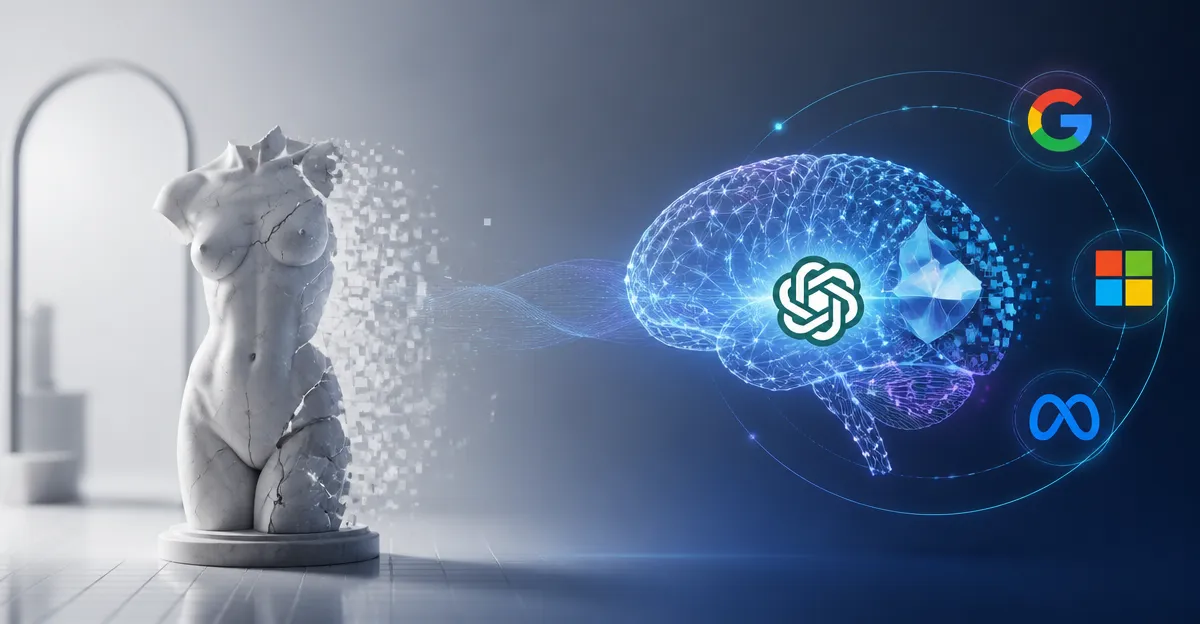
August 19, 2026, (Inside AI) — Masahiro Mori first named the “uncanny valley” in 1970 to explain why near-human robots unsettle us. Now that valley has swallowed human identity itself.
People increasingly reshape their faces, voices, and writing to mimic machine-like perfection. A 2025 Max Planck Institute for Human Development study found a measurable shift in language after ChatGPT launched. Researchers analyzed 360,000 YouTube videos and 772,000 podcasts. They found people began using AI-preferred words such as “delve,” “boast,” and “meticulous” far more often, even in speech.
The philosopher Günther Anders predicted this trajectory in 1956. In The Obsolescence of the Human, he argued that technological progress would breed a new self-contempt. Humans would feel ashamed of their “bodily clumsiness” and “corporeal imprecision.” They would envy the perfection of mass-produced goods.
Anders wrote:
Read: AI Consciousness Debate
“Each day out of machines arise ever more beautiful machines. Only we remain malformed, only we’re born obsolete.” Günther Anders, philosopher
His prediction was not rebellion against machines. It was imitation of them. Humans would aspire to become standardized, optimized, and literally “put together.”
From cosmetic surgery to cognitive mimicry
Cosmetic procedures are booming globally as prices fall. The goal often is not to look natural, but to adopt product design logic: symmetry, recognizability, flawless contour. Faces associated with Kim Kardashian and the angular chins sought by “looksmaxxers” reflect this shift.
The same impulse now extends to the mind. The shame of comparing a “small, moody and heat-sensitive brain” to relentless AI computing power is spreading. Four years after ChatGPT’s public launch, AI use keeps expanding, just like cosmetic procedures.
The cycle is vicious. Better AI imitates humans minus our flaws. We perceive our minds as defective. We use AI more, and we start to talk, sing, and behave like technology.
Read: AI Personality Problem
The uncanny valley becomes a home
Mori’s uncanny valley described discomfort with robots that almost pass as human. The trigger may be our inability to categorize something as human or not. Or features that seem “off” may resemble signs of disease or death.
For a robot, triggering that sensation means failure. For a human, it signals something else. The unease now appears in a date’s oddly staccato text message. A tender love ballad created by a program that never experienced heartbreak. A former colleague who once wrote one-line emails now publishing polished essays weekly.
That persistent suspicion about whether what we see, read, and hear is human now accompanies us everywhere. Both humans and technology are moving into the same hybrid grey space. The uncanny valley is no longer a place we visit. It is the space we inhabit.
Yet the lingering unease should not be eliminated. It should be cultivated. As long as something in us recoils from that world, there is hope. Recognizing our own self-alienation is the first step toward resisting it.