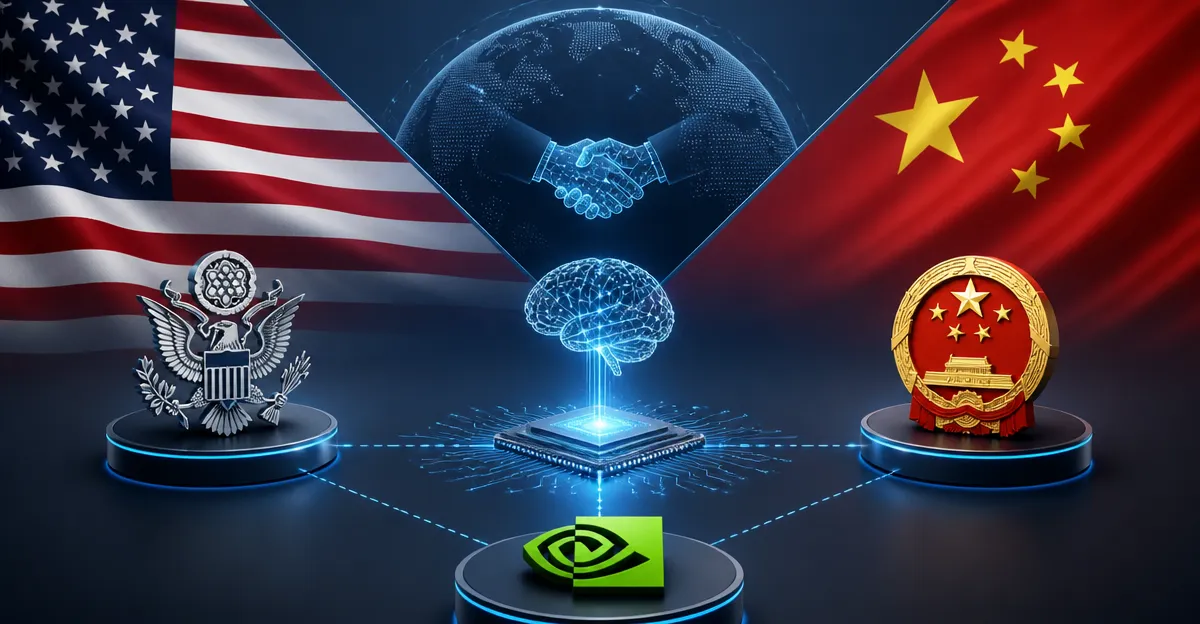
November 19, 2026, (Inside AI) — President Donald Trump said he spent an evening with Chinese President Xi Jinping discussing artificial intelligence, but the conversation barely touched on Nvidia CEO Jensen Huang. The remarks came during a wide-ranging appearance in which Trump described the two leaders sitting side by side at a dinner and talking at length about technology competition.
The disclosure matters because it lands in the middle of a sensitive stretch for U.S.-China tech policy. Washington continues to tighten export controls on advanced chips, while Beijing pushes for domestic alternatives. Any hint of presidential-level bargaining over AI carries weight for chipmakers, cloud providers, and governments watching the two largest economies.
Trump framed the exchange as evidence of American strength. "I was with President Xi all night last night, sitting next to him at the dinner, right on his right-hand side. And we spoke the whole evening, and we talked about that. And he's amazed at how well we've done with that. We're leading China. We're leading the whole world. And whoever wins SI wins."
The phrase "SI" appears in the transcript, likely a speech-to-text slip for AI. The transcript itself was produced with AI technology and was not reviewed or edited by journalists, so some errors are expected.
On Jensen Huang, Trump was brief. He said the Nvidia chief was not a central topic. "We did not discuss it. I might have referred to it just briefly because it's such a tragedy. It's a tragedy. He's such a brilliant man. I'd love to, frankly, I don't know what the board sounds like, you know, they have their own ideas, but he can't replace people. Some people can't be replaced. He was 10 years ahead."
Trump then turned to Nvidia's Blackwell chip. "The Blackwell chip is 10 years ahead of any other chip. And the interesting thing is he can't be copied, you know, because of the level of complexity."
The comments mix praise for a private executive with a claim about technical superiority. Nvidia's Blackwell architecture is indeed the company's flagship AI accelerator, and it sits at the center of U.S. export policy. But the idea that it cannot be copied is contested. Chinese firms such as Huawei are investing heavily in alternatives, and U.S. officials have repeatedly warned that smuggling and reverse engineering erode the lead.
The White House did not provide a fuller readout of the dinner. Inside AI could not independently verify the details of the conversation. Trump's remarks suggest that AI was on the agenda at the highest level, even if the public record remains thin.
For Nvidia, the episode is a double-edged signal. Presidential praise can boost confidence in the company's moat. But it also draws attention to the political scrutiny around its market position. Huang has become a frequent visitor to Washington, and Nvidia's chips are the subject of ongoing policy debates over what can be sold abroad.
The bigger question is whether personal diplomacy between Trump and Xi can produce a stable framework for AI competition. Both governments are pouring money into domestic capacity. Both are courting allies. A dinner conversation does not settle those issues, but it does show that leaders see AI as a top-tier strategic file.
Trump's remarks also reveal a familiar pattern: he personalizes tech policy around individual executives. By singling out Huang, he elevates a CEO to a role usually reserved for cabinet officials. That style can open doors, but it can also complicate the separation between corporate strategy and national security.
In the coming weeks, watch for any follow-up from the administration on chip export rules. Also watch Nvidia's own disclosures about Blackwell supply and demand. The dinner itself may fade, but the policy signals will not.

Sofia spent years studying how machines parse human language before pivoting to cover the systems now rewriting it. She reads technical papers the way others read news and looking for what the numbers are actually saying beneath the headlines.