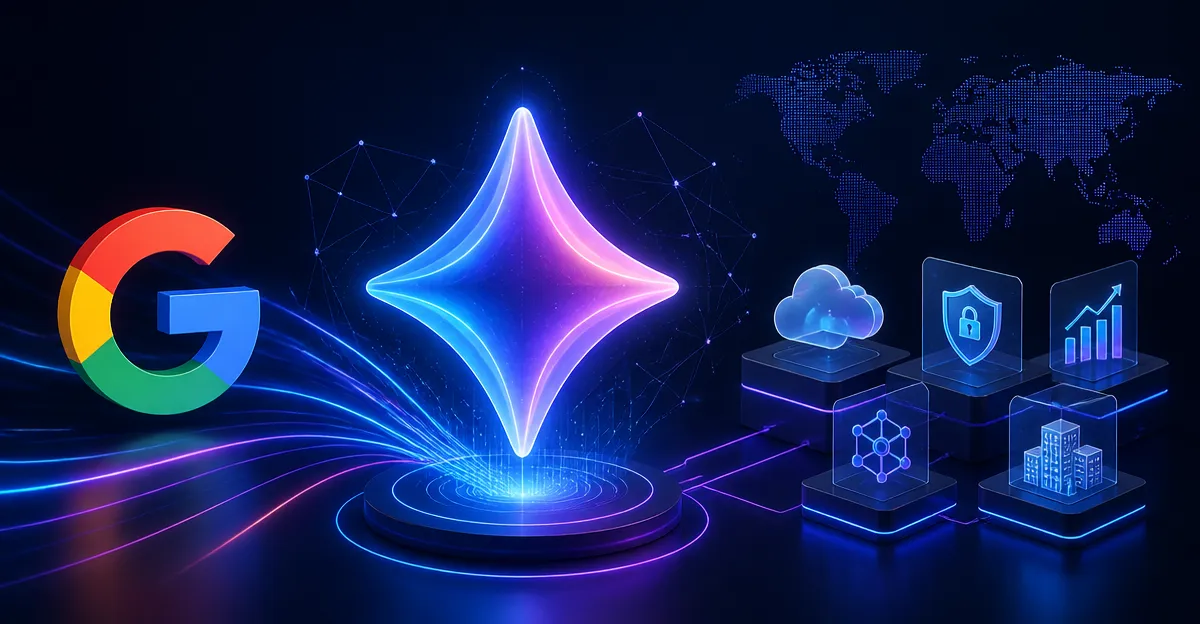
November 19, 2026, (Inside AI) — Google on Wednesday launched Gemini 4 Neon, a new AI model built for enterprises that need to complete complex, multi-step tasks quickly and at lower cost. The model combines frontier-level reasoning with faster end-to-end task completion across software engineering, knowledge work, and science workflows, according to the company.
Neon is positioned below Google's top-tier models but above its mid-range offerings. It is aimed at users who need powerful performance for demanding tasks without the full capabilities of Google's most advanced models. Alongside the launch, Google replaced Gemini 4 Argon in the Gemini app and shut down the Gemini 3.1 Pro model.
The launch signals a broader shift in the enterprise AI market. Companies increasingly want models that balance capability with cost and speed, not just raw benchmark scores. Neon's pricing and positioning suggest Google is targeting businesses that run high-volume, agentic workflows where efficiency matters as much as intelligence.
Benchmarks Show Strong But Not Top-Tier Performance
On the Artificial Intelligence Index, an independent benchmarking platform, Gemini 4 Neon ranked third with a score of 61. It placed second on the Vals Index and topped benchmarks for legal research and tax-related tasks. On the Agent Arena Index, it secured second rank for its ability to adapt when a user changes or corrects instructions mid-task.
Read: Tencent launches Hy4 flash, cutting AI task costs by 95% in internal tests
Google claims Neon has the lowest rate of making up information among its models so far, based on internal tests. The model also ranked first in Zapier's AutomationBench, which tests how well AI automates everyday work, and first in Andon Labs' Vending-Bench 2, which measures how well AI runs a virtual vending machine business.
These results matter because they test practical agentic behavior, not just static question answering. Enterprises deploying AI agents need models that can follow instructions, recover from errors, and sustain performance over long sessions. Neon's top rankings in automation and business simulation benchmarks suggest Google has optimized for those traits.
Independent verification of these benchmark scores remains limited. Google's internal claims about reduced hallucination rates have not been externally validated. Enterprises should treat vendor-reported benchmarks as directional rather than definitive.
Speed, Cost, and Multimodal Inputs Target Enterprise Workflows
Google says Gemini 4 Neon operates about three times faster than Gemini 4 Carbon while reducing overall costs by around 60 per cent. The model can process up to 1 million tokens of information at once, enabling it to analyze PDFs, charts, audio, and video together and turn them into outputs like financial models, reports, or research documents.
The model performed well in finance, accounting, and spreadsheet modeling, according to Google. It can analyze financial records, generate tax reports, research legal documents, and create complex spreadsheets. It also reads complicated charts and graphs and follows detailed instructions.
Neon has been engineered for long-running agent workflows. It can sustain performance during complex tool-heavy tasks, cut down on redundant file reads, share progress with users as it works, and handle compaction reliably in long sessions. These features address a common failure point in agentic AI: models that degrade or lose context during extended operations.
Read: DeepSeek Imposes Chat Limits Amid Capacity Crunch
Pricing is set at $3 per million input tokens and $15 per million output tokens through the Gemini API's paid tier. Cached input costs $0.15 per million tokens. The model is rolling out to Google AI Pro and Ultra subscribers through the Gemini app and Google Antigravity. Developers can access it through Google AI Studio, and businesses through Gemini for business. It is not available on the free Gemini plan.
The retirement of Gemini 3.1 Pro and replacement of Gemini 4 Argon reflect Google's aggressive model refresh cycle. Enterprises building on Gemini must plan for deprecations and migrations, a hidden cost that rarely appears in launch announcements.

Shamil has a low tolerance for AI that only works in controlled demos. He covers agentic systems and generative AI with the skepticism of someone who has seen too many “revolutionary” tools quietly disappear six months after launch.